


















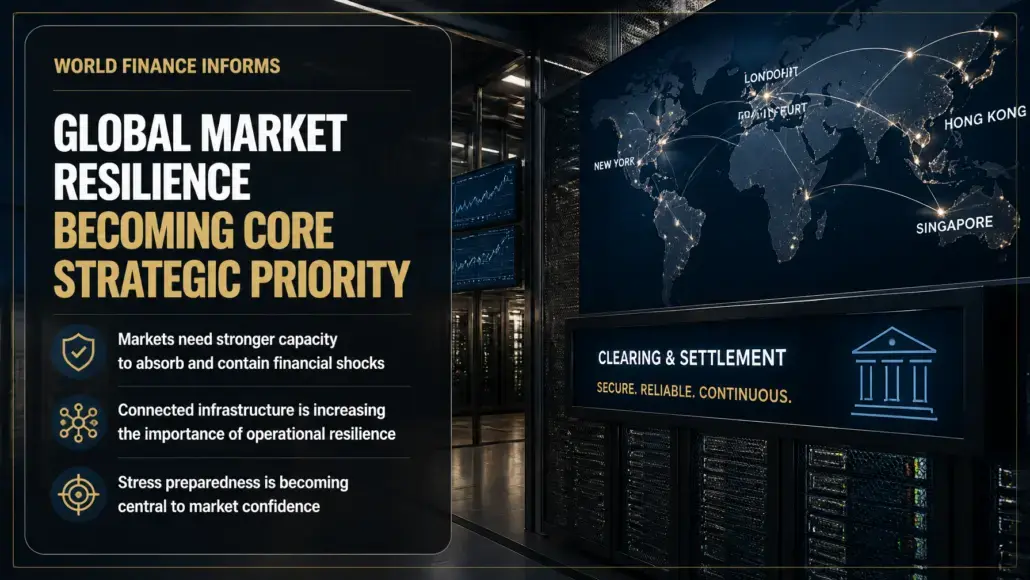


Global markets resilience is increasingly being tested by geopolitical shocks, liquidity pressures, leverage and technology-related disruptions. Recent episodes have shown that trading, funding and settlement can continue under stress, but they have also highlighted how quickly vulnerabilities can move across institutions, asset classes and jurisdictions. The focus is therefore shifting from simply limiting individual risks toward strengthening the structures that allow financial markets to absorb disruption, maintain essential services and recover without triggering wider instability. This makes global market resilience a standing requirement rather than a contingency objective.
Market Structures Strengthening the Capacity to Absorb Shocks
Resilience depends on more than strong balance sheets. Financial institutions and market infrastructures also rely on functioning trading venues, clearing arrangements, settlement systems, reliable market data, diverse sources of liquidity and tested mechanisms for responding when conditions deteriorate. The interaction between these elements matters because a disruption in one part of the system can affect financing conditions, market liquidity and confidence elsewhere. The International Monetary Fund has noted that markets remained broadly orderly during a major geopolitical shock, while also warning that leverage, debt vulnerabilities, concentration and liquidity pressures could still amplify future stress. Several capabilities are becoming particularly important:
- Liquidity – Markets need sufficient funding and liquidity to absorb large flows without triggering disorderly selling or funding strains.
- Market depth – Diverse participation and functioning markets can help absorb transactions without excessive price disruption.
- Clearing – Central clearing can strengthen risk management and reduce some bilateral exposures across interconnected transactions.
- Buffers – Capital, liquidity and collateral resources provide institutions with greater capacity to withstand periods of elevated stress.
The objective is not to eliminate volatility or guarantee uninterrupted market performance under every scenario. It is to reduce the likelihood that a temporary shock becomes a broader disruption to trading, funding, clearing or settlement. Global market resilience therefore increasingly depends on the interaction between financial buffers, market structure and the infrastructure supporting core market activity.
Critical Dependencies Increasing Operational Resilience Risks
The resilience of financial markets increasingly depends on a network of trading venues, clearing houses, settlement systems, technology providers and financial institutions that perform interdependent functions. This means a disruption at one point in the system can create operational, liquidity or confidence effects elsewhere, particularly where market participants rely on common infrastructure or service providers. Global market resilience therefore has to account for operational connections as well as traditional financial exposures. Several dependencies deserve closer attention:
- Cybersecurity – Attacks on trading, clearing, settlement or payment infrastructure can interrupt critical financial services and create knock-on effects across connected institutions.
- Third-party providers – Concentration among cloud, data, software and other critical technology providers can create common points of failure.
- Market fragmentation – Differences in rules, infrastructure and cross-border arrangements can make coordinated responses more difficult during periods of stress.
- Operational continuity – Institutions and market infrastructures need tested recovery processes so essential services can continue or resume rapidly after disruption.
The growing focus on financial market infrastructure resilience reflects this interconnectedness. The Committee on Payments and Market Infrastructures (CPMI) and the International Organization of Securities Commissions (IOSCO) have emphasised cyber resilience at Financial Market Infrastructures (FMIs) and highlighted the risks arising from dependence on third-party service providers. The objective is not to eliminate operational failures but to limit their propagation. Global market resilience is strengthened when institutions can identify critical dependencies, maintain alternative processes and test how systems respond under stressed conditions.
Stress Testing Moves Toward Multiple-Scenario Resilience
Technology is adding further complexity to this resilience challenge. Artificial intelligence (AI) can strengthen monitoring, analysis and cyber defence, but wider adoption can also increase the speed and scale at which vulnerabilities spread through shared digital infrastructure and common service providers. The International Monetary Fund has highlighted the potential for AI-enabled cyber risks to create broader systemic effects when financial institutions depend on common technologies. This is pushing stress testing toward combinations of risks rather than isolated events. Institutions increasingly need to consider how a geopolitical shock could interact with liquidity pressure, a cyber incident, a technology outage or sudden market dislocation. Global market resilience is stronger when these scenarios are assessed together and supported by clear governance, recovery capabilities and coordination across the financial ecosystem.
Resilience Becomes Core to Market Confidence
The ability of financial markets to withstand disruption is increasingly being treated as an ongoing structural requirement rather than a response reserved for exceptional events. Stronger financial buffers, resilient market infrastructure, tested recovery processes and coordinated crisis frameworks can help prevent stress from spreading across interconnected markets. At the same time, the Financial Stability Board continues to identify vulnerabilities involving sovereign debt, private credit, leverage, market concentration and technology-related risks, showing that resilience cannot be treated as a completed objective. As financial-market infrastructure becomes more digital and interconnected, digital asset servicing becomes increasingly relevant to the resilience of post-trade processes, custody and securities administration.
References
- International Monetary Fund – Global Financial Markets Confront the War in the Middle East and Amplification Risks – 2026
- Financial Stability Board – FSB Chair’s letter to G20 Finance Ministers and Central Bank Governors: August 2026 – 2026
- Financial Stability Board – FSB Work Programme for 2026 – 2026
- Bank for International Settlements – Cyber resilience toolkit: practical considerations for FMIs – consultative report – 2026
- Bank for International Settlements – FMIs’ reliance on third-party service providers: challenges and risks – discussion paper – 2026
- International Monetary Fund – Artificial Intelligence and Cybersecurity in the Financial Sector – 2026