

















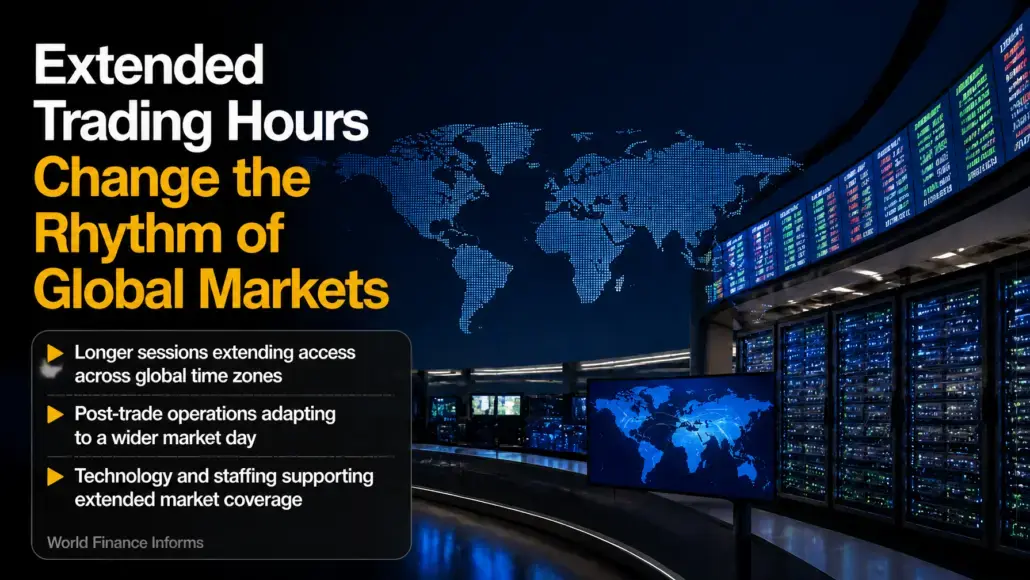


Financial markets are extending beyond traditional daytime sessions as exchanges respond to investors operating across time zones and seeking more continuous access. The trend is no longer limited to a few electronic venues. South Korea began 24-hour onshore spot trading of the dollar-won currency pair, while Nasdaq plans to introduce a 23-hour, five-day trading schedule for U.S. equities. These developments are changing the operating day for market participants and the infrastructure supporting them.
Trading Hours Expanding Across Global Financial Markets
Longer trading hours can give investors greater access to markets outside their domestic time zones and allow them to respond more directly to international developments. Nasdaq’s planned 23/5 model will add a night session from 9 p.m. to 4 a.m. Eastern Time alongside existing pre-market and post-market sessions, with a one-hour daily pause for processing and trade-date transition. South Korea’s move to 24-hour dollar-won trading provides another example of markets adjusting their schedules to support international participation.
- Global access widening: Longer sessions can allow investors in Asia, Europe and other regions to participate more directly in markets that would traditionally be closed during their local trading hours.
- Market responses becoming faster: Extended sessions can reduce the delay between international news, economic developments and investor execution.
- Operating schedules becoming more complex: Longer trading hours can compress the periods previously used for reconciliation, maintenance and other operational processes.
- Market structures adapting: Exchanges, clearing systems and market-data infrastructure increasingly need to support activity across a wider operating window.
The change is therefore broader than adding time to an exchange schedule. As trading hours expand, the boundaries between trading, clearing, settlement and operational processing become less distinct. The resulting changes also raise questions about how other parts of the financial system, including digital money, will operate across a market that increasingly runs across time zones.
Trading Hours Extending the Operational Day Across Markets
The expansion of trading hours is changing more than when investors can place orders. Exchanges are increasingly extending access across time zones, forcing market participants to reconsider how trading, market data, clearing and support functions operate outside traditional sessions. Nasdaq plans to introduce a new 9 p.m. to 4 a.m. Eastern Time session from 6 December 2026, creating a 23-hour weekday market when combined with its existing sessions. The exchange will retain a one-hour daily pause for processing and trade-date rollover.
- Overnight access broadening: Nasdaq’s planned 23/5 model is designed to give investors outside U.S. time zones greater access to U.S. equities.
- Global products already using longer sessions: CME Group has expanded 24/7 trading to selected products, including 100-ounce silver futures from September 2026, while maintaining a weekly maintenance window.
- Regional markets are extending access selectively: Deutsche Börse already offers extended trading through its Xetra Retail Service, with selected trading available from early morning to late evening in Central European Time.
- The market day is becoming less uniform: Different asset classes and venues are adopting different schedules, creating a more complex global trading environment.
Longer Sessions Increasing Pressure on Market Operations
For firms, longer trading hours can reduce the separation between front-office activity and overnight processing. Market-data systems, order management, risk controls and operational support may need to remain available for longer periods, while clearing and settlement functions still have to accommodate distinct trade dates and maintenance windows. Nasdaq’s implementation illustrates this operational challenge: it is using a separate matching engine for the new overnight session, while upgrading market-data products and testing downstream systems ahead of launch.
- Technology coverage extending: Market-data feeds, matching engines and downstream systems must support additional sessions and timestamps.
- Maintenance windows becoming strategic: Exchanges need defined periods for processing, infrastructure maintenance and trade-date transitions even as markets move toward longer availability.
- Staffing models becoming more distributed: Operations, surveillance, risk and support teams may need coverage across a wider range of time zones rather than relying on a concentrated trading-day workforce.
- Post-trade processes remaining critical: Longer access does not remove settlement and clearing requirements, meaning firms must coordinate extended trading with established post-trade cycles.
The result is a market environment where trading hours are becoming increasingly connected to the design of the wider operating model rather than being determined solely by investor demand.
Trading Hours Balancing Access with Operational Resilience
The expansion of trading hours is increasingly shifting attention from investor access to the operating infrastructure required to support markets beyond traditional sessions. Nasdaq is preparing to introduce 23-hour, five-day trading on 6 December 2026, while Hong Kong Exchanges and Clearing (HKEX) and the Hong Kong Monetary Authority (HKMA) are testing a 24/7 wholesale central bank digital currency solution for advance margin payments during after-hours derivatives trading.
- Longer sessions can widen access: Investors in different time zones can participate closer to their local market hours.
- Extended operations require stronger infrastructure: Clearing, margin, market data and technology systems need to remain available across longer operating windows.
The next challenge is ensuring that longer market access does not create disproportionate operational costs or weaken resilience. This also connects extended market availability with the evolution of digital money, where new settlement technologies could support markets operating beyond traditional banking hours.
References
- Nasdaq – 23/5 Trading Information Hub – 2026
- Nasdaq – Global Trading on Nasdaq: What Market Participants Need to Know – 2026
- Hong Kong Exchanges and Clearing (HKEX) and Hong Kong Monetary Authority (HKMA) – Digital Payment Solution for Derivatives After-Hours Trading Pilot – 2026
- Deutsche Börse – Trading Calendar and Trading Hours – 2026
- CME Group – CME Globex Notice: September 7, 2026 – 2026