


















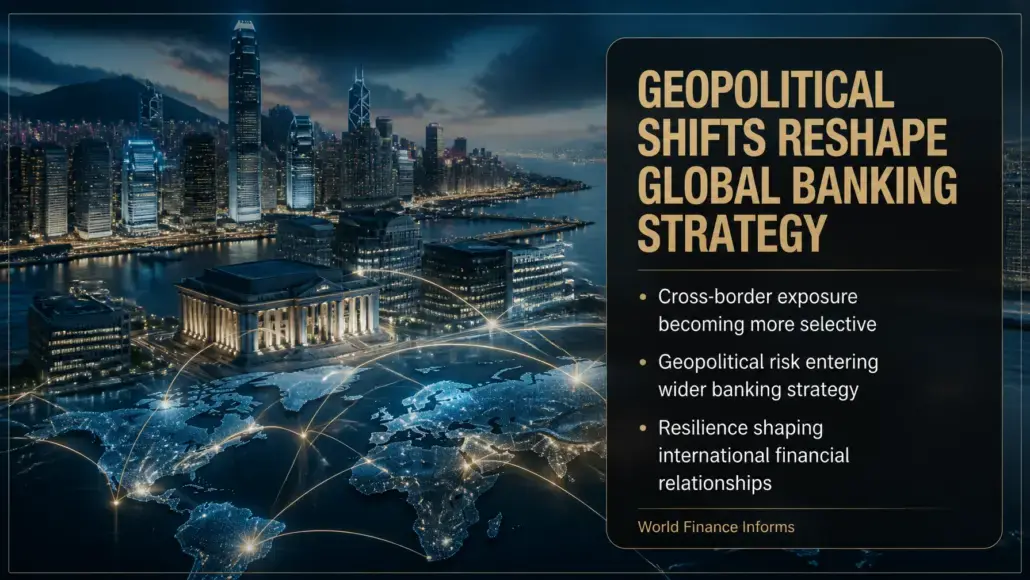


Geopolitical tensions are becoming a more important consideration in how banks manage cross-border lending, funding relationships and international market exposure. The change does not mean international banking is retreating across the board. Cross-border bank credit has reached about $39.5 trillion, with the market still expanding, while research also shows that geopolitical differences can influence where that credit is allocated. Banks are therefore having to balance commercial opportunities with a wider set of considerations around jurisdiction, counterparties, sanctions, funding dependencies and operational resilience.
Geopolitical Risk Moving Closer to Banking Strategy
International banks have long managed country and credit risk, but geopolitical developments can now affect several parts of the same relationship at once. Changes in sanctions, trade restrictions, capital controls or diplomatic relations can influence borrowers, payment channels, market access and the ability to move funds across borders. Research from the Bank for International Settlements (BIS) found that negative geopolitical events produced a 10% to 20% larger decline in bank credit between countries in different geopolitical blocs than between countries within the same bloc. This suggests that global banking is increasingly shaped not only by financial fundamentals, but also by the strategic relationships between jurisdictions. This is making global banking more sensitive to several areas of cross-border exposure:
- Geographic Concentration: Banks need to assess how much lending, funding or market activity depends on individual jurisdictions or closely connected markets.
- Counterparty Relationships: Geopolitical shifts can change the risk assessment of borrowers, financial institutions and other counterparties operating across sensitive jurisdictions.
- Sanctions and Regulation: Diverging sanctions regimes, capital controls and regulatory requirements can increase the complexity of maintaining international banking relationships.
- Payment and Funding Access: Dependence on particular currencies, correspondent banking networks and financial infrastructure can become a strategic consideration when geopolitical conditions change.
The continued scale of international credit shows that global banking remains deeply interconnected, but the way that connectivity is managed is becoming more selective. Banks may continue serving international clients and markets while reassessing individual exposures, strengthening contingency arrangements and building greater flexibility into their cross-border strategies. The result is not necessarily a less international banking system, but one in which geopolitical risk is becoming more closely integrated into decisions about where capital is deployed and how international relationships are maintained.
Cross-Border Exposure Becoming More Selective
The continued scale of international bank activity shows that geopolitical pressure is not eliminating cross-border finance, but it is changing how exposures are assessed and managed. Banks are increasingly considering whether lending, funding and counterparty relationships create concentration in jurisdictions affected by geopolitical tensions or regulatory restrictions. The International Monetary Fund (IMF) estimates that bank claims involving countries exposed to major geopolitical risks account for about 8% of total cross-border bank claims, while related liabilities account for around 10%. This makes geopolitical exposure a meaningful component of international balance-sheet management rather than a peripheral consideration.
- Geographic Diversification: Banks can spread lending and investment across markets to reduce dependence on individual jurisdictions, although wider geographic coverage can also increase regulatory and operational complexity.
- Credit Allocation: Geopolitical developments can influence which borrowers, sectors and markets receive capital as banks reassess country risk alongside conventional credit fundamentals.
- Funding Dependencies: International banks need to consider concentration in particular funding markets, currencies and financial counterparties when assessing the resilience of their cross-border balance sheets.
- Market Access: Restrictions affecting capital flows, settlement systems or financial institutions can alter the practical ability of banks to maintain international relationships.
These conditions are making global banking more selective in how international exposure is structured. The objective is not necessarily to withdraw from sensitive markets, but to understand where geopolitical developments could create correlated risks across several parts of a banking relationship.
Risk Management Expanding Beyond Traditional Credit Exposure
Geopolitical considerations can extend from lending decisions into payments, liquidity and operational resilience. IMF analysis shows that cross-border bank funding is also highly concentrated, with five jurisdictions accounting for 73% of bank cross-border funding. Such concentration can create vulnerabilities when financial institutions depend heavily on a limited number of markets or intermediaries. Sanctions, capital controls and disruptions to financial infrastructure can further complicate cross-border activity by affecting payment channels and the movement of capital.
- Sanctions Compliance: Changes in sanctions regimes can require banks to reassess clients, counterparties and transaction routes across multiple jurisdictions.
- Operational Continuity: Banks need contingency arrangements for disruptions affecting payment infrastructure, market access or critical financial services.
- Liquidity Positioning: Greater geopolitical uncertainty can increase the importance of maintaining reliable access to funding and liquid assets across different markets.
- Regulatory Coordination: Diverging rules between jurisdictions can raise compliance and operational requirements for institutions maintaining international networks.
The result is a broader conception of global banking risk, where geopolitical exposure increasingly sits alongside credit, market and liquidity considerations. This can encourage banks to build greater strategic flexibility while preserving international connectivity where the commercial and risk-adjusted case remains strong.
Strategic Flexibility Becoming More Important
The changing geopolitical environment is encouraging banks to place greater emphasis on strategic flexibility when managing international exposures. Maintaining access to multiple markets, funding sources and counterparties can help institutions respond to disruption, but diversification also brings additional regulatory, operational and liquidity requirements. The challenge is therefore to strengthen resilience without weakening the international connectivity that supports global financial activity.
- Geographic Optionality: Banks can balance international growth with greater attention to concentration across individual jurisdictions and markets.
- Resilient Infrastructure: Payment, settlement and financial infrastructure need contingency arrangements that can support continuity during geopolitical disruption.
- Counterparty Diversification: Wider relationships can reduce dependence on individual institutions while creating more complex monitoring and due-diligence requirements.
- Scenario Planning: Banks increasingly need to assess how sanctions, capital restrictions, market disruption and funding stress could affect several exposures at the same time.
The direction of global banking is therefore not necessarily toward a retreat from international markets, but toward more selective and risk-aware participation. As banks balance connectivity with resilience, the ability to manage collateral and liquidity across markets becomes increasingly important, creating a natural transition to collateral and liquidity management.
References
- Bank for International Settlements – Global banking and geopolitics through time – 2026
- Bank for International Settlements – BIS international banking statistics and global liquidity indicators at end-March 2026 – 2026
- International Monetary Fund – Global Financial Stability Report, April 2025 – 2025
- International Monetary Fund – Global Financial Stability Report, April 2026 – 2026