




















Capital markets are becoming increasingly connected, but financial integration is not advancing at the same pace across jurisdictions. The International Monetary Fund (IMF) found that Asia-Pacific accounted for around 33% of global gross domestic product (GDP) and trade in 2023, while its share of global external financial assets was 21% and external liabilities 16%. The gap illustrates how economic integration does not automatically translate into equivalent financial integration, with regulatory, infrastructure and market-access conditions continuing to shape cross-border capital flows.
Cross Border Market Access Moving Beyond Market Opening
The development of cross border market activity increasingly depends on whether investors, issuers and financial institutions can operate efficiently after entering another jurisdiction. The IMF found that advanced Asia-Pacific economies are considerably more integrated into global financial markets than most emerging economies, while foreign direct investment (FDI) and cross-border banking have developed more strongly than foreign portfolio investment (FPI). Elsewhere, the European Union’s Market Integration and Supervision Package is targeting barriers to cross-border financial activity, demonstrating how regulators are moving beyond formal market opening toward greater practical integration.
- Regulatory differences affecting participation: Licensing, supervision, disclosure and investor-protection requirements can create additional costs for institutions operating across jurisdictions.
- Infrastructure shaping practical access: Trading, clearing, settlement, custody and payment arrangements influence how efficiently investors can transact across markets.
- Broader access expanding capital pools: Easier international participation can connect issuers with wider sources of funding and investors with more diversification opportunities.
- Integration creating new risk channels: Greater cross border market activity can also increase exposure to international liquidity conditions, market volatility and changes in investor sentiment.
The uneven pace of financial integration shows why cross border market access is increasingly being treated as an infrastructure and operating issue as well as a regulatory one. The next question is how those markets and their supporting systems can connect more effectively across jurisdictions.
Market Infrastructure Connecting Global Financial Markets
The development of cross border market activity increasingly depends on how effectively financial infrastructures connect across jurisdictions. Trading access alone does not guarantee efficient international participation. Securities still need to move through clearing, settlement and custody systems, while associated payments need to be processed across compatible financial networks. The Bank for International Settlements (BIS) has highlighted examples in Asia, including links between Hong Kong’s Central Moneymarkets Unit and international central securities depositories such as Euroclear and Clearstream, alongside connections between regional real-time gross settlement systems.
- Settlement links supporting international investors: Connections between central securities depositories can make it easier to hold and settle securities across different markets.
- Payment systems extending market connectivity: Links between domestic real-time gross settlement systems can support cross-border movement of funds alongside securities transactions.
- Custody infrastructure influencing participation: Efficient custody arrangements can reduce operational complexity for institutions investing outside their home markets.
- Interoperability reducing duplication: Connected infrastructures can limit the need for investors and intermediaries to navigate entirely separate processes for each market.
These links show why cross border market integration increasingly depends on the underlying infrastructure connecting financial systems. The ability to transact internationally can be strengthened when settlement, custody and payments operate through established connections rather than isolated national arrangements.
Digital Infrastructure Making Market Access More Practical
Digitalisation is also changing how international market participation can be supported. Standardised financial messaging, electronic processing and digital connectivity can reduce manual intervention across transactions that cross jurisdictions. The International Monetary Fund (IMF) has noted that technologies such as real-time cross-border payments, open banking and application programming interface (API)-based ecosystems could support deeper financial integration, although adoption remains uneven across regions.
- Standardised messaging improving processing: Consistent data structures can make information easier to exchange between institutions in different markets.
- Digital onboarding reducing friction: More streamlined processes can simplify access for investors and financial institutions operating across jurisdictions.
- Real-time payments supporting faster transfers: Faster payment connectivity can improve the movement of funds associated with cross-border transactions.
- API-based infrastructure enabling integration: Connected digital platforms can allow financial services and market infrastructure to interact more efficiently.
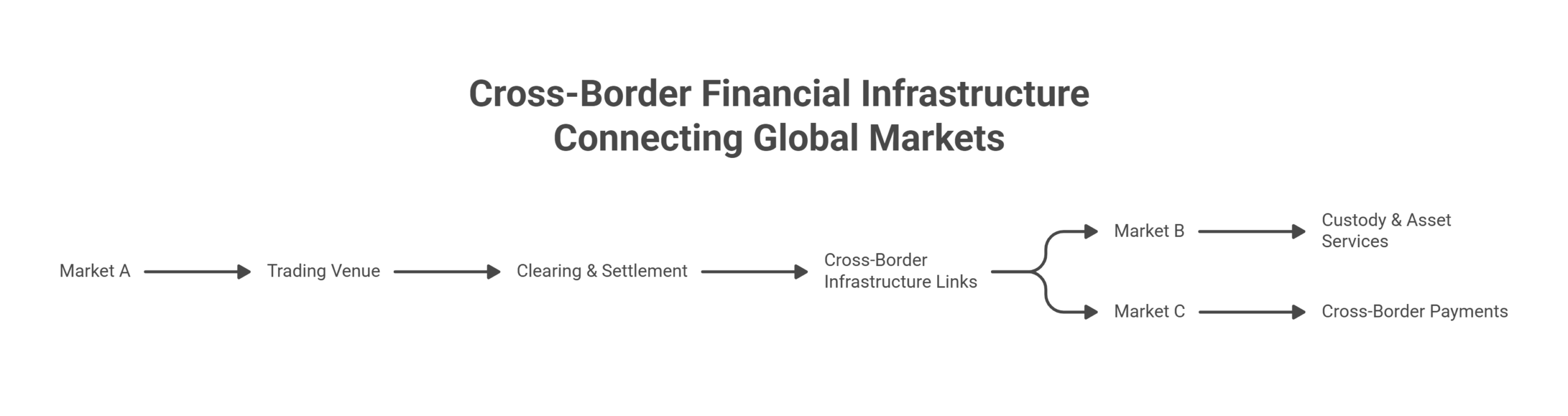 The examples show how connected trading, settlement, custody and payment infrastructure can make cross-border participation more practical across different financial markets. As these systems develop, cross border market access becomes increasingly linked to the digital compatibility of financial infrastructures. This also brings the discussion toward the structures that support clearing and risk management, where central clearing across markets.
Cross Border Market Access Balancing Openness with Resilience
The expansion of cross border market activity can widen investor access, diversify funding sources and strengthen links between financial centres, but greater integration can also transmit global shocks more quickly. The International Monetary Fund (IMF) has highlighted how financial integration across Asia-Pacific remains uneven, while infrastructure links between markets continue to develop through connected settlement and payment systems.
- Broader access can deepen markets: International participation can expand liquidity, investment opportunities and funding options for issuers.
- Greater integration can increase exposure: More connected markets can transmit changes in global liquidity, risk sentiment and financial conditions more rapidly.
The next phase will depend on whether regulators and market infrastructures can reduce unnecessary barriers while maintaining effective safeguards. Greater connectivity therefore needs to combine cross border market access with efficient settlement, compatible rules and resilient financial infrastructure.
References
- International Monetary Fund (IMF) – The Changing Landscape of Financial Integration in Asia-Pacific – 2026
- Bank for International Settlements (BIS) – Global PMI Summit: Cross-Border Financial Infrastructure Links – 2026
- European Commission – Market Integration and Supervision Package – 2025