




















Financing Options Expanding Beyond Traditional Bank Lending
Bank lending remains a major source of corporate and project finance, but capital markets and non-bank lenders are becoming more important parts of the wider funding ecosystem. Global corporate debt issuance reached about $13.7 trillion, comprising approximately $6.8 trillion in corporate bonds and $7 trillion in syndicated loans, demonstrating the scale of market-based borrowing available to companies. Non-bank financial intermediation has also grown to around $256.8 trillion, representing 51% of total global financial assets across the jurisdictions monitored by the Financial Stability Board. These developments show how funding routes are becoming more varied across the financial system. This broadening of funding routes is giving businesses and investment projects more options across different stages of their financing needs:
- Bank Financing: Traditional lenders continue to provide working capital, revolving facilities, acquisition finance and longer-term corporate lending.
- Corporate Debt Markets: Bonds and syndicated loans allow larger borrowers to raise substantial amounts from a wider investor base and access capital beyond individual bank relationships.
- Private Credit: Direct lending by non-bank investors can provide customised financing for companies that may require structures or transaction terms not readily available through public markets.
- Institutional Capital: Asset managers, insurers, pension funds and other institutional investors can provide longer-term capital for businesses, infrastructure and other projects requiring substantial investment.
The wider financing ecosystem is therefore becoming less dependent on a single channel of capital. Different forms of finance can be combined within the same capital structure, allowing companies and projects to balance flexibility, maturity, cost and risk according to their specific requirements. The significance of these funding routes lies not simply in creating more sources of capital, but in expanding the ways financial markets can connect investors with the investment needs of the real economy.
Private Credit and Capital Markets Broadening Access to Finance
The expansion of non-bank financing is giving companies more options beyond traditional lending relationships, particularly where funding requirements are larger, more specialised or longer term. Private credit can provide customised debt structures, while public debt markets allow companies to reach a broader investor base through bonds and syndicated loans. The scale of these markets shows that capital is increasingly being distributed through several channels rather than through banking alone. The Financial Stability Board estimates that non-bank financial intermediation has reached about $256.8 trillion, equivalent to 51% of total global financial assets across the jurisdictions it monitors.
- Private Credit: Direct lending can provide customised financing for companies requiring flexible structures, acquisition finance, refinancing or specialist forms of debt.
- Corporate Bonds: Bond markets allow established borrowers to access institutional investors and raise longer-term capital outside individual bank balance sheets.
- Syndicated Loans: Multiple lenders can participate in larger facilities, spreading exposure while giving companies access to substantial pools of bank and institutional capital.
- Securitisation: Loans and other financial assets can be packaged into securities, connecting lending activity with capital-market investors and creating additional funding capacity.
These developments are broadening funding routes without removing the role of banks. Instead, companies can combine different sources of debt according to their financing requirements, while lenders and investors can participate at different points across the capital structure.
Institutional Capital Supporting Complex Investment Needs
Long-duration investment is also creating demand for financing structures that extend beyond conventional corporate borrowing. Infrastructure, energy transition projects and other capital-intensive activities can require combinations of project finance, institutional investment, private debt and risk-sharing mechanisms. Blended finance can use public or development-oriented capital to help attract private investment where commercial financing alone may face higher perceived risks. The World Bank Group has also reported a significant increase in private capital mobilisation, illustrating how guarantees and other mechanisms can bring additional investors into projects that require substantial upfront funding.
- Infrastructure Finance: Project-based structures can align debt and investment with long-lived assets and predictable cash flows.
- Blended Finance: Public or development capital can help reduce selected risks and encourage participation from private investors.
- Institutional Investors: Pension funds, insurers and asset managers can provide longer-duration capital suited to large-scale investment needs.
- Digital Financing: Emerging tokenised and distributed-ledger structures may eventually support more efficient issuance, trading and administration across selected financing markets.
The widening of funding routes can therefore improve financing flexibility across the real economy, but it also creates a more complex ecosystem of lenders, investors and intermediaries. As capital becomes more diversified, pricing, liquidity, transparency and refinancing conditions remain important determinants of whether additional financing capacity translates into durable investment.
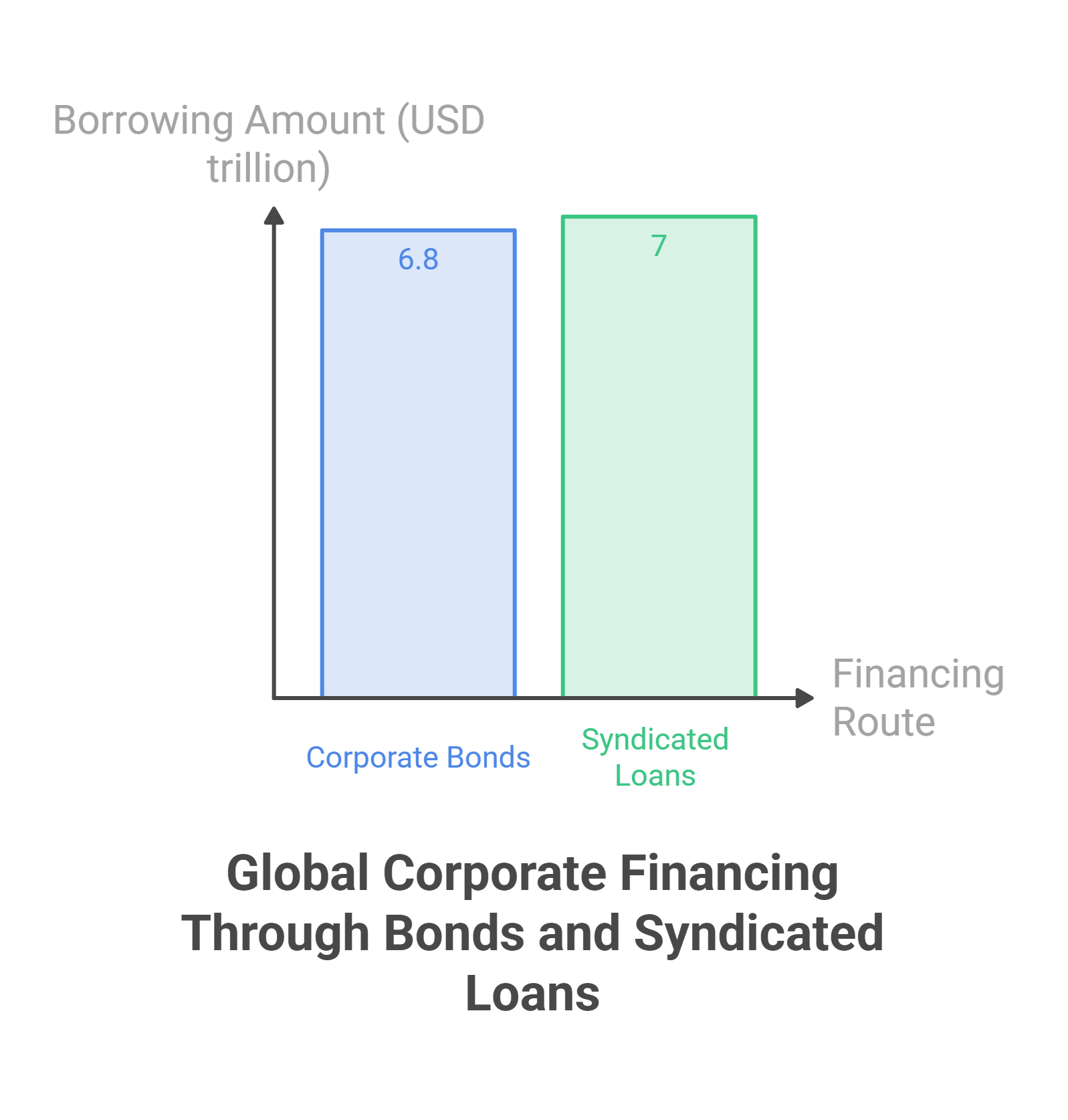 The visual demonstrates the scale of corporate borrowing through capital markets and syndicated lending, reinforcing the article’s focus on expanding financing options.
A Broader Capital Stack Creates New Financing Choices
The expansion of non-bank lending, debt markets and institutional investment is giving businesses and projects more ways to structure capital around their operating and investment needs. The benefit is greater flexibility across funding requirements, but the broader financing ecosystem also creates more variables around pricing, liquidity, refinancing and risk.
- Financing Flexibility: Companies can combine bank debt, bonds, private credit and other capital sources according to their needs.
- Refinancing Exposure: A wider range of lenders and instruments can also create different maturity and refinancing requirements.
- Liquidity Management: More dispersed sources of capital increase the importance of maintaining reliable access to liquidity across market conditions.
- Risk and Transparency: Investors and borrowers require clearer information on leverage, credit quality and interconnected exposures.
The development of funding routes is therefore widening the capital stack rather than replacing traditional banking. As this broader financing ecosystem develops, the financial conditions shaping banks and investors will also influence how capital is allocated, creating a natural link to broader financing ecosystem.
References
- OECD – Global Debt Report 2026: Sustaining Debt Market Resilience Under Growing Pressure – 2026
- Financial Stability Board – Global Monitoring Report on Non-Bank Financial Intermediation 2025 – 2025
- World Bank Group – World Bank Group Mobilizes Record Private Capital for Developing Countries, Driving Job Creation – 2026