


















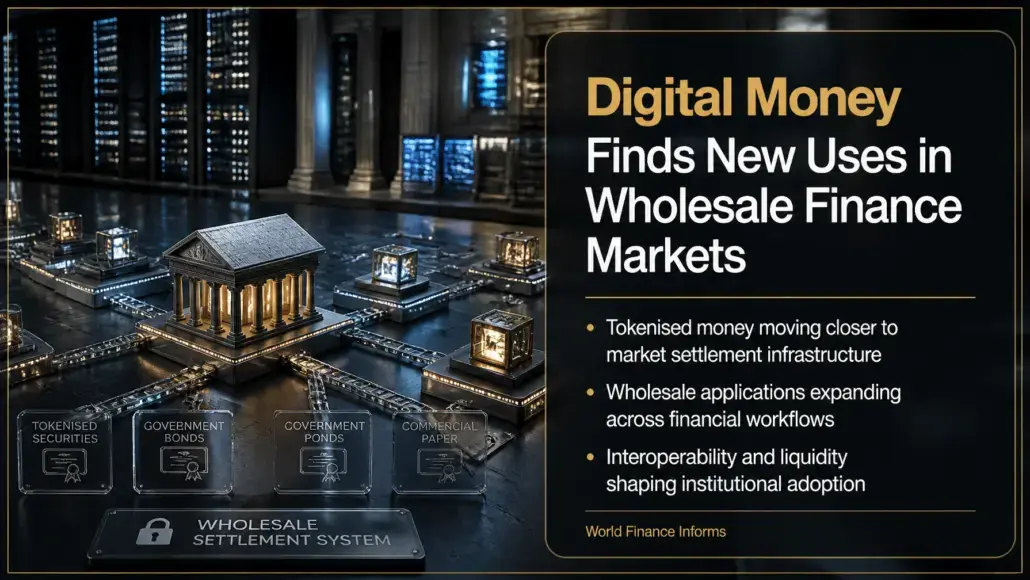


Wholesale finance is entering a phase in which the form of money used for settlement is becoming part of the wider market infrastructure discussion. Banks, central banks and financial institutions are testing tokenised forms of money alongside tokenised assets, creating new possibilities for how transactions, settlement and liquidity interact. The shift is not simply about making payments digital. It is about how money can operate on programmable infrastructure and connect more directly with financial-market processes.
Digital Money Moving Closer to Core Market Infrastructure
Traditional wholesale markets already rely on electronic payment and settlement systems, but tokenisation introduces a different architecture in which money and financial assets can operate on compatible digital infrastructure. Tokenised commercial bank deposits, wholesale central bank money and regulated stablecoins represent different approaches, while institutional experimentation is testing how each can support broader market activity. Project Agorá, led by the Bank for International Settlements (BIS), brought together seven central banks and more than 40 regulated financial institutions to explore programmable wholesale payments using tokenised deposits and central bank reserves. This progression is bringing digital money into a broader range of institutional workflows:
- Securities Settlement: Project Acacia tested 20 wholesale tokenised-asset market use cases across areas including fixed income, managed funds, repo, structured products and private markets.
- Treasury and Liquidity: Swift is working with 17 banks across six continents to test tokenised deposits for cross-border payments and more efficient liquidity management.
- Repo and Collateral: Tokenised money can work alongside tokenised assets and collateral, creating opportunities for more integrated transaction structures across wholesale markets.
- Conditional Payments: Programmable transactions can link the movement of digital money to predefined contractual or settlement conditions.
The development is therefore extending digital money beyond conventional payment activity and toward a broader role within financial-market infrastructure. As these models develop, interoperability, liquidity management and the connection between new tokenised systems and established settlement frameworks will remain important to how widely they can be used.
Interoperability Becoming Central to Wholesale Settlement
The expansion of tokenised financial markets is also exposing a key challenge: different forms of money and financial infrastructure need to work together without fragmenting liquidity. The Reserve Bank of Australia (RBA) and the Digital Finance Cooperative Research Centre found through Project Acacia that interoperability, liquidity fragmentation, legal uncertainty and coordination remain important considerations across wholesale tokenisation use cases. These issues become more significant as institutions move beyond individual transactions and consider how tokenised money can connect with existing payment, settlement and banking systems.
- Interoperable Infrastructure: Different ledgers, payment systems and settlement platforms need compatible mechanisms for assets and money to move across networks.
- Liquidity Management: Fragmented pools of tokenised money could make liquidity harder to manage unless institutions can transfer and use settlement assets efficiently.
- Legal Certainty: Different forms of tokenised deposits, central bank money and stablecoins carry different legal and risk characteristics that influence their suitability for wholesale markets.
- Operational Resilience: New programmable infrastructures must operate alongside established financial systems while maintaining reliability, security and settlement integrity.
Institutional Experiments Expanding Across Market Functions
The development of digital money is therefore being tested across a wider range of wholesale activities rather than being limited to cross-border payments. Project Acacia examined 20 use cases spanning fixed income, managed funds, repo, structured products, private markets, carbon credits and trade payables, illustrating how tokenised money can become relevant wherever financial assets and settlement processes interact. At the same time, institutional pilots are testing different monetary forms rather than assuming a single model will dominate. Tokenised commercial bank deposits can provide a deposit-based settlement asset, wholesale central bank money can maintain direct central-bank settlement, while regulated stablecoins offer another structure with different liquidity and risk considerations.
- Wholesale Payments: Programmable settlement can allow payment instructions and transaction conditions to operate within the same digital workflow.
- Tokenised Securities: Money and securities can potentially be represented on compatible infrastructures, bringing delivery and payment processes closer together.
- Liquidity Transfers: Tokenised deposits can support movement of funds across institutional workflows where conventional settlement arrangements may involve additional intermediaries.
- Market Connectivity: Initiatives connecting tokenised asset platforms with established central-bank settlement infrastructure are testing how new and existing systems can operate together.
This experimentation suggests that digital money is becoming part of a broader infrastructure question for wholesale finance. The potential value lies not only in moving funds faster, but in making settlement more closely connected to assets, contractual conditions and institutional workflows.
Settlement Trust Becoming Central to Digital Money Adoption
As wholesale markets test tokenised forms of money, the longer-term question is how these systems can scale while maintaining the trust, liquidity and settlement certainty expected across financial markets. Central banks and financial institutions are therefore examining not only technical capabilities but also the governance and risk frameworks needed to support wider institutional use.
- Settlement Confidence: Central bank money remains important for final settlement where institutions require a trusted settlement asset.
- Liquidity Integration: Tokenised money needs to connect efficiently with existing sources of wholesale liquidity rather than creating isolated pools.
- Common Standards: Shared technical, legal and operational standards can reduce fragmentation as different platforms develop.
The direction of travel suggests that digital money is becoming increasingly connected to the wider architecture of wholesale finance, with interoperability and institutional trust likely to determine where adoption gains lasting traction. These developments also connect with the emergence of new mechanisms for funding businesses and investment, as explored in digital settlement infrastructure.
References
- Bank for International Settlements – Project Agorá – 2025
- Reserve Bank of Australia and Digital Finance Cooperative Research Centre – Project Acacia: Exploring the Role of Digital Money in Wholesale Tokenised Asset Markets – 2026
- Swift – Tokenised Deposits and Blockchain Ledger Initiative – 2026
- European Central Bank – Pontes – 2026