

















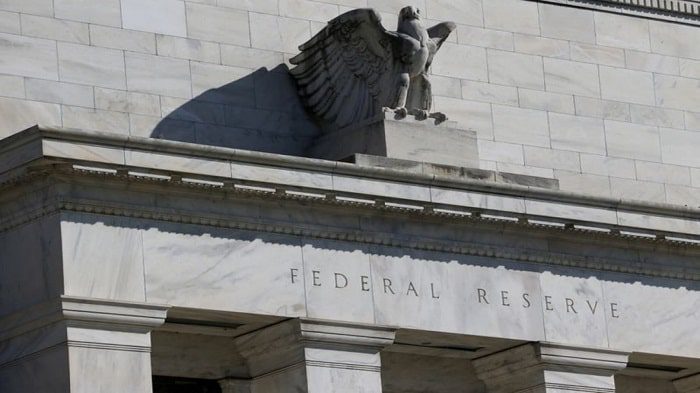


According to economists, the US Federal Reserve will increase interest rates by 50 basis points in September despite forecasts that inflation has peaked and mounting concerns about a recession. The risks were weighted in favour of a higher peak, the respondents said.
Inflation last month started to decline, hovering near a 4-decade high. As a result, Fed funds futures barely changed their prices to reflect a 50-basis point increase in September after 75 basis point increases in June and July. According to the majority of analysts surveyed between August 16 and 19, the benchmark interest rate will increase by 0.5% to 2.75-3% in the coming month.
18 of the 94 participants in the study said the Fed will aim for 75 basis points.
Prior to his speech at Jackson Hole the following week, Fed Chair Jerome Powell stated that it would likely become prudent to decrease the pace of increases. The survey found that there is a 50% likelihood of a recession occurring within two years and a median probability of 1% during the next year, up from 40% in July. This is due to the cumulative 225 basis point hikes since March and further hikes still to come.
According to Philip Marey, senior US strategist at Rabobank, a downturn is a necessary thing and the sole way to get to where one wants to be, where consumers don’t lose all their money to increasing costs. Since financial crises typically accompany severe recessions, the current state of family balance sheets means that a severe recession is not necessary.
Of 48 economists, 37 predicted that whatever recession the US experiences in the next two years will be brief and weak. One predicted long and deep, whereas the other ten predicted long and shallow. Averaging 8% and 3.7% this year and next, respectively, consumer price inflation was predicted to remain over the Federal Reserve’s 2% target until at least 2024, perhaps forcibly increasing the central bank’s main policy rate into restricted area.
The majority of participants, or close to 90%, predicted that the main policy rate would be between 3.25 and 3.50% or higher by the end of this year. Over the past week, anticipation of a slower rate hike schedule has buoyed both the equity and bond markets and partly relaxed financial conditions, increasing pressure on the Fed.
Despite poll medians predicting a terminal fed funds rate of 3.50 to 3.75% for Q1 2023, a level at which they would peak in the current tightening cycle, nearly 80% of economists who responded to a second question, 29 out of 37, said the consequences were skewed towards a higher rate than they anticipated. The economy continues to be most at risk from persistent inflation. It’s possible that inflation won’t decline as expected. Senior economist at BMO Capital Markets, Sal Guatieri, stated that in this situation, policy rates would need to be much more stringent, around 4% to 5%.
There won’t be much discussion about whether the economy can avert a severe slump if this is the case. The greatest economy in the world saw a contraction in the first two quarters of the year, which is essentially a technical recession.
But in order to formally declare a recession in the US, the National Bureau of Economic Research also takes into account other elements, including employment and real income.
The unemployment rate dropped to 3.5% last month, its lowest level since before the pandemic, and non-farm payrolls have remained robust, so it was anticipated that the economy would expand on average by 1.7% this year and 1% the next year.
In comparison to prior recessions, the unemployment rate was anticipated to average 3.6%, 3.9%, and 4.0% in 2022, 2023, and 2024, respectively.