


















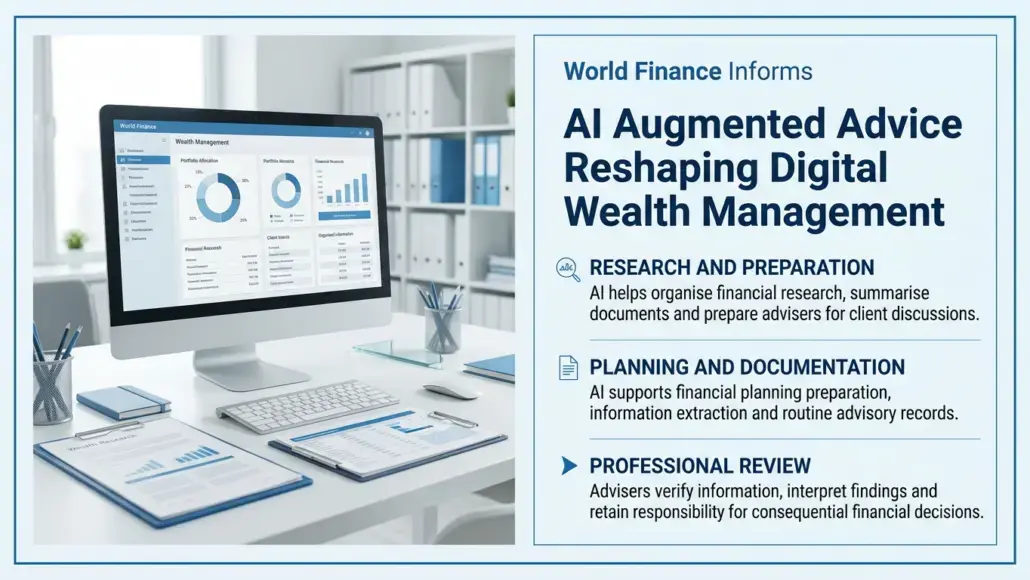


Artificial intelligence is changing how wealth management professionals research markets, prepare financial plans, analyse portfolios and manage client relationships. Rather than replacing the entire advisory process, AI is increasingly being considered for tasks that involve organising information, preparing documentation and supporting analysis. AI augmented advice reflects this shift towards using technology to support professional judgement while keeping advisers involved in consequential financial decisions.
A 2026 global survey by the Financial Planning Standards Board (FPSB), covering 8,095 financial planners across 37 territories, found that eight in ten respondents reported their firm was using AI or planned to adopt it within the next 12 months. The findings indicate growing interest in AI, although adoption plans and reported benefits do not establish that every implementation produces better client outcomes.
Advisory Workflows Moving Beyond Manual Preparation
The practical value of AI depends on where it enters the advisory workflow. Research summaries, document review, information retrieval and meeting preparation are potential starting points because they can reduce the effort required to gather and organise material. Financial planners can then devote more attention to interpreting information, understanding client objectives and evaluating financial decisions.
AI augmented advice can also support the preparation of client records and financial planning documents, but its outputs require review for accuracy, completeness and relevance. Incorrect information, incomplete summaries or the mishandling of confidential records can undermine the benefits of faster preparation. The approach becomes more demanding when advisers work with complex family circumstances, including intergenerational wealth transfer, where financial information and long term objectives may span several generations.
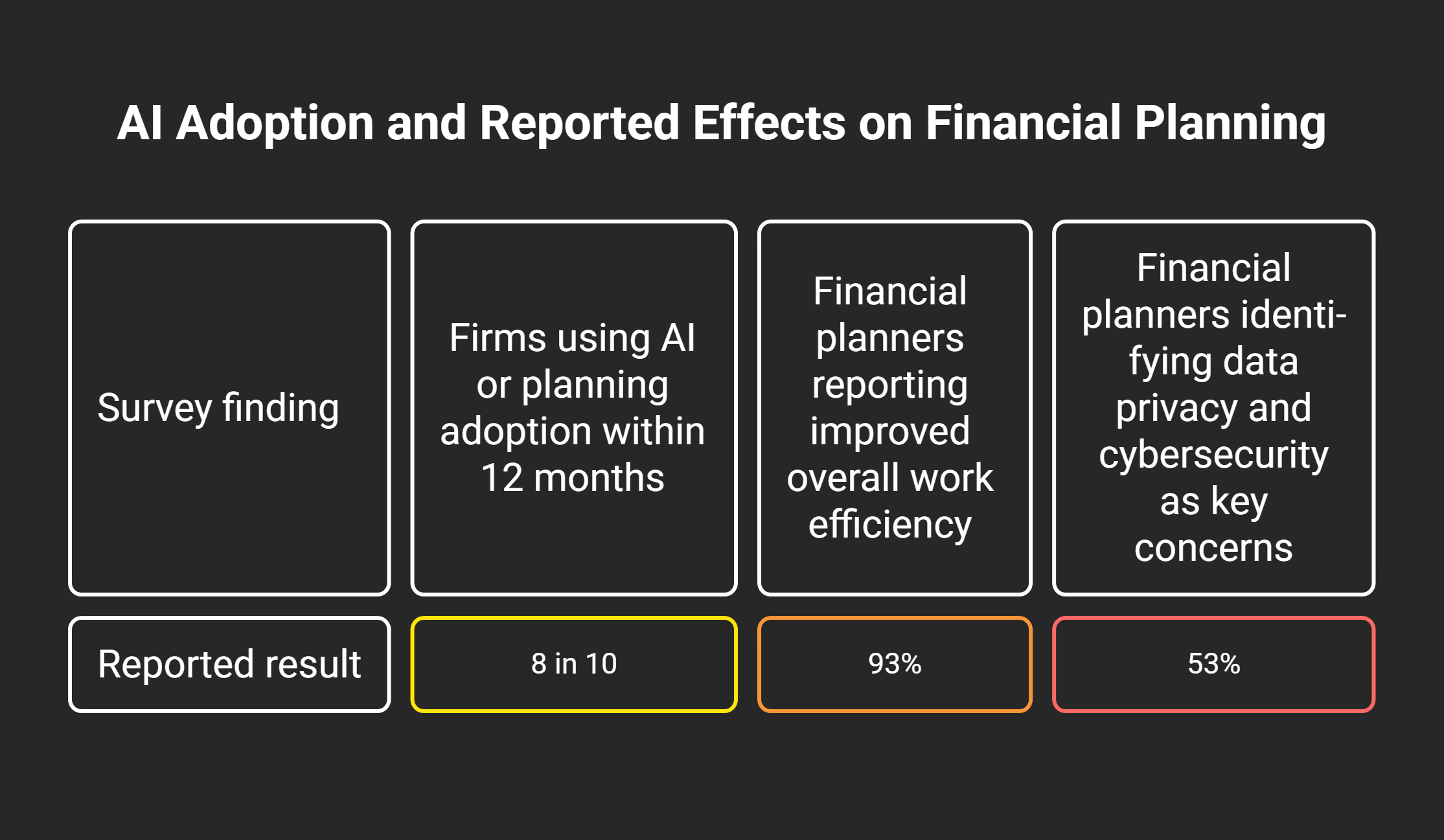
These findings show that reported efficiency improvements coexist with concerns about protecting client information and ensuring reliable AI outputs.
Where AI Can Support Advice Workflows
- Research and preparation: Organise market information, summarise documents and help advisers prepare for client discussions.
- Planning and documentation: Assist with information extraction, financial planning preparation and routine record keeping, subject to verification.
- Professional review: Use AI augmented advice to support analysis while retaining human oversight of suitability, interpretation and consequential recommendations.
AI Integration Connects Research with Advisory Decisions
The usefulness of AI depends on how well it fits into the wider advisory process. Wealth management professionals often work across client relationship management systems, financial planning software, portfolio records, market research and compliance documentation. When these systems remain disconnected, information must be transferred manually, creating duplication and increasing the risk of inconsistencies. AI augmented advice can help organise information across these activities, but the benefits depend on data quality, system compatibility and clear workflow responsibilities.
For example, an adviser preparing for a portfolio review may use AI to summarise recent client interactions and organise relevant financial information before assessing whether the portfolio remains aligned with the client’s objectives. The adviser still needs to confirm that the source information is current, interpret the findings and determine whether further analysis is necessary.
Practical Areas for Workflow Integration
- Research preparation: Summarise lengthy reports, retrieve relevant information and organise findings for professional review.
- Client documentation: Assist with meeting summaries, draft correspondence and routine records, subject to checks for accuracy and confidentiality.
- Portfolio analysis: Help organise asset allocation information and identify areas for closer examination without treating automated outputs as investment recommendations.
- Process coordination: Connect information gathering, preparation and follow up tasks to reduce unnecessary duplication across advisory teams.
Reliable Outputs Require Professional Verification
Faster preparation does not automatically produce better advice. AI systems can omit important context, misinterpret financial information or generate conclusions that appear convincing despite containing errors. These limitations become particularly significant when advisers use outputs to support decisions involving investment suitability, liquidity requirements, risk tolerance or long term financial planning.
AI augmented advice therefore requires a defined review process in which professionals check the underlying evidence, assess whether the output reflects the client’s circumstances and correct inaccuracies before using the material. Firms also need to consider how sensitive client information is shared with external systems and whether the data used by AI tools is authorised for that purpose. The level of review should reflect the task’s complexity and the consequences of an error.
Practices that Support Reliable Use
- Verify source information: Check figures, assumptions and supporting material against reliable records before relying on generated summaries or analysis.
- Preserve client context: Review outputs against documented objectives, financial circumstances, risk preferences and relevant changes in the client’s situation.
- Define review responsibilities: Establish who checks, approves and corrects AI supported work, particularly when it informs consequential client decisions.
- Measure practical outcomes: Assess whether implementation reduces rework and administrative effort without weakening accuracy, service quality or professional oversight.
Ultimately, AI augmented advice is most useful when it strengthens an established advisory process rather than bypassing it. Integration, verification and professional judgement determine whether faster workflows can support dependable financial services.
Building Trust in AI Supported Financial Advice
The long term value of AI augmented advice depends on whether wealth management firms can combine operational efficiency with accuracy, confidentiality and accountable decision making. AI can help advisers organise information and prepare for client interactions, but it cannot remove the need to assess individual financial circumstances or verify consequential outputs. Firms that establish clear review responsibilities, maintain reliable data and evaluate workflow outcomes are better positioned to integrate these tools responsibly. As adoption develops across global wealth management, the emphasis will increasingly be on how AI supports professional judgement, rather than on automation alone.
Implementation Priorities
- Establish clear review procedures for AI supported research, planning and documentation.
- Protect confidential client information through appropriate data access and security controls.
- Evaluate efficiency gains alongside accuracy, service quality and client interests.
References
- Financial Planning Standards Board. Impact of AI on Financial Planning Global Research 2026.
- Financial Stability Board. The Financial Stability Implications of Artificial Intelligence. November 2024.
- UK Financial Conduct Authority. Understanding the Advice Market: Financial Advice Firms Survey 2025. Published April 2026.
- European Securities and Markets Authority. Guidance on AI in Investment Services. May 2024.