


















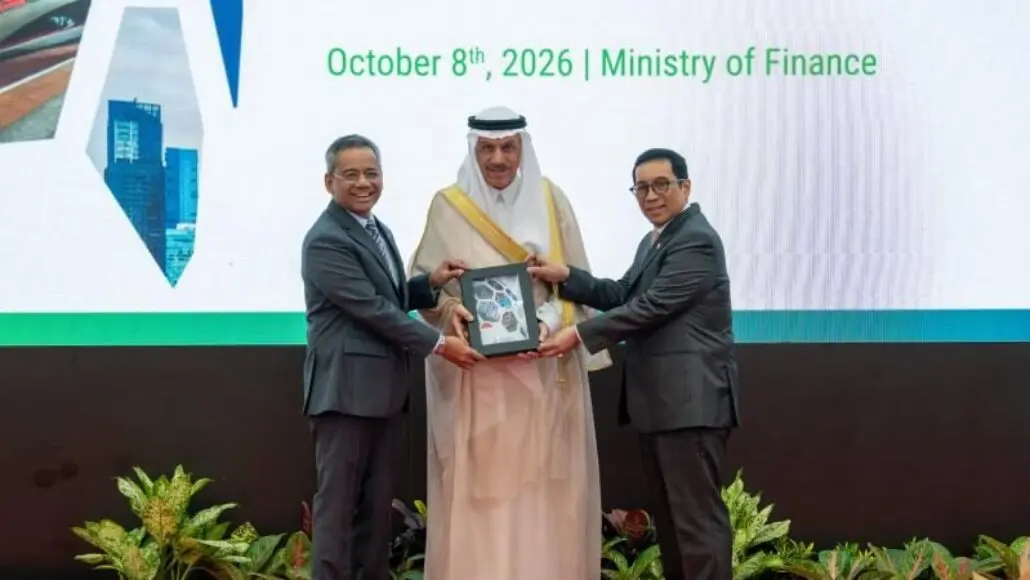


The Islamic Development Bank Group has unveiled a new five-year partnership framework for Indonesia, backed by an indicative financing envelope of approximately US$2.56 billion. The financing strategy was formally launched on October 8, 2026, at the Ministry of Finance in Jakarta, marking the beginning of the 2026–2030 Member Country Partnership Strategy for the Republic of Indonesia.
The strategy, developed jointly with the Government of Indonesia, is titled “Supporting Inclusive and Sustainable Economic Transformation for a Prosperous and Resilient Indonesia.” It will serve as the guiding framework for IsDB Group support toward the country’s development priorities over the coming five years. The financing strategy was introduced by Dr. Muhammad Al Jasser, Chairman of the IsDB Group, alongside Dr. Suahasil Nazara, Minister of Finance of Indonesia and IsDB Governor, and Mr. Febrian Ruddyard, Vice Minister of National Development Planning, who represented the Minister of National Development Planning and Head of BAPPENAS.
It is important to note that the US$2.56 billion figure represents an indicative financing envelope rather than funds already disbursed or committed to specific projects. The framework sets out the intended scale and direction of IsDB Group engagement with Indonesia through 2030.
Structure of the Financing Strategy
The financing strategy encompasses a broad range of instruments that the IsDB Group plans to deploy in support of Indonesia’s national development agenda.
- Approximately US$2.56 billion indicative financing envelope over a five-year period from 2026 to 2030
- Sovereign financing alongside private sector investment
- Trade finance, guarantees and insurance products
- Islamic finance instruments and technical assistance
- Knowledge solutions with a focus on project readiness and implementation quality
Dr. Al Jasser noted during the launch ceremony that the IsDB Group’s contribution extends well beyond financing alone. The partnership intends to combine multiple development tools to advance Indonesia’s priorities effectively. The strategy aligns with both Indonesia’s National Medium-Term Development Plan for 2025 to 2029 and the IsDB Group Ten-Year Strategic Framework covering 2026 to 2035. Islamic finance, climate action, and the empowerment of women and youth are embedded across the entire framework.
Strategic Pillars and Development Priorities
The partnership strategy rests on two defined pillars that address distinct but complementary areas of Indonesia’s development needs.
- Infrastructure for connectivity, resilience and industrial upgrading, covering transport, food resilience, agriculture and sustainable fisheries
- Energy security and transition, including the blue economy
- Workforce development through stronger health systems
- Expanded education and skills development programmes
- Empowerment of women and youth across both pillars
The first pillar focuses on infrastructure development, targeting transport and connectivity, food resilience and agriculture, sustainable fisheries and the blue economy, and energy security and transition. The second pillar centres on workforce development, prioritising stronger health systems alongside expanded education and skills training to prepare Indonesia for its next stage of economic transformation.
The financing strategy builds on more than five decades of cooperation between the IsDB Group and Indonesia, during which cumulative IsDB Group approvals for the country have reached approximately US$7.2 billion. Through 2030, the partnership aims to strengthen connectivity, improve the resilience of food and energy systems, and expand opportunities for women and youth across Indonesia.