
















Close
Optic 2026

Core Banking Modernisation Supporting Real-Time Banking

Note* - All images used are for editorial and illustrative purposes only and may not originate from the original news provider or associated company.

Related stories

Digital Bank Profitability Bringing Greater Focus to Banking Unit Economics

Across the global digital-banking sector, the emphasis is increasingly...

Fast Payment Systems Becoming Part of Macroeconomic Infrastructure

Across the global payments landscape, fast payment systems are...

Instant Payments and Card Payments Showing Diverging Transaction Patterns

Across the global payments landscape, instant payments and card...
- Advertisement -

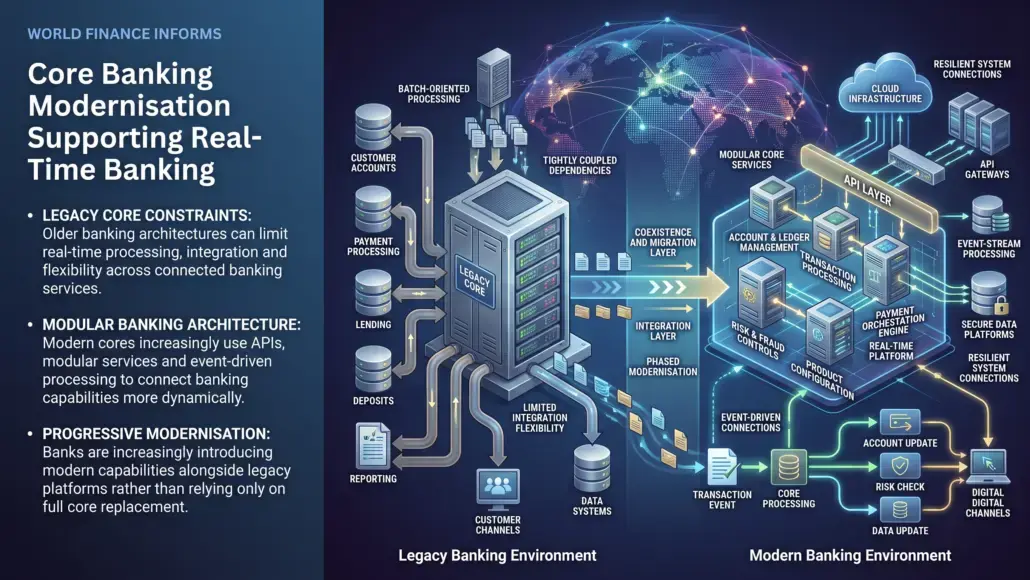
Across the global banking industry, the expansion of real-time services is increasing pressure on the core systems that manage accounts, transactions and financial records. For World Finance Informs, the issue is not simply whether a bank can connect to faster payment infrastructure, but whether its internal architecture can process transactions and update connected services with comparable speed. fast payment systems are exposing the limits of legacy environments as banks seek to provide continuously available banking services across digital channels.

Modern Core Architectures Supporting Continuous Banking Operations

Traditional core environments often depend on tightly coupled applications, batch-oriented processing and rigid interfaces. Real-time banking requires a different operating model, in which account balances, transaction records and connected services can respond rapidly as events occur. This makes fast payment systems an important catalyst for core modernisation because payment speed can expose delays elsewhere in the banking architecture. A payment may settle quickly while customer-facing channels, account updates or supporting processes still depend on slower workflows.

Modernisation is therefore moving toward modular architectures, API-based connectivity and event-driven processing. These approaches allow banks to introduce or update individual capabilities without necessarily replacing every component of the existing environment. Fast payment systems can then connect more effectively with account management, transaction processing, data platforms and risk controls, creating a banking architecture designed for continuous operation.

The transition also requires banks to consider how new technology can coexist with critical legacy infrastructure. Rather than treating modernisation solely as a full core replacement, financial institutions are increasingly examining phased approaches that introduce new capabilities alongside existing systems. This creates a more flexible foundation for real-time services and connects naturally with payment verification and safer transaction initiation.
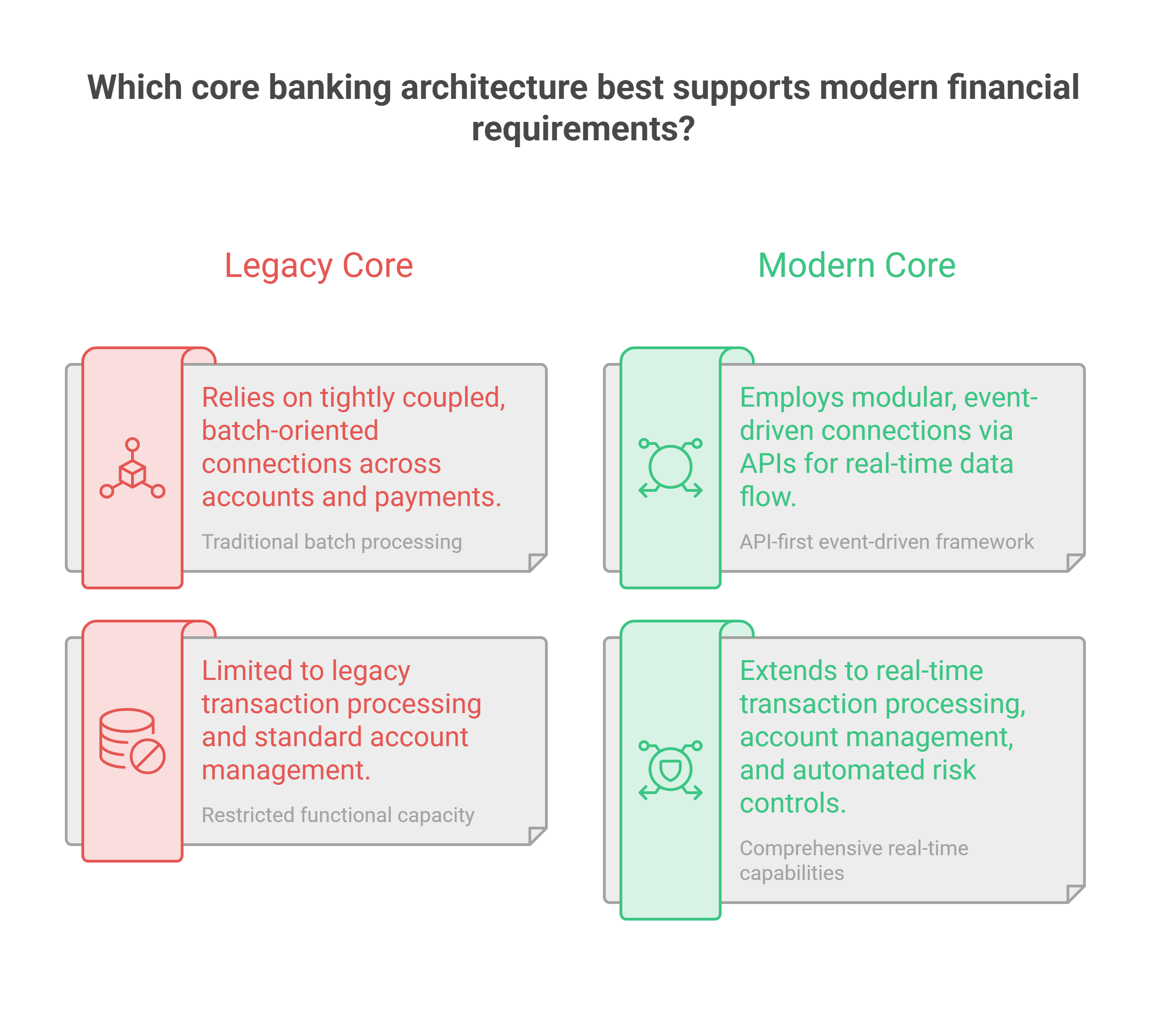
Key Takeaway: Real-time banking requires core architectures that can process transactions, data and connected services with greater speed, flexibility and continuity.

Progressive Modernisation Changing the Path From Legacy to Real-Time Banking

Banks are increasingly using progressive modernisation to introduce real-time capabilities without replacing critical systems in a single transition. The approach can involve sidecar platforms, component-based upgrades and API layers that allow newer services to operate alongside established cores. A 2025 FIS survey of banking executives across North America and Asia Pacific found that 52% planned to use a sidecar approach, while the Federal Reserve Bank of Kansas City identifies wrapping or augmenting legacy cores as one of several possible modernisation paths. This reflects the operational complexity of fast payment systems, where uninterrupted account and transaction processing remains essential during technology migration.

Modern architectures are also changing how fast payment systems interact with the rest of the bank. API-first and event-driven designs can allow transaction events to trigger connected processes, including account updates, risk checks, data flows and customer notifications. This reduces dependence on rigid batch sequences and can make banking services more responsive. ISO 20022 adds another dimension by introducing richer, more structured payment data that can support greater automation and straight-through processing. The BIS has highlighted the need for banks to make core systems more capable of handling this richer information as migration progresses.

Cloud infrastructure is supporting this transition by providing greater deployment flexibility and scalability, but moving workloads to cloud environments does not by itself modernise the underlying banking architecture. Finastra’s 2026 multi-market research found that 84% of surveyed financial-services organisations used some cloud solutions, while 87% planned further modernisation investment. The more significant change is the combination of cloud infrastructure with modular cores, integrated data platforms and event-driven processing.

Fast payment systems are therefore increasing the importance of architectural resilience as well as speed. Banks must maintain data consistency, system availability, secure integration and controlled migration while introducing new capabilities. Current modernisation programmes show that institutions are often choosing staged migration and coexistence so that legacy and modern platforms can operate together before workloads are progressively transferred. This approach allows banks to improve real-time capabilities while managing the operational risks associated with changing systems that support critical financial services.

Core Modernisation Becoming a Foundation for Real-Time Banking

The modernisation of bank cores is becoming a structural requirement as real-time services expand across the global financial system. fast payment systems are increasing expectations for continuously available banking, but meeting those expectations also requires responsive account processing, connected data environments, flexible product architecture and resilient integration layers.

The transition is unlikely to follow one universal model. Banks are balancing the need for modern capabilities with the operational complexity of changing systems that support critical financial services. Phased migration, modular architectures and coexistence between legacy and modern platforms can provide different routes toward this transition.

For World Finance Informs, the development shows that real-time banking depends on more than payment speed. It increasingly requires a core technology environment capable of supporting continuous transactions, richer data and adaptable banking services across the wider digital ecosystem.

World Finance Informs brings together the global financial industry — from banking and investment leaders to fintech innovators and capital markets professiona ls — through trusted editorial, market intelligence, and digital engagement.

Our 2026 Media Pack offers integrated solutions to reach your audience:

  • Magazine & Digital Editions Showcase your brand within premium financial industry coverage read by execut ives and decision - makers worldwide.
  • Industry Insights & Reports Align with data - driven analysis, trend reports, and regional roundups across the global finance and banking value chain.
  • Brand Authority & Credibility Position your company as a thought leader through expert commentary, interviews, and special features.

Subscribe

- Never miss a story with notifications

- Gain full access to our premium content

- Browse free from any location or device.

Media Packs

Expand Your Reach With Our Customized Solutions Empowering Your Campaigns To Maximize Your Reach & Drive Real Results!

– Access the Media Pack Now

– Book a Conference Call

Leave Message for Us to Get Back

Latest stories

Related stories

Digital Bank Profitability Bringing Greater Focus to Banking Unit Economics

Across the global digital-banking sector, the emphasis is increasingly...

Fast Payment Systems Becoming Part of Macroeconomic Infrastructure

Across the global payments landscape, fast payment systems are...

Instant Payments and Card Payments Showing Diverging Transaction Patterns

Across the global payments landscape, instant payments and card...

Merchant Fees Reshaping the Economics of Instant Payment Rails

Instant payment systems have often been built around rapid...

Subscribe

- Never miss a story with notifications

- Gain full access to our premium content

- Browse free from any location or device.

Media Packs

Expand Your Reach With Our Customized Solutions Empowering Your Campaigns To Maximize Your Reach & Drive Real Results!

– Access the Media Pack Now

– Book a Conference Call

Leave Message for Us to Get Back

Translate »