


















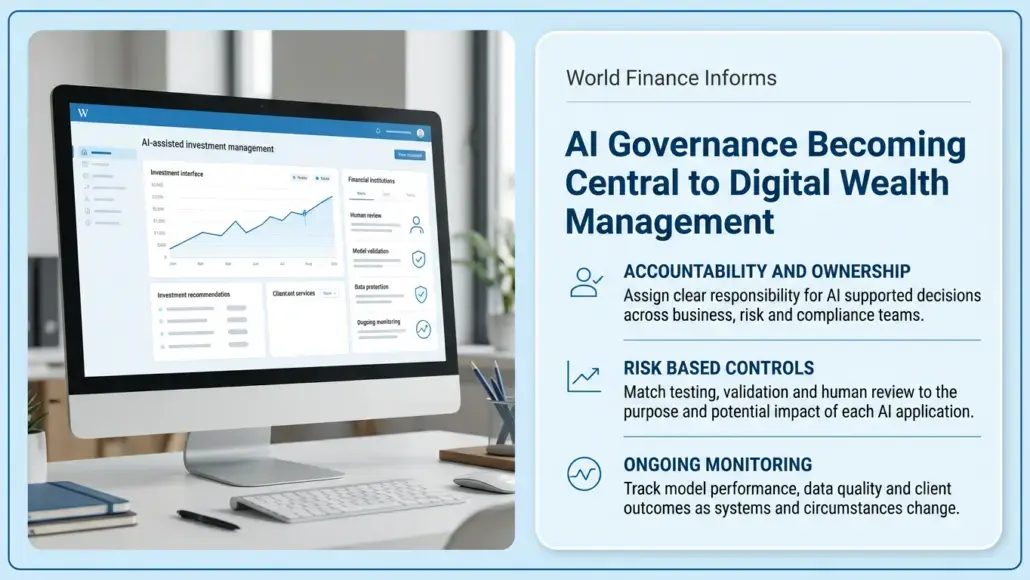


Artificial intelligence (AI) is becoming embedded in digital wealth management, from client onboarding and financial planning to portfolio research, personalised recommendations and adviser support. These applications can help firms process information at scale and tailor services to individual needs, but they also raise questions about accuracy, accountability, data use and the boundaries of automated decision making. AI governance is therefore moving from a technology policy issue to an operating priority for wealth managers.
The question is not simply whether a tool produces useful outputs, but whether the firm can explain how it was selected, tested and supervised, and how problems will be corrected as models or circumstances change. For internationally active firms, this responsibility also spans different regulatory frameworks and customer expectations. Tools that work well in controlled testing can behave differently with new data, unusual client circumstances or rapidly changing market conditions, making continued review essential.
Embedding AI Oversight into Wealth Management Operations
Wealth management decisions are closely tied to individual circumstances. A recommendation that overlooks a client’s investment horizon, financial position, risk tolerance or documented preferences can be unsuitable even when the underlying model appears technically sound. Generative AI can produce convincing but inaccurate explanations, while models trained on incomplete or unrepresentative data may deliver uneven results across client groups.
These concerns do not mean every AI use carries the same level of risk. They mean that controls should reflect what a system does, the decisions it influences and the potential consequences for clients. AI governance must connect technical validation with suitability, disclosure and the firm’s existing conduct obligations. In practice, AI governance must cover the full service journey, because a technically accurate output can still be unsuitable if it is presented without context or conflicts with a client’s objectives; review processes should test decision quality, not only model performance.
For wealth managers, effective oversight begins with a clear view of where AI is used and who is responsible for each application. Key priorities include:
- Defined accountability: Assign ownership across senior management, investment teams, compliance, risk and technology functions.
- Risk based classification: Distinguish administrative support and research tools from systems that shape personalised recommendations or execute actions.
- Reliable data and testing: Assess data quality, model limitations, accuracy and potential bias before deployment.
- Meaningful human review: Establish when advisers must verify outputs, challenge recommendations or escalate uncertain cases.
- Ongoing monitoring: Track model performance, customer outcomes, input changes and external provider services after launch.
Building Controls Across the AI Lifecycle
An effective framework starts with an inventory of AI use cases, including tools embedded in software supplied by external vendors. Each application should have a named business owner, documented purpose and assessment of potential harm. Testing should consider not only technical performance but also whether outputs are explainable enough for the task, whether data use is authorised and whether errors could affect client decisions.
AI governance also requires clear procedures for approving changes, reporting incidents, suspending unreliable systems and keeping evidence of key decisions. Human oversight should be meaningful rather than ceremonial: advisers need enough information and authority to question a recommendation instead of routinely accepting a model’s output. The depth of review should be proportionate to the use case and its foreseeable impact.
Practical controls can include:
- Document the system’s intended use, limitations, data sources and accountable owner.
- Test outputs against relevant client profiles and challenging scenarios before release.
- Set escalation thresholds for uncertain, inconsistent or potentially harmful recommendations.
- Review performance after updates and monitor whether outcomes differ across client groups.
- Assess external providers for security, continuity, data handling and transparency about model changes.
Cross Border Rules Require Adaptable Frameworks
Regulatory approaches are converging on accountability and risk management, but the rules are not identical. The Financial Stability Board reported that it had finalised international sound practices for responsible AI adoption by financial institutions. Singapore’s Monetary Authority of Singapore issued AI risk management guidelines. In the United Kingdom, the Financial Conduct Authority has said it will rely on existing frameworks, including the Consumer Duty and senior management accountability rules, rather than introduce separate AI regulation at this stage.
In the European Union, the AI Act became applicable in August 2026, while some high risk system obligations have later application dates. These differences make local legal analysis essential. AI governance should translate common principles into controls that match each market’s requirements, not assume one policy automatically satisfies every regulator.
For firms operating internationally, implementation requires:
- Map each AI use case to relevant rules in the markets where services are provided.
- Keep records showing how suitability, consumer protection and model risks are assessed within the firm’s AI governance framework.
- Align internal policy with the firm’s existing risk and compliance framework.
- Connect related research on AI augmented advice.
Accountability as a Condition for Responsible Adoption
AI can improve the speed and reach of wealth management, but its value depends on whether firms can manage the risks created by its use. AI governance is most effective when responsibility is clear, testing reflects real client situations and monitoring continues after deployment. It should also be proportionate: a tool that summarises research does not necessarily require the same controls as a system that generates individual recommendations or initiates transactions.
Wealth managers should prioritise three enduring safeguards:
- Clear ownership of every material AI application.
- Documented review, escalation and incident procedures.
- Continuing assessment of client outcomes, data quality and external provider risks.
As supervisory expectations develop across markets, firms that treat oversight as part of product design and daily operations will be better prepared to adopt AI without weakening suitability, transparency or client trust.
References
- Financial Stability Board. FSB Chair Sets Out FSB Work on AI and Stablecoins. October 2026.
- Monetary Authority of Singapore. Guidelines on Artificial Intelligence Risk Management for Financial Institutions. October 2026.
- Financial Conduct Authority. AI in Financial Services: Shaping Our Approach Through Industry Engagement. June 2026.
- European Commission. AI Act: Shaping Europe’s Digital Future. Updated October 2026.
- International Organization of Securities Commissions. Artificial Intelligence in Capital Markets: Use Cases, Risks, and Challenges. March 2025.