


















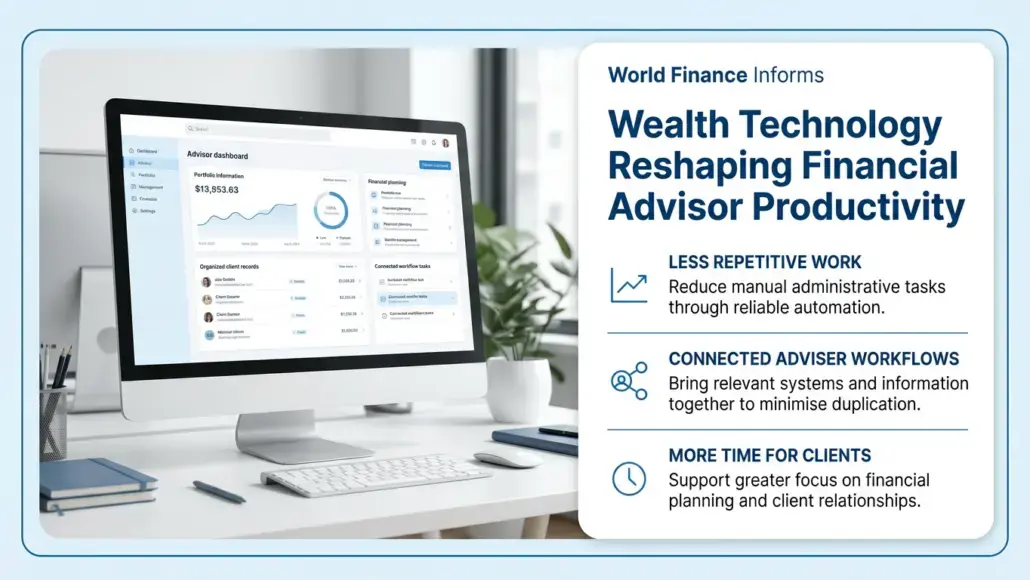


Wealth management firms are investing in artificial intelligence (AI), portfolio management platforms and workflow automation to improve how advisers organise information, prepare recommendations and serve clients. However, adopting new tools does not automatically reduce workloads or create more capacity for client relationships. Wealth technology creates business value when it removes repetitive work, connects previously separate processes and allows advisers to spend more time on activities requiring professional judgement.
Morningstar’s October 2026 Investor Perspectives Advisor Study found that 48% of surveyed US advisers reported improved day to day efficiency from AI, while 56% still identified excessive administrative or operational work as a major barrier to delivering the service they wanted. The findings highlight the difference between improving individual tasks and transforming overall productivity.
Efficiency Gains Do Not Automatically Create More Client Time
Advisers work across client records, portfolio information, financial planning tools, research systems and compliance documentation. When these activities remain disconnected, time saved in one task can be lost through repeated data entry, document checks and manual handoffs. Effective wealth technology therefore requires firms to assess entire workflows rather than isolated applications. The objective is to improve how work moves from preparation through review and delivery, while retaining appropriate controls. Portfolio management solutions and digital investment platforms can also support more consistent investment implementation, potentially reducing the time advisers spend on repetitive portfolio tasks.
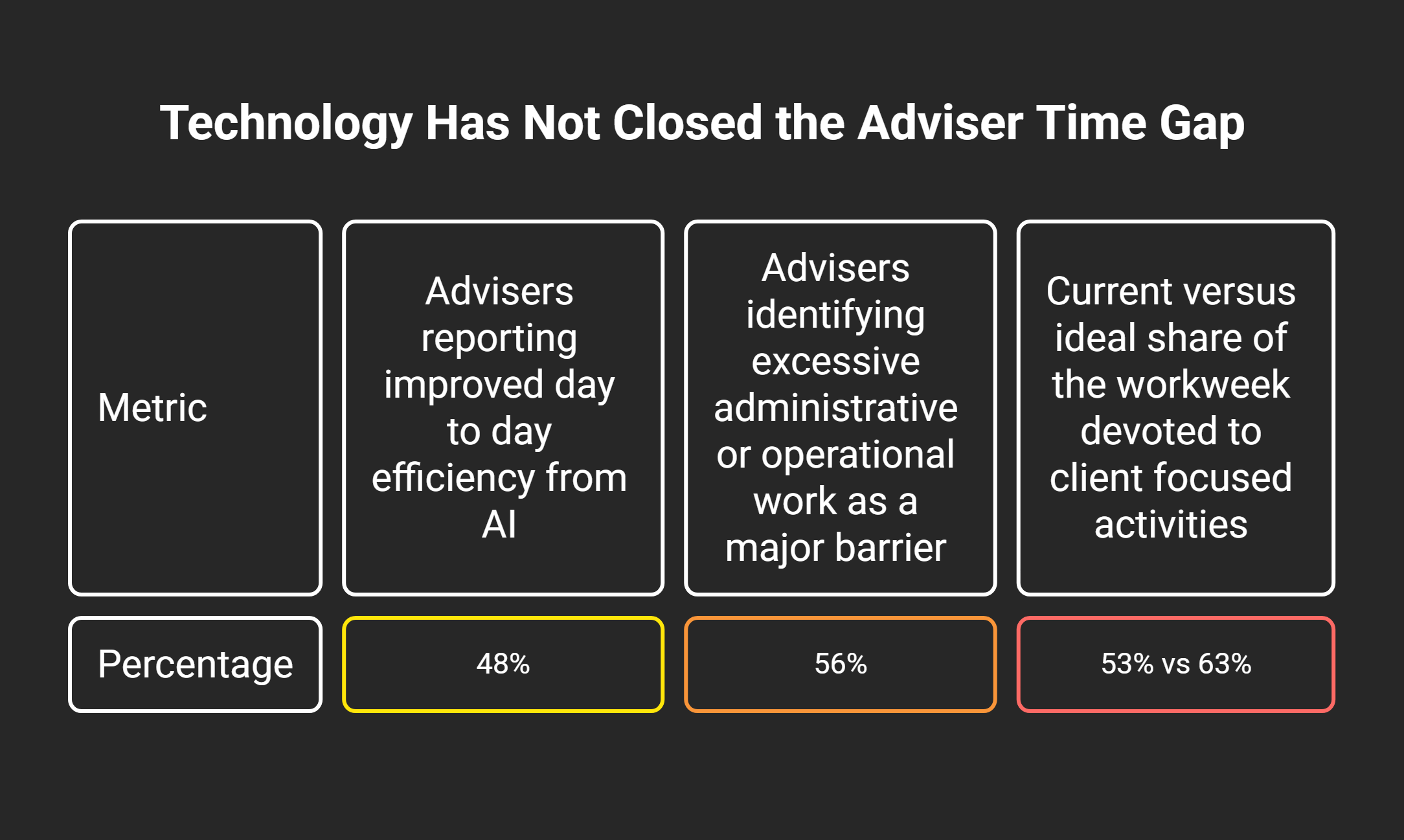
These findings show that reported efficiency gains can coexist with administrative pressure and unmet demand for more client focused time.
Practical priorities for improving productivity include:
- Remove repetitive administrative tasks where automation is reliable and appropriate.
- Connect systems to reduce duplicate information entry and unnecessary manual handoffs.
- Redirect recovered time towards client relationships, financial planning and other higher value activities.
Wealth technology should ultimately be assessed by how effectively it improves the flow of work and the use of adviser capacity, not simply by the number of tools a firm adopts.
Integrated Workflows Matter More than the Number of Tools
Productivity depends on how effectively technology fits into existing operations. FE fundinfo’s 2026 Financial Adviser Survey reported that 95% of its respondents considered themselves to be using too many software tools, while around half spent four to six hours each week reconciling information across platforms. These findings come from a provider survey whose publicly available summary does not state the sample size, so they should be treated as indicative rather than representative of the entire global industry. Nevertheless, they illustrate how disconnected systems can offset the benefits of automation.
Firms need to examine whether their applications share information reliably, whether teams follow consistent processes and whether existing capabilities are being used effectively. Deloitte’s May 2026 global wealth management technology research similarly identifies core platforms, data foundations and end to end workflow redesign as important implementation priorities. Wealth technology can support productivity when it reduces duplication across these connected activities rather than adding another isolated system.
- System integration: Connect relevant client, portfolio and planning information across authorised platforms.
- Process ownership: Assign responsibility for handoffs, exceptions and approvals so tasks do not remain unresolved between teams.
- Technology utilisation: Review existing software capabilities before introducing overlapping applications or additional subscriptions.
Productivity Must Be Measured Through Outcomes
A reduction in administrative time is useful only when firms understand what happens to the capacity released. Vanguard’s September 2026 survey of 549 US financial advisers found that 72% wanted more time for prospecting and strengthening existing client relationships. Its research also identified administrative tasks, including email drafting, research and meeting notes, as common AI use cases. These findings suggest that advisers see potential value in technology, but the business benefit depends on how firms allocate the time and resources saved.
Wealth technology should therefore be evaluated against the actual performance of the advisory operation, rather than adoption rates alone.
- Time allocation: Track whether reduced administrative workloads result in more time for clients and financial planning.
- Service quality: Monitor responsiveness, unresolved requests, rework and the consistency of client communications.
- Operating efficiency: Assess processing delays, duplicate work, platform utilisation and the cost of maintaining systems.
Firms should also consider the reliability of automated outputs, staff training and the need for human review. These factors influence whether efficiency improvements persist beyond initial implementation and whether additional capacity creates meaningful benefits for the business and its clients.
Turning Technology Investment into Adviser Capacity
The productivity value of wealth technology depends on whether firms translate task level improvements into better use of professional time. Integrated workflows, reliable data and appropriate automation can reduce administrative friction, but fragmented systems and growing service demands may absorb the gains. Firms need to evaluate technology against client service, operating costs, rework and adviser capacity rather than measuring success through adoption alone.
Key priorities include:
- Simplify workflows before adding further tools.
- Measure how recovered time is allocated across client service and business development.
- Maintain appropriate review, information security and staff accountability.
Ultimately, technology creates sustainable productivity when it supports a coherent operating model and allows advisers to concentrate on work requiring professional expertise.
References
- Morningstar. 2026 Investor Perspectives Advisor Study. October 2026.
- FE fundinfo. 2026 Financial Adviser Survey.
- Deloitte Global. From Ambition to Execution: Wealth Management Technology. May 2026.
- Vanguard. Advisors Embrace New Technologies, but Still Lack Time to Focus on Client Relationships. September 2026.