


















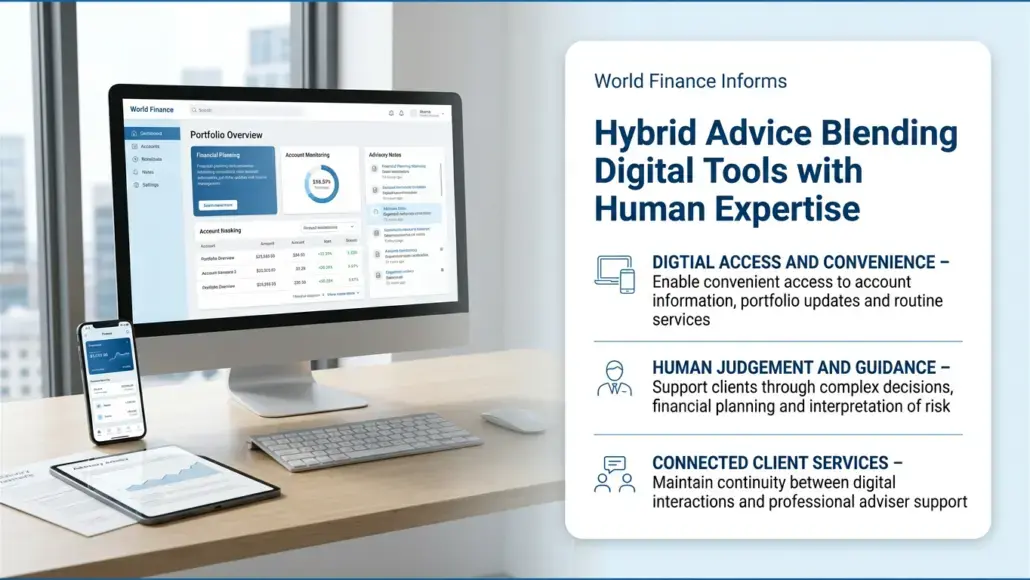


Digital Access Must Complement Human Judgement
The business challenge is deciding which activities can be handled digitally and where direct adviser involvement adds value. Clients may use digital platforms to monitor portfolios, review documents and explore investment opportunities, while advisers provide contextual interpretation, discuss risks and assess whether proposed decisions fit individual circumstances.
Hybrid advice therefore requires firms to design clear transitions between self service, automated support and professional consultation. Without consistent information and coordinated workflows, clients may need to repeat details, receive inconsistent explanations or struggle to obtain support when circumstances become more complex. The objective is not to maximise automation or adviser interaction independently, but to deliver an appropriate level of support for each situation.
Several considerations shape this service model:
- Routine digital services: Enable convenient access to account information, portfolio updates, documents and standard transactions.
- Human advisory intervention: Retain direct professional involvement where decisions require contextual interpretation, discussion of trade offs or complex financial planning.
- Consistent client information: Ensure advisers can access relevant records and understand previous digital interactions when a client seeks support.
- Clear escalation routes: Make it straightforward for clients to move from automated services to a qualified professional when additional guidance is necessary.
Hybrid advice becomes commercially meaningful when these components function as one coherent client journey, balancing convenience, service quality and professional accountability.
Integrating Digital Channels with Advisory Workflows
A coordinated service model depends on how well digital interactions connect with the adviser’s existing work. Client relationship management systems, portfolio platforms and financial planning tools should provide consistent information across channels so that an adviser can understand what a client has reviewed, what questions remain unresolved and which issues require follow up.
Deloitte’s May 2026 wealth management technology research identifies adviser enablement, data foundations and end to end journey redesign as important implementation priorities. This highlights why hybrid advice involves operating model changes as well as customer facing technology. Adding an application or automated service without connecting it to the wider advisory process can create additional handoffs rather than reduce friction.
Firms should consider several operational requirements:
- Connected workflows: Link digital requests, adviser follow ups and relevant portfolio information to reduce duplication.
- Defined responsibilities: Establish which activities can be completed automatically and which require professional assessment or approval.
- Consistent communication: Maintain continuity when clients move between online services, remote consultations and in person meetings.
- Appropriate support levels: Match the degree of adviser involvement to client needs, decision complexity and service arrangements.
Trust Depends on Clear Responsibilities
Digital tools can expand access to financial information, but they do not eliminate the need to assess accuracy, suitability and individual circumstances. The Financial Planning Standards Board’s October 2026 global research found that 21% of surveyed financial planners reported a greater need to contextualise or correct AI generated information brought into client discussions.
A further 19% reported increased collaborative discussions associated with clients’ use of AI. These findings suggest that digital information can become part of the advisory conversation, making explanation and professional assessment important elements of the service.
For hybrid advice to remain dependable, firms need clear processes for reviewing information and resolving uncertainty.
-
Professional judgement: Ensure advisers can question automated outputs and explain the reasoning behind recommendations.
-
Transparent service boundaries: Clarify what digital tools provide and when clients need direct professional assistance.
-
Confidentiality and control: Protect client information and establish appropriate permissions across platforms and advisory teams.
-
Service evaluation: Monitor client engagement, unresolved queries, service quality and operating costs rather than measuring digital adoption alone.
The objective is to make digital convenience and human expertise complementary parts of wealth management, with responsibilities remaining clear throughout the client relationship.
Building a Sustainable Hybrid Service Model
The value of hybrid advice depends on how effectively firms align digital convenience with professional judgement, connected information and appropriate client support. Successful implementation requires more than offering multiple channels: firms must coordinate workflows, define responsibilities and ensure that clients can access human guidance when circumstances demand it. Evaluating these models also requires attention to service quality, operating costs and the needs of different client groups.
Key priorities include:
- Integrate digital services with adviser workflows and client records.
- Preserve professional accountability for consequential recommendations.
- Measure service outcomes alongside efficiency and digital engagement.
A well designed model can also improve advisor productivity, by allowing advisers to focus their time on activities where professional judgement and client interaction add the most value.
Ultimately, combining technology with human expertise is an operating model decision, not simply a technology choice. Its effectiveness depends on whether the service remains coherent, appropriate and accountable for clients.
References
- HSBC and Ipsos. The Trust Threshold: AI Makes Investors Bolder, but They Want Human Judgement to Make Decisions. June 2026.
- CFA Institute. Next Gen Investors: A Guide for Wealth Managers and Financial Advisers. March 2026.
- Deloitte Global. From Ambition to Execution: Wealth Management Technology. May 2026.
- Financial Planning Standards Board. Impact of AI on Financial Planning Global Research 2026. October 2026.