
















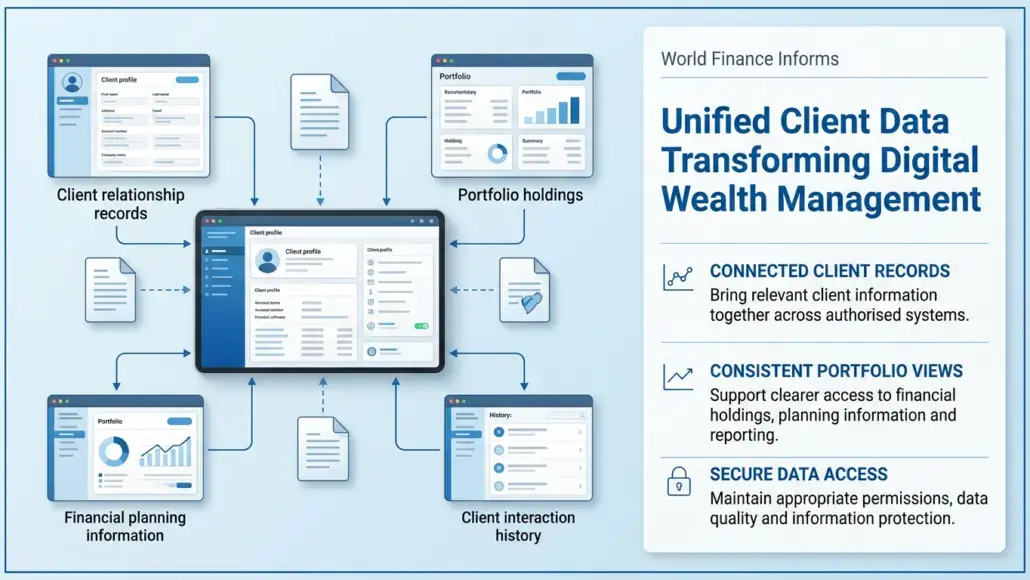


Wealth management firms increasingly need to connect client information across portfolio systems, financial planning tools, customer relationship management (CRM) platforms and service records. When these systems operate separately, advisers may have to assemble financial information manually, teams can work from inconsistent records, and important details may be overlooked during client reviews.
Unified client data addresses this challenge by connecting information across business functions to create a more consistent view of each client’s financial position, objectives and relationship with the firm. The goal is not simply to collect more information, but to make relevant, accurate and appropriately authorised records usable across the organisation. This requires attention to data quality, system integration, common definitions and access controls, alongside investment in technology.
Connecting Fragmented Systems to Build a Complete Client View
A connected client view depends on how effectively a wealth manager links information from different sources. Capgemini’s World Wealth Report 2025 identifies fragmented systems and data silos as obstacles to unified client experiences, while Deloitte’s 2026 wealth management technology research highlights the importance of data foundations and platform modernisation.
These challenges affect more than adviser convenience. Inconsistent portfolio records can complicate reporting, duplicated client profiles can create operational inefficiencies, and outdated financial information can weaken the context available for planning discussions.
Unified client data therefore requires firms to establish how records are matched, validated, updated and shared between authorised systems. This information foundation can also support more relevant client segmentation, where firms consider client objectives and preferences alongside traditional asset categories.
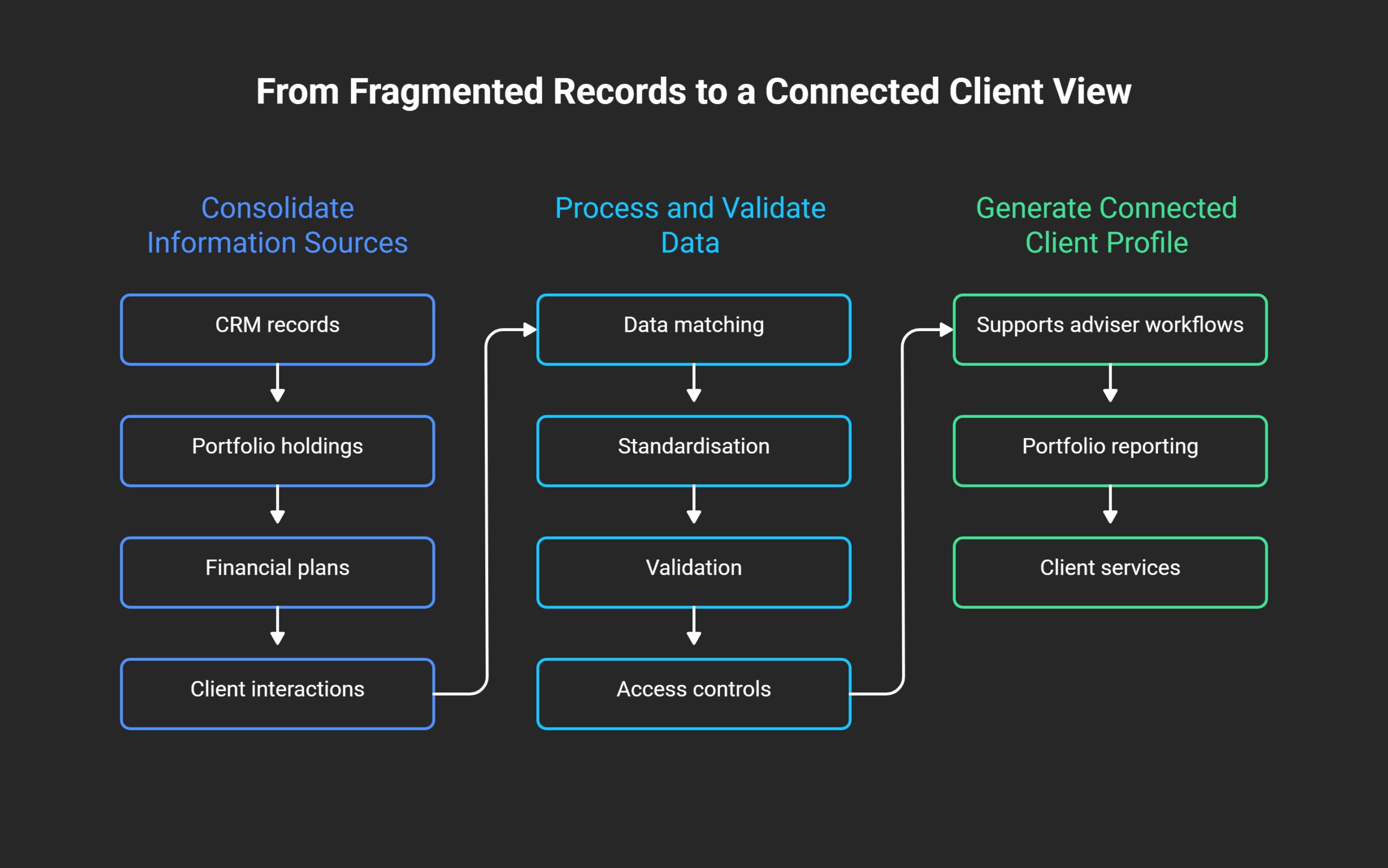
The diagram illustrates how integrating and validating information can help wealth management teams work from a more consistent client view.
A reliable connected data environment depends on several practical foundations:
- Consistent client identification across systems to reduce duplicate profiles and mismatched records.
- Clear ownership of information, including responsibility for resolving conflicting or outdated entries.
- Appropriate access permissions to protect confidential financial information and restrict unauthorised use.
- Reliable connections between portfolio, planning and relationship management systems so that authorised teams can use relevant information without repeated manual entry.
Ultimately, unified client data is an operating foundation for more consistent wealth management services, rather than simply a technology dashboard.
Data Integration Requires Consistent Definitions and Reliable Connections
Connecting wealth management systems involves more than transferring information between platforms. Client identities, asset classifications, valuation dates and financial planning assumptions must remain consistent when records are combined. Unified client data depends on clear rules for matching records, resolving discrepancies and determining which source is authoritative when systems contain conflicting information.
SimCorp’s 2025 Global InvestOps Report found that 58% of surveyed buy side operations leaders identified maintaining data models and underlying metadata as a major challenge. Although the research covers investment operations more broadly than wealth management, it illustrates why data integration requires ongoing maintenance rather than a one time technology implementation.
Wealth managers can address these challenges through several operational practices:
- Client identity matching: Establish consistent identifiers to reduce duplicate profiles and prevent information from being assigned to the wrong client.
- Data standardisation: Define common formats and classifications for holdings, valuations, financial objectives and client records.
- Integration monitoring: Track failed transfers, incomplete updates and inconsistencies between connected systems.
- Information ownership: Assign responsibility for correcting inaccurate records and maintaining authoritative data sources.
Data Governance Determines Whether Connected Information Can be Trusted
A consolidated client view can improve access to information, but it also creates responsibilities around confidentiality, permissions and accountability. Firms must determine which employees and systems can access particular records, how information may be used and how changes are documented. Unified client data should not mean unrestricted access to every client’s financial information.
Access controls need to reflect professional responsibilities, client authorisations and applicable privacy requirements. Firms must also consider data retention, third party providers and the security of connections between legacy and modern platforms. Without these controls, broader connectivity can increase exposure to inappropriate access or allow errors to spread across multiple systems.
Effective governance requires coordinated oversight across technology, operations, compliance and advisory teams:
- Access management: Restrict information to authorised users and applications according to defined responsibilities.
- Data quality controls: Validate important fields, identify outdated records and establish procedures for resolving discrepancies.
- Auditability: Maintain records of relevant changes, access and corrections so that issues can be investigated.
- Ongoing measurement: Monitor record completeness, duplication, integration failures and data correction workloads to assess whether the environment remains reliable.
For wealth management firms, unified client data is therefore an ongoing operating capability that combines technology, governance and clear ownership. Its value depends on maintaining dependable information across the client relationship, not simply creating a consolidated interface.
Building a Reliable Foundation for Wealth Management
The effectiveness of unified client data depends on firms maintaining accurate, consistent and appropriately protected information across their technology environments. Connecting records can support more informed advisory discussions, consistent reporting and coordinated client services, but these benefits depend on clear data ownership, reliable integration and continuing validation. Wealth managers must treat data management as an ongoing operational responsibility rather than a one time technology project.
Key priorities include:
- Maintain data quality: Establish clear processes for correcting outdated, duplicated or inconsistent records.
- Strengthen governance: Apply appropriate access permissions, confidentiality controls and audit trails.
- Measure performance: Monitor record completeness, integration failures and the effort required to resolve data discrepancies.
Ultimately, connected client information can strengthen the foundations of digital wealth management when technology investments are supported by accountable teams, consistent standards and reliable information.
References
- Capgemini Research Institute. World Wealth Report 2025.
- Deloitte. From Ambition to Execution: Wealth Management Technology. May 2026.
- SimCorp. 2025 Global InvestOps Report.