


















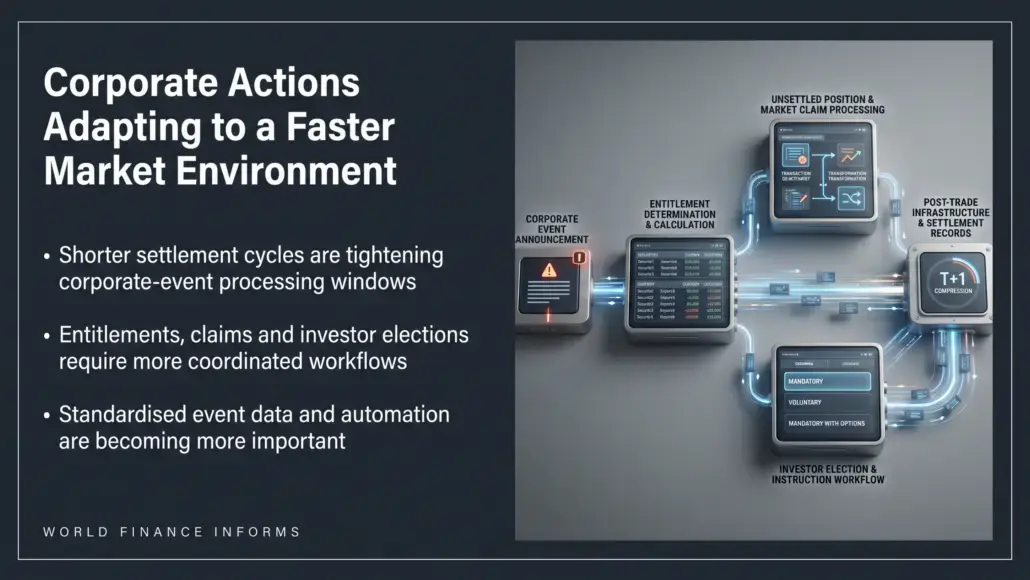


Corporate actions are becoming more closely tied to the operational changes created by shorter securities settlement cycles. As markets move toward T+1, the time available to coordinate dividends, reorganisations, entitlement processing and investor elections is becoming more compressed. The connection between corporate events and settlement is increasingly important to The timing and procedures of an event can depend on the status of the underlying securities, making the timely exchange of information and instructions between issuers, intermediaries, custodians, and market infrastructures essential for efficient processing.
Shorter Settlement Cycles Tightening Event Timelines
The impact is most visible in the relationship between trade dates, settlement dates and the dates used to determine investor entitlements. Under a shorter cycle, securities can settle closer to the record date, reducing the time available to identify unsettled positions and determine how an entitlement should be handled. The U.S. move to T+1 has already altered dividend-date mechanics, while European markets are preparing changes to event-processing procedures ahead of the planned 2027 transition.
The pressure extends across different types of events. Mandatory distributions require accurate identification of eligible positions, while reorganisations can require pending settlement instructions to be transformed when securities or entitlements change. Elective events create an additional timing challenge because investors need enough time to receive event information, make decisions and transmit instructions through intermediaries. For firms, the shorter timetable can make small inconsistencies more consequential because there is less time to reconcile positions, clarify event information or correct an instruction before a deadline passes. This is where corporate actions processing increasingly depends on coordinated workflows rather than isolated event handling.
Processing Changes Extending Across the Post-Trade Chain
European preparations are increasingly focused on harmonising these procedures rather than treating them as separate local processes. The ECB’s corporate-events work covers market claims, transformations and buyer protection, reflecting the need to manage unsettled transactions and investor entitlements consistently as settlement timelines change. This makes the transition in corporate actions processing a question of coordination as much as speed, with firms needing event information, transaction data and instructions to reach the right participants within tighter operational windows.
The broader significance is that corporate actions are becoming another area where the move to T+1 exposes the limitations of fragmented processing. As timelines contract, standardised information exchange, accurate position data and earlier operational preparation become increasingly important across the post-trade chain.
Market Claims and Transformations Requiring Earlier Processing
The operational impact of shorter settlement cycles extends beyond dividend dates into the handling of transactions that remain unsettled when a corporate event takes place. Market claims can be required when an investor is entitled to a distribution even though the underlying securities transaction has not settled by the record date, while transformations are used when a pending transaction needs to reflect a reorganisation affecting the security. The European Central Bank’s harmonised framework treats market claims, transformations and buyer protection as connected parts of the T+1 corporate-events model, highlighting the need for consistent treatment across market infrastructures.
For elective events, the compression can be even more pronounced. Investors need to receive event information, assess available choices and transmit instructions through intermediaries before defined deadlines. Custodians and other intermediaries then have to validate and process those instructions within a narrower window. Under corporate actions workflows, delays in receiving or interpreting event information can therefore reduce the time available for downstream processing and increase the importance of accurate, timely communication.
Standardisation Supporting More Compressed Event Processing
European market infrastructures are responding through greater standardisation and automation. The ECB’s work has identified inconsistencies in the creation and processing of market claims and transformations across different environments, while the European T+1 programme is introducing harmonised procedures intended to improve consistency. Standardised event information and structured messaging can help systems identify entitlements, process transaction adjustments and transmit instructions without relying as heavily on manual intervention.
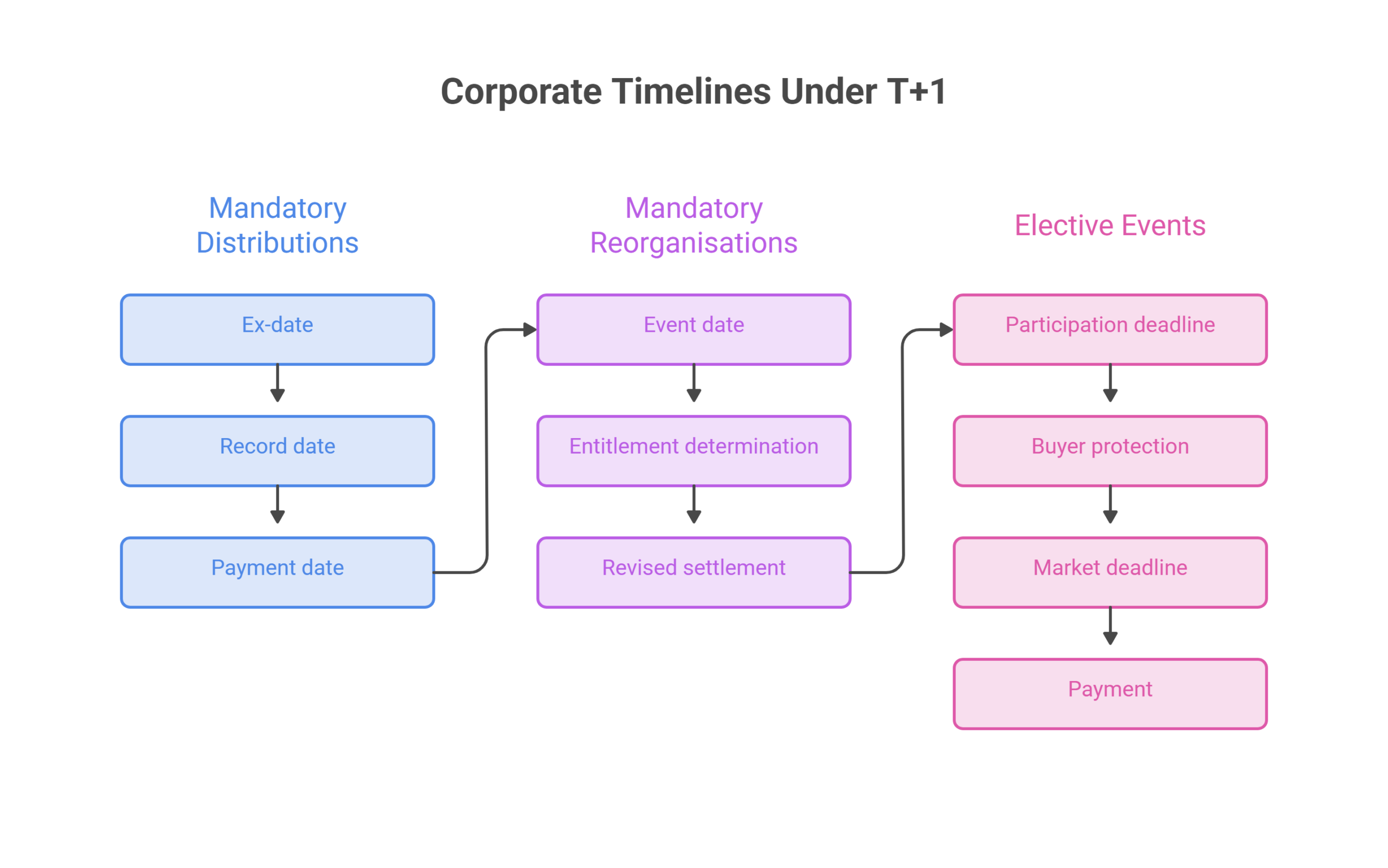
Key Takeaway: T+1 compresses corporate-event timelines, leaving less time for entitlement processing, investor elections and adjustments to unsettled transactions.
These changes make corporate actions increasingly dependent on connected post-trade systems and reliable event data. The objective is not simply to accelerate processing after an event is announced, but to ensure that event information, settlement positions and investor instructions can move through the chain in the correct sequence. This creates a natural link to securities financing processes affected by shorter settlement windows.
Corporate Event Processing Becoming More Time Sensitive
Shorter settlement cycles are making corporate actions more dependent on timely information, accurate position data and coordinated processing across issuers, intermediaries, custodians and market infrastructures. Market claims, transformations and investor elections all require information to move through the post-trade chain within tighter windows, increasing the importance of standardised procedures and automated workflows. The transition to T+1 is therefore extending settlement-cycle change into the operational mechanics surrounding corporate events.
The wider implication is that corporate-event processing is becoming increasingly integrated with the broader settlement infrastructure rather than operating as a separate administrative function. As firms adapt to compressed timelines, the pressure also extends to securities availability, collateral and funding processes, all of which play a role in ensuring transactions are completed on time.