

















Close
Connected Claims USA 2026
Optic 2026

Failed Trades Bringing New Focus to Settlement Discipline

Note* - All images used are for editorial and illustrative purposes only and may not originate from the original news provider or associated company.

Related stories

Traditional Market Infrastructure Adapting to Digital Assets

Traditional market infrastructure is increasingly being adapted to accommodate...

Market Transparency Driving Demands for Data Infrastructure

Market transparency is increasingly dependent on how quickly and...

Simpler Reporting Changing Flow of Financial Market Data

Financial reporting frameworks are being redesigned as regulators and...
- Advertisement -
Optic 2026

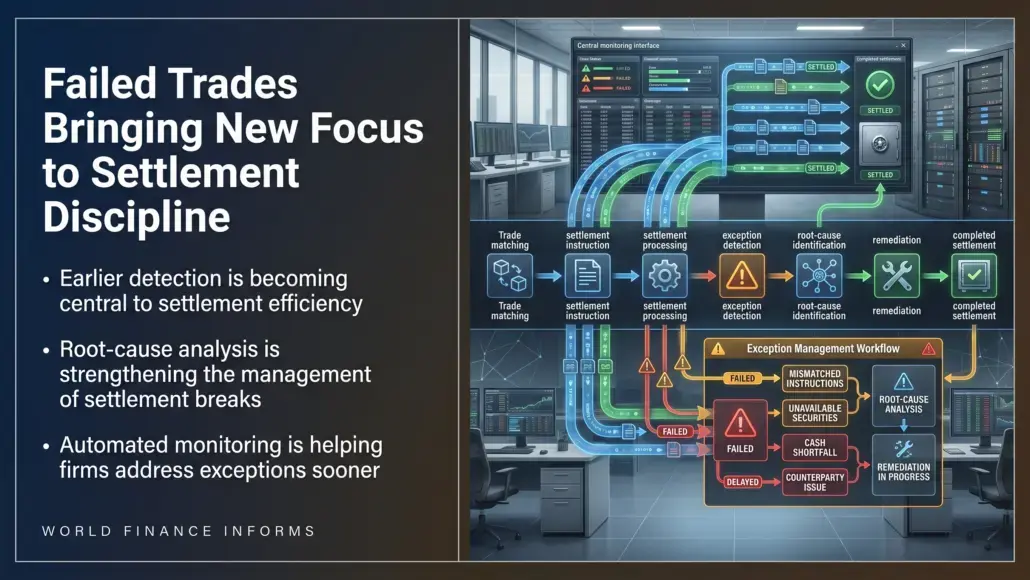
Failed trades are becoming a more consequential operational issue as securities markets move toward shorter settlement cycles. From the perspective of World Finance Informs, the shift is less about assuming that a faster settlement cycle will automatically lead to more settlement failures and more about the shorter recovery window available when a transaction does not settle as intended. Allocations, matching, securities availability, settlement instructions and cash funding all have less time to be corrected as the intended settlement date moves closer.

Settlement Failures Leaving Less Time for Recovery

When failed trades miss their intended settlement date, they can tie up securities or cash, create additional reconciliation work and require further intervention from counterparties and intermediaries. Under shorter settlement cycles, the same operational break can become more difficult to resolve because the time between trade execution and settlement has contracted. This is increasing attention on early detection of unmatched trades, incorrect settlement instructions and securities or cash shortfalls before they become settlement-day problems.

European settlement data shows why prevention remains important even when overall efficiency is high. T2S recorded average settlement efficiency of 93.5% by volume and 98.0% by value in 2025. These figures should not be interpreted as direct failed-trade rates, but they indicate that a remaining population of transactions still requires intervention or does not settle within the relevant efficiency measure.
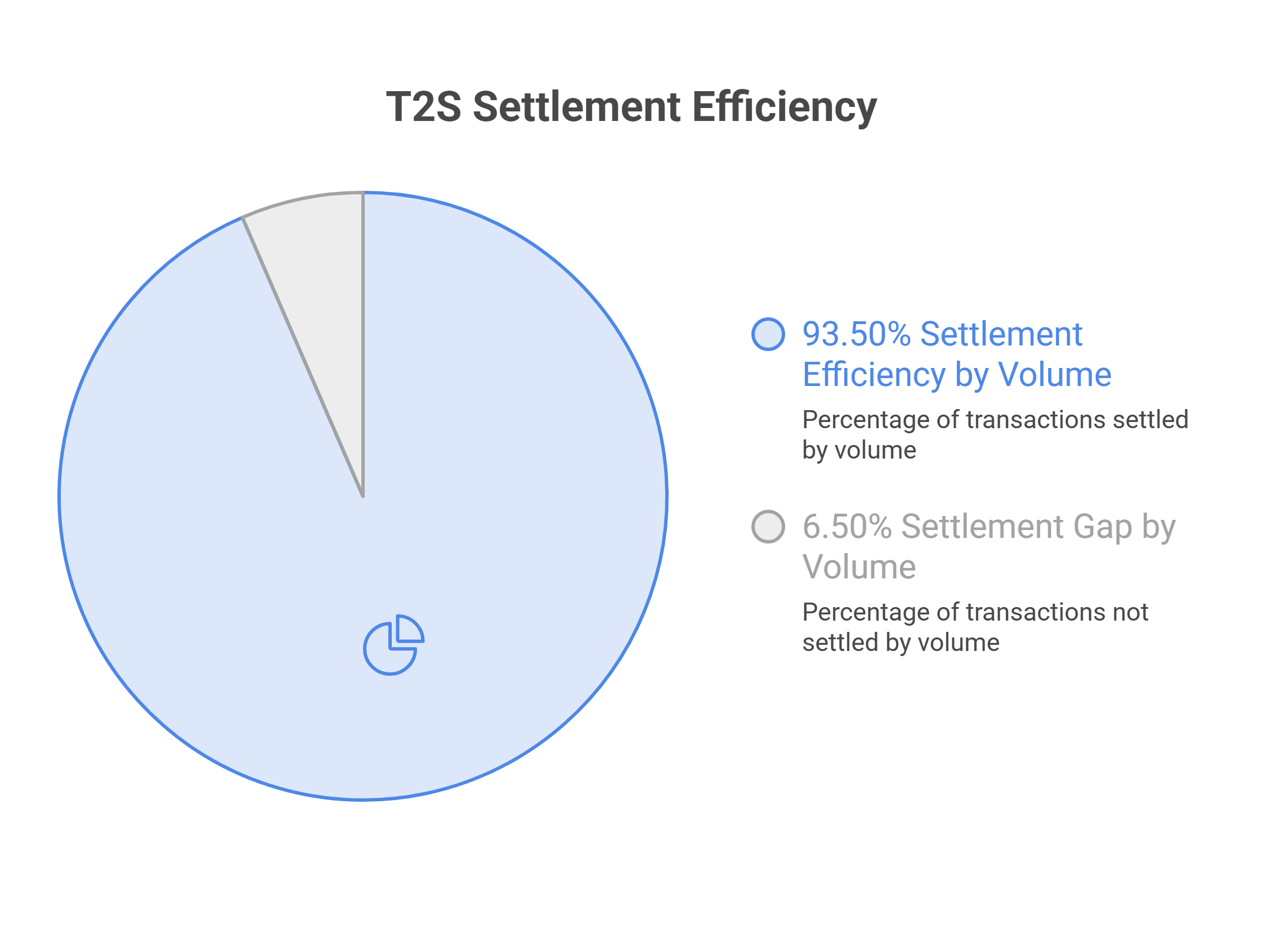
Key Takeaway: High aggregate settlement efficiency still leaves a measurable population of transactions requiring stronger monitoring and intervention.

Earlier Detection Strengthening Settlement Discipline

The shift toward shorter cycles is therefore placing greater emphasis on preventive controls. Firms are increasingly expected to identify problems while there is still time to correct them, rather than relying primarily on post-settlement remediation. Electronic matching, accurate standing settlement instructions, deadline monitoring and automated exception management can all reduce the time between detecting a break and taking corrective action. This makes failed trades increasingly connected to settlement windows and infrastructure operating hours.

Monitoring and Root-Cause Analysis Becoming More Important

The management of failed trades is increasingly shifting toward prevention, with firms focusing on identifying the operational cause of a break before the intended settlement date passes. Incorrect settlement instructions, unavailable securities, insufficient cash, late matching and counterparty processing issues can each prevent a transaction from settling on time. Monitoring systems that track matching status, settlement instructions and available inventory can help operations teams identify these issues earlier, while automated alerts can direct exceptions to the appropriate team before they become settlement-day problems.

This is particularly relevant under T+1 because the shortened cycle reduces the time between trade execution and settlement. A discrepancy that might previously have been identified and corrected within a longer processing window can now require immediate intervention. Accurate reference data, timely instruction exchange and automated matching therefore become part of settlement-discipline practices rather than separate operational improvements. The objective is to move from detecting a settlement failure after it occurs to identifying the conditions that could produce one.

Settlement Discipline Extending Beyond Penalties

European settlement rules already provide a framework for monitoring settlement fails and applying cash penalties in cases where participants are responsible. The purpose of these measures is not simply to impose a cost after a failure, but to create an incentive for market participants to improve settlement efficiency and reduce recurring operational problems. Recent European reforms have also placed greater emphasis on reporting and identifying circumstances where a failure results from factors outside a participant’s control, including certain infrastructure disruptions.

The distinction became particularly visible following the 2025 disruption affecting T2 and T2S, when technical problems interrupted settlement and payment processing and contributed to a significant increase in settlement fails. The episode demonstrated that settlement discipline depends not only on the readiness of individual firms but also on the resilience of the infrastructure through which transactions are processed. For failed trades, this makes root-cause analysis essential because remediation differs when a problem originates with a participant, a counterparty, a data issue or a market infrastructure.

As firms prepare for shorter settlement cycles, failed trades are therefore becoming a measure of the effectiveness of the wider post-trade operating model. Earlier exception detection, automated monitoring, accurate settlement data and clearer attribution of failure causes can help firms reduce avoidable breaks while responding more effectively when failures occur.

Optic 2026

World Finance Informs brings together the global financial industry — from banking and investment leaders to fintech innovators and capital markets professiona ls — through trusted editorial, market intelligence, and digital engagement.

Our 2026 Media Pack offers integrated solutions to reach your audience:

  • Magazine & Digital Editions Showcase your brand within premium financial industry coverage read by execut ives and decision - makers worldwide.
  • Industry Insights & Reports Align with data - driven analysis, trend reports, and regional roundups across the global finance and banking value chain.
  • Brand Authority & Credibility Position your company as a thought leader through expert commentary, interviews, and special features.

Subscribe

- Never miss a story with notifications

- Gain full access to our premium content

- Browse free from any location or device.

Media Packs

Expand Your Reach With Our Customized Solutions Empowering Your Campaigns To Maximize Your Reach & Drive Real Results!

– Access the Media Pack Now

– Book a Conference Call

– Leave Message for Us to Get Back

Latest stories

Related stories

Traditional Market Infrastructure Adapting to Digital Assets

Traditional market infrastructure is increasingly being adapted to accommodate...

Market Transparency Driving Demands for Data Infrastructure

Market transparency is increasingly dependent on how quickly and...

Simpler Reporting Changing Flow of Financial Market Data

Financial reporting frameworks are being redesigned as regulators and...

Digital Securities Gaining New Role in Collateral Markets

Digital securities are moving beyond issuance and settlement experiments...

Subscribe

- Never miss a story with notifications

- Gain full access to our premium content

- Browse free from any location or device.

Media Packs

Expand Your Reach With Our Customized Solutions Empowering Your Campaigns To Maximize Your Reach & Drive Real Results!

– Access the Media Pack Now

– Book a Conference Call

– Leave Message for Us to Get Back

Translate »