
















Close
Connected Claims USA 2026
Optic 2026

Faster Settlement Bringing New Pressure to Trade Processing

Note* - All images used are for editorial and illustrative purposes only and may not originate from the original news provider or associated company.

Related stories

BNP Paribas and Google Cloud Expand Agentic AI in Banking

BNP Paribas and Google Cloud are expanding their collaboration...

Tokenised Deposits Move into Live Interbank Payments

Britain's largest banks have completed live interbank transactions using...

Murex Expands Capital Markets Cloud Deployment with Google Cloud

Murex and Google Cloud have formed a strategic partnership...
- Advertisement -
Optic 2026

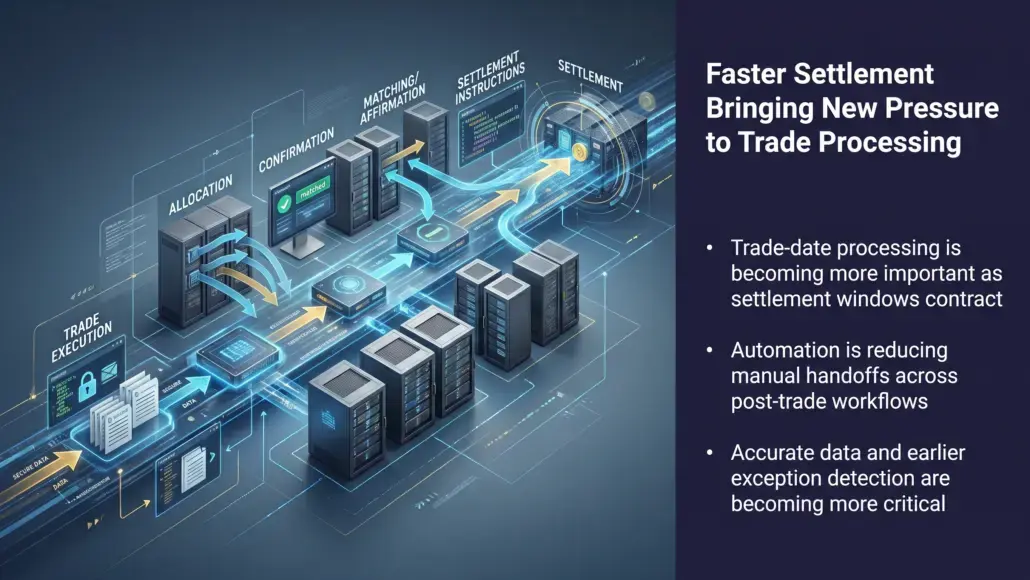
The move toward faster settlement is changing how market participants manage the period between trade execution and final settlement. For World Finance Informs, the development points to a broader operational shift across securities markets: activities that once had more time to complete are increasingly being pulled toward trade date. Allocations, confirmations, matching and settlement instructions now face tighter deadlines, leaving firms with less room to correct incomplete or inaccurate information before settlement.

Trade-Date Processing Becoming More Critical

The move to faster settlement is therefore putting pressure on the processes that prepare a trade for settlement rather than on settlement itself. In Europe, the planned transition to T+1 on 11 October 2027 is already driving changes to allocation and confirmation practices, with ESMA proposing electronic, standardised communication and earlier completion of these processes. AFME’s roadmap similarly calls for standardised electronic exchange of allocations and confirmations and intraday transmission, reflecting the need to move more post-trade activity into the trade date.

The effect extends across the transaction chain because each stage depends on information generated earlier. An incorrect allocation can delay confirmation, an unmatched trade can complicate settlement instructions, and incomplete data can leave less time for operational teams to intervene. As the move toward faster settlement progresses, firms therefore have greater incentive to reduce manual handoffs, improve data quality and identify discrepancies while there is still time to act.
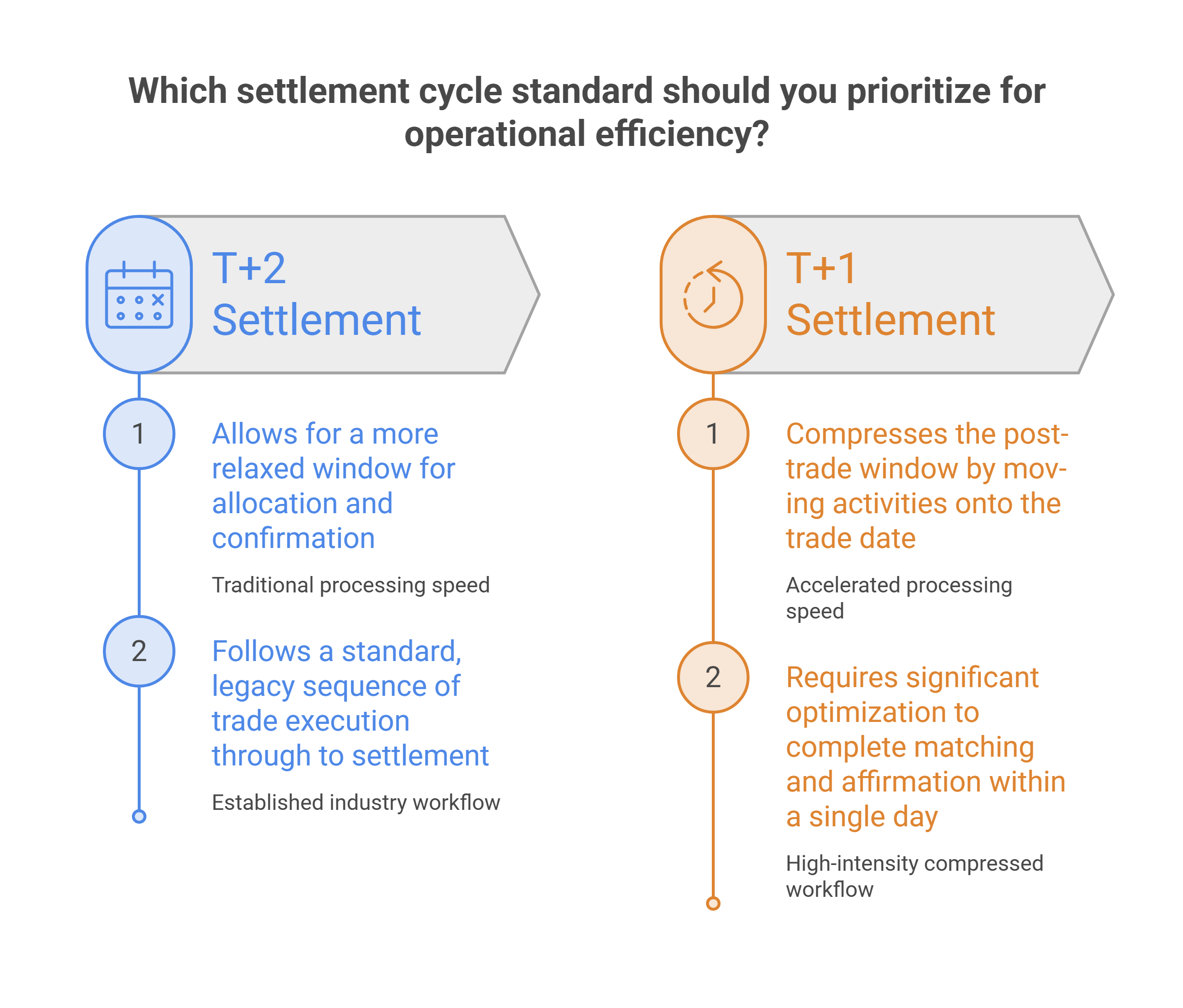
Key Takeaway: T+1 compresses the upstream post-trade window, making timely processing and accurate settlement data more important.

The U.S. transition provides practical evidence of how firms can adapt to a shorter cycle. Industry data showed nearly 95% of transactions met the affirmation criteria by the 9:00 p.m. ET trade-date cutoff after the 2024 transition, compared with 73% at the end of January 2024. The experience does not remove the operational challenges of shorter settlement, but it demonstrates why trade-date processing and automation have become central to readiness. That creates a natural bridge to corporate-event processing within compressed settlement timelines.

Automation Moving More Work into the Trade Date

The operational response to faster settlement is increasingly centred on automation, standardisation and earlier exception management. Firms need systems that can transmit allocations, confirmations and settlement instructions without relying on manual exchanges that consume time. Trade-matching platforms can compare transaction details across counterparties earlier, while automated workflows can identify missing information or discrepancies before they reach the settlement stage. The objective is not automation for its own sake, but creating enough processing capacity within the shortened cycle to resolve exceptions while there is still time to act.

Data Quality and Workflow Integration

Data quality becomes more consequential when the window for correction is shorter. Settlement instructions, account information and trade details need to be available in consistent, machine-readable formats and flow correctly between connected systems. ESMA’s proposed requirements include electronic and standardised communication for allocations and confirmations, while AFME’s roadmap calls for improvements to settlement-instruction management and the automation of processes across the post-trade lifecycle. These changes show that faster settlement is pushing firms to address the handoffs between systems, not simply adjust a settlement date.

Standing settlement instructions illustrate why upstream data management is becoming more important. When an instruction is incorrect or outdated, there is less time under T+1 to identify the problem and obtain a corrected instruction before settlement. Industry initiatives around centralised SSI data, automated validation and machine-readable messaging are therefore part of the wider preparation effort. These measures help move error detection earlier in the workflow, where operational teams still have time to intervene.

Cross-border activity adds another layer of complexity. Different market infrastructures, time zones and operational practices can create dependencies that are harder to resolve when processing is compressed. The European transition therefore requires readiness across the wider ecosystem, including trading parties, settlement intermediaries, custodians and market infrastructures. ESMA has specifically urged firms to test readiness across the entire trading and settlement chain rather than treating the migration as a single-system exercise.

The U.S. experience also shows the value of preparing the operational chain rather than concentrating only on settlement. Following the 2024 transition, the share of transactions meeting the 9:00 p.m. ET affirmation criteria reached nearly 95%, up from 73% in January 2024. For firms preparing for faster settlement, the implication is that trade-date processing, automated matching and dependable reference data increasingly function together as one operational discipline.

Optic 2026

World Finance Informs brings together the global financial industry — from banking and investment leaders to fintech innovators and capital markets professiona ls — through trusted editorial, market intelligence, and digital engagement.

Our 2026 Media Pack offers integrated solutions to reach your audience:

  • Magazine & Digital Editions Showcase your brand within premium financial industry coverage read by execut ives and decision - makers worldwide.
  • Industry Insights & Reports Align with data - driven analysis, trend reports, and regional roundups across the global finance and banking value chain.
  • Brand Authority & Credibility Position your company as a thought leader through expert commentary, interviews, and special features.

Subscribe

- Never miss a story with notifications

- Gain full access to our premium content

- Browse free from any location or device.

Media Packs

Expand Your Reach With Our Customized Solutions Empowering Your Campaigns To Maximize Your Reach & Drive Real Results!

– Access the Media Pack Now

– Book a Conference Call

– Leave Message for Us to Get Back

Latest stories

Related stories

BNP Paribas and Google Cloud Expand Agentic AI in Banking

BNP Paribas and Google Cloud are expanding their collaboration...

Tokenised Deposits Move into Live Interbank Payments

Britain's largest banks have completed live interbank transactions using...

Murex Expands Capital Markets Cloud Deployment with Google Cloud

Murex and Google Cloud have formed a strategic partnership...

Core Banking Modernisation Supporting Real-Time Banking

Across the global banking industry, the expansion of real-time...

Subscribe

- Never miss a story with notifications

- Gain full access to our premium content

- Browse free from any location or device.

Media Packs

Expand Your Reach With Our Customized Solutions Empowering Your Campaigns To Maximize Your Reach & Drive Real Results!

– Access the Media Pack Now

– Book a Conference Call

– Leave Message for Us to Get Back

Translate »