Europe’s capital markets have become more integrated in some areas, but important differences remain in the infrastructure connecting investors, issuers and financial intermediaries across national borders. The European Central Bank says financial integration in the euro area has strengthened since late 2022, while fragmentation remains particularly visible in securities settlement and asset servicing. National legal frameworks, tax arrangements and market practices continue to influence how cross-border transactions are processed.
That makes European Capital Markets a question of infrastructure as much as financial depth. Investors may operate within a common European market, but the systems supporting trading, clearing, settlement and asset servicing do not always function as one integrated structure. Differences between national frameworks can add complexity to transactions that cross borders and make it harder to achieve the scale and efficiency associated with a more unified market.
The issue has gained greater policy attention as Europe looks to mobilise more private capital for investment. The European Commission’s Savings and Investments Union is intended to improve the flow of savings into productive investment and reduce barriers between national financial markets. Its market-integration measures include efforts to improve cross-border access and strengthen links between financial-market infrastructures.
Infrastructure is Becoming a Competitiveness Issue
The infrastructure challenge is most visible in post-trade activity. Securities settlement and asset servicing remain substantially organised around national structures, even after the development of shared European settlement infrastructure. The ECB has identified differences in national legal and tax systems, as well as variations in market practices, as continuing obstacles to deeper integration.
This matters because cross-border investment depends on more than the ability to execute a trade. Once a transaction has taken place, it has to be cleared, settled, recorded and serviced. When those processes require different procedures across jurisdictions, transactions can become more complex and potentially more costly than comparable domestic activity.
The ECB has also pointed to limited cross-CSD activity as evidence that European settlement infrastructure, while substantially more integrated than in the past, has not eliminated all barriers affecting cross-border activity. Shared systems can provide common infrastructure, but they do not automatically remove differences in legal requirements, tax processes or operational practices.
The scale of Europe’s capital markets provides another part of the context. European Commission data shows stock-market capitalisation at around 73% of EU GDP, compared with roughly 270% in the United States and 130% in the United Kingdom. The same comparison shows that European investment funds are, on average, around five times smaller than those in the United States. These figures do not establish that infrastructure fragmentation causes the difference, but they illustrate the broader scale challenge facing European capital markets.
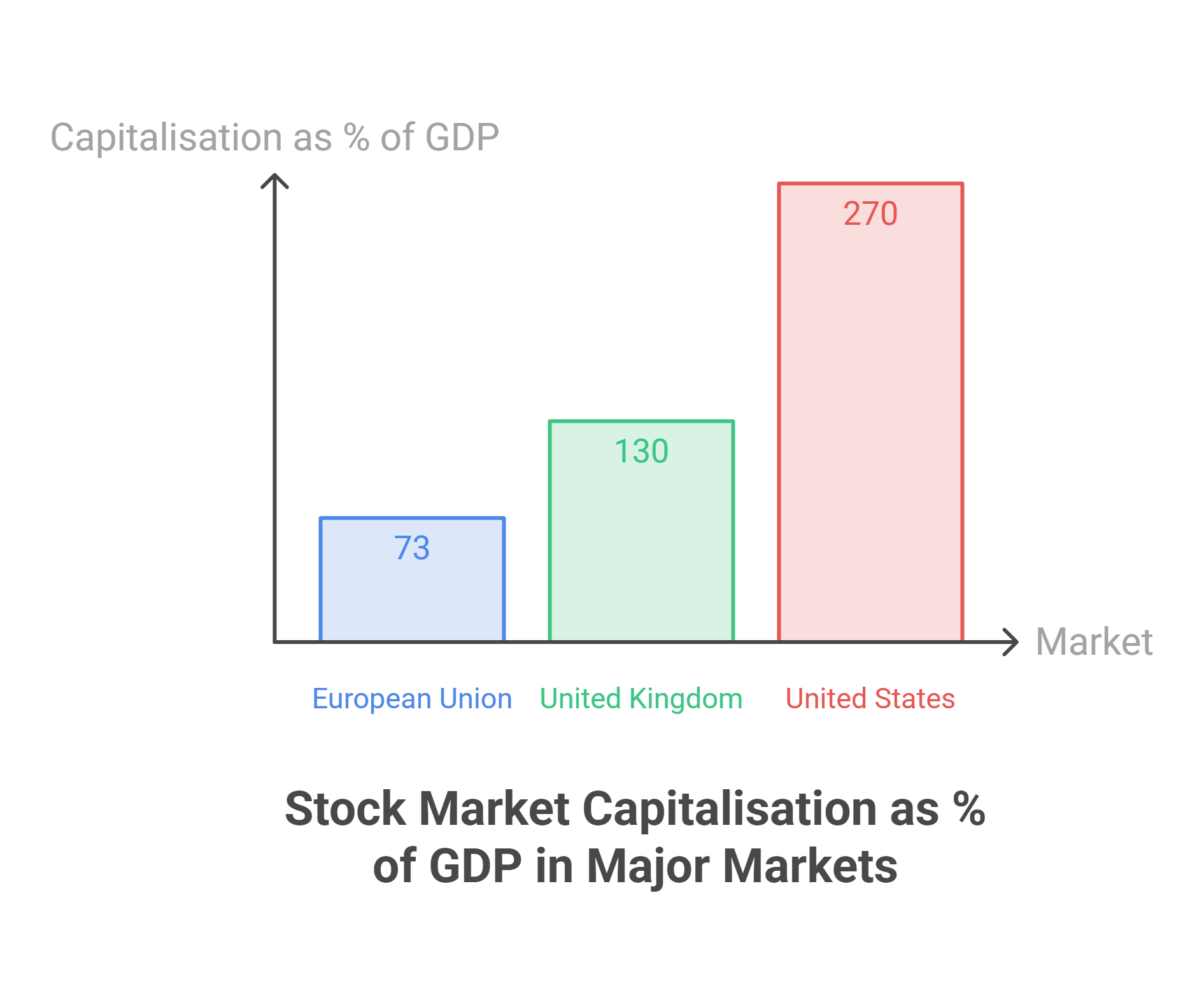
Key Takeaway: European stock markets remain smaller relative to economic output than those of the United States and United Kingdom, highlighting the broader scale and integration challenge facing European capital markets.
Infrastructure alone cannot explain that difference. Market structure, investor participation, corporate financing patterns, regulation and economic conditions also matter. But infrastructure determines how efficiently capital can move through the market once investors and issuers seek to transact across borders. That makes the quality of the underlying financial-market architecture an increasingly important part of Europe’s competitiveness discussion.
Infrastructure Integration is Becoming a Competitiveness Priority
The competitiveness question becomes more practical when looking at how European financial-market infrastructure works across borders. Europe has already created shared settlement infrastructure, but common platforms have not removed every obstacle to cross-border activity. Differences in national legal frameworks, tax requirements and market practices continue to influence how securities are issued, transferred and serviced across jurisdictions.
This creates a distinction between having common infrastructure and having a fully integrated market. A transaction can move through a shared settlement environment while still encountering different rules and operational processes depending on the markets involved. The European Central Bank has identified these remaining differences as important barriers to deeper integration, particularly in securities settlement and asset servicing.
The limited use of cross-CSD settlement provides a useful measure of that gap. Data from the European settlement infrastructure shows that in 2025, 95.7% of settlement volume and 96.0% of settlement value remained within the same CSD, while cross-CSD settlement accounted for only 3.5% of volume and 4.0% of value.
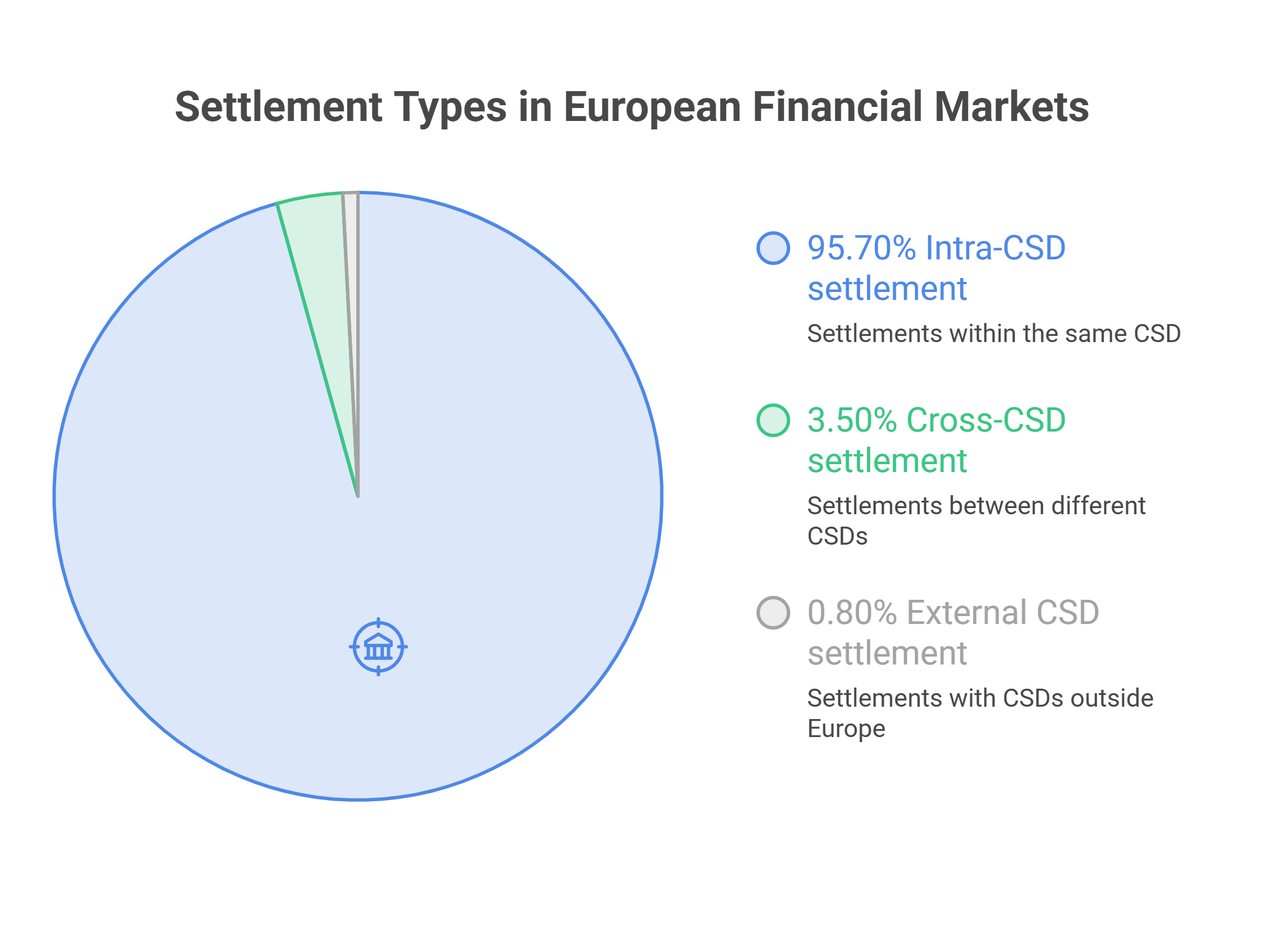
Key Takeaway: Shared European settlement infrastructure has improved integration, but the small share of cross-CSD activity indicates that significant settlement activity still remains concentrated within individual CSD structures.
That matters because deeper integration depends not only on the existence of shared systems, but also on whether market participants can use those systems efficiently across borders. The European Central Bank has noted that cross-CSD transactions remain limited and that behavioural, legal and business barriers continue to restrict wider integration.
Policy efforts are increasingly aimed at addressing those frictions. The European Commission’s Savings and Investments Union agenda includes measures intended to improve cross-border access, strengthen connections between settlement systems and make it easier for market infrastructure providers to operate across the European market.
The underlying objective is broader than reducing administrative complexity. More integrated infrastructure can make it easier for capital to move between investors and issuers, potentially improving market depth and reducing some of the friction associated with cross-border activity. At the same time, infrastructure is only one part of the competitiveness equation. Investor behaviour, regulation, market structure, corporate financing patterns and economic conditions also influence the size and attractiveness of European markets.
The direction of policy therefore points less toward creating a single identical infrastructure across every jurisdiction and more toward reducing the friction between existing systems. Interoperability, common standards and easier cross-border access can help turn shared infrastructure into more practical market integration.
For European Capital Markets, that distinction is becoming increasingly important. Competitiveness is not determined simply by how advanced individual market infrastructures are. It also depends on how effectively those infrastructures connect with one another and allow capital to move across borders with less operational and institutional friction.
Conclusion
European Capital Markets are increasingly shaped by the infrastructure that connects trading, clearing, settlement and investment across national borders. Europe has made progress in integrating these systems, but differences in legal frameworks, tax requirements and market practices continue to create friction for cross-border activity.
The challenge is therefore not simply to build more financial infrastructure. It is to make existing infrastructure work more efficiently across markets through stronger interoperability, common standards and easier cross-border access. As Europe seeks to deepen its capital markets and mobilise more investment, the effectiveness of that underlying infrastructure will remain an important part of the competitiveness equation.