





















Insurance companies have moved past the early stage of asking whether artificial intelligence can be used in claims. The bigger question now is whether the money being spent on AI can produce measurable financial returns. That shift is changing the way insurers evaluate claims automation, fraud detection, document processing, damage assessment and decision-support tools.
The opportunity is significant because claims remain one of the largest areas of cost and operational activity for insurers. Recent global insurance research estimates that industry premiums reached about US$8.3 trillion in 2025, while profit before tax was around US$580 billion. At the same time, profit growth has lagged premium growth over the longer term, putting greater attention on productivity and operating efficiency.
This is where AI Claims ROI becomes important. An AI system that can read documents faster or classify claims more accurately is useful, but those improvements have to translate into something the business can measure. That could mean a lower cost per claim, fewer claims leaks, faster settlements, better fraud detection or more productive adjusters.
The technology is already moving into real insurance operations. Industry regulatory research shows insurers using AI and machine learning across claims handling, image analysis, fraud detection and claims adjudication. Among insurers surveyed across several major lines, adoption, planned adoption or exploration reached 88% for private passenger auto, 70% for homeowners, 92% for health and 58% for life insurance.
But high adoption does not automatically mean high returns. Recent research into generative AI in insurance suggests that many initiatives are still being tested through pilots, where proving technical feasibility is easier than demonstrating meaningful financial value at enterprise scale.
For claims leaders, that creates a different investment discipline. Instead of measuring success by the number of AI tools deployed, insurers increasingly need to understand how each use case changes the economics of the claims process.
AI Is Moving From Claims Pilots to Measurable Business Outcomes
The strongest AI applications are those connected to clear operational problems. Claims teams handle large volumes of documents, photographs, medical records, estimates and correspondence, making many parts of the process suitable for automation or decision support.
AI can help sort claims, extract information, assess images, identify unusual patterns and support adjusters with faster access to relevant information. It can also help insurers identify claims that need specialist attention while allowing simpler cases to move through more automated workflows.
The financial benefit can come from several directions at once. Faster triage can reduce handling time. Better fraud detection can reduce avoidable payouts. Automated document processing can lower administrative work. More accurate decisions can reduce leakage and rework. And when routine tasks are handled more efficiently, experienced claims professionals can spend more time on complex cases where judgement still matters.
Recent insurance AI research also shows that insurers are increasingly looking beyond isolated efficiency gains and toward changes in the wider economics of the business. The potential for AI to lower the unit cost of underwriting, servicing and claims is becoming part of the broader discussion around insurance operating leverage.
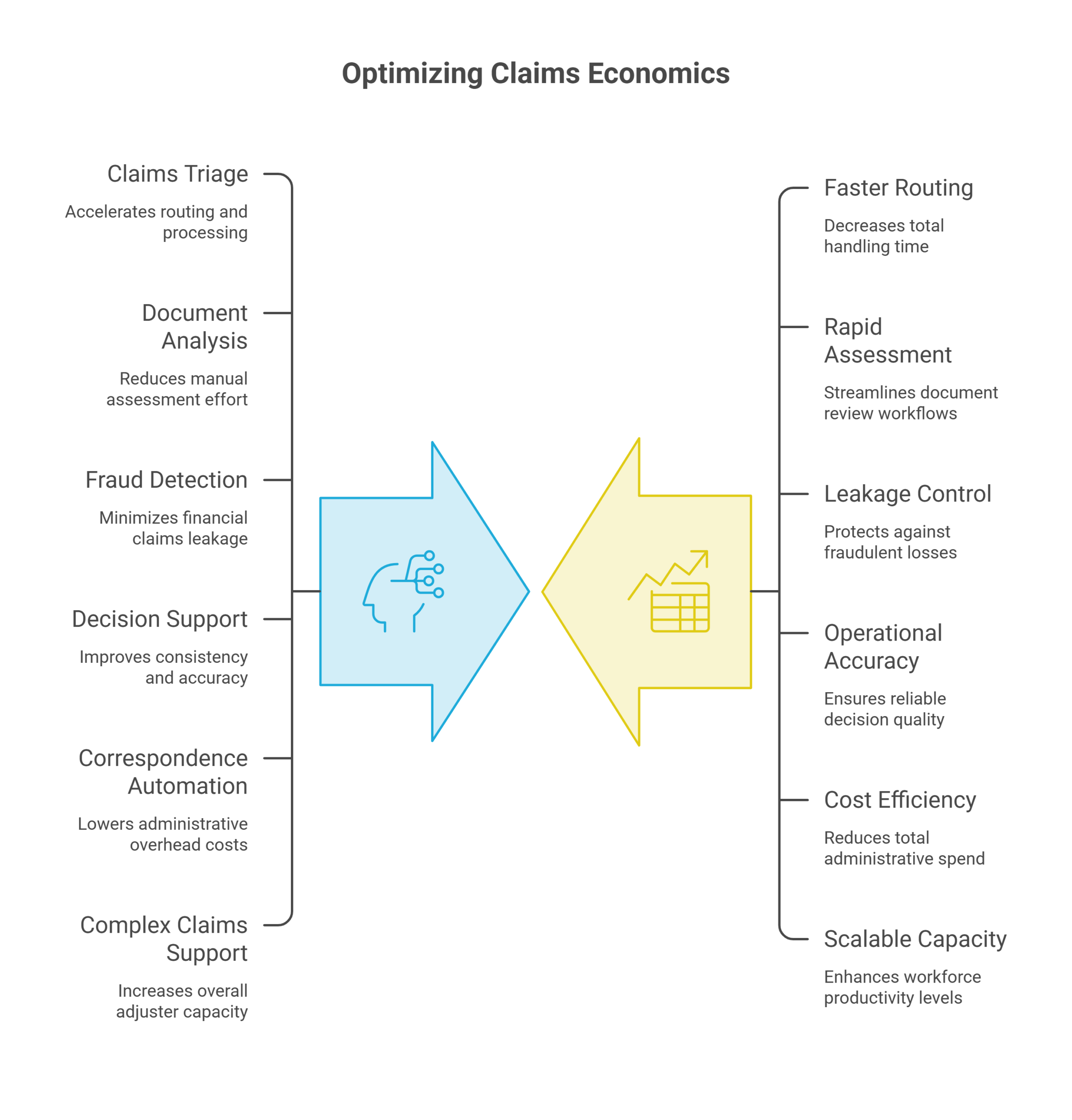
Key takeaway: AI creates stronger business value when insurers connect individual claims use cases to measurable financial and operational outcomes.
The important shift is therefore simple, insurers are no longer just asking what AI can do. They are asking what it can change in the economics of claims.
From AI Adoption to Measurable Claims Performance
The insurance industry is moving into a more disciplined phase of AI adoption. The question is no longer whether insurers can use AI in claims, but whether those deployments can improve the economics of the claims operation. Recent market research shows that insurers are increasingly placing AI inside core functions such as claims and underwriting, while measurable financial returns are still limited across much of the market.
That gap matters because claims is where relatively small improvements can translate into large financial effects. Reducing the cost of handling a claim, identifying fraud earlier or improving settlement accuracy can affect loss costs and operating expenses across a large portfolio. Recent insurance research also points to a broader opportunity to improve operating leverage, as global insurance premiums have grown faster than profits over the longer term.
The strongest AI Claims ROI cases are therefore likely to come from clearly defined business problems rather than broad technology programmes. Claims triage is one example. AI can sort incoming claims by complexity, identify cases that need specialist attention and route simpler cases through faster workflows. Similar opportunities exist in document processing, damage assessment and claims correspondence.
Fraud detection is another area where the financial link can be more direct. Better models can help identify unusual patterns before an unnecessary payment is made, while reducing the amount of manual investigation required. Regulatory research also shows that insurers are already using AI for claims settlement amounts, document summarisation, damage assessment and fraud detection. Across surveyed insurers, adoption, planned adoption or exploration of AI reached 88% in auto insurance and 70% in homeowners insurance.
But adoption figures do not tell insurers whether the investment is paying off. Recent research found that 42% of insurers do not track AI metrics, while 60% remain in exploration or proof-of-concept stages. That makes it difficult to compare the cost of an AI programme with the value it creates.
For a claims organisation, the useful measures are much more practical: cost per claim, claims leakage, cycle time, settlement accuracy, fraud savings, adjuster productivity and customer complaints. These measures can show whether an AI system is improving the entire claims process or simply automating one task.
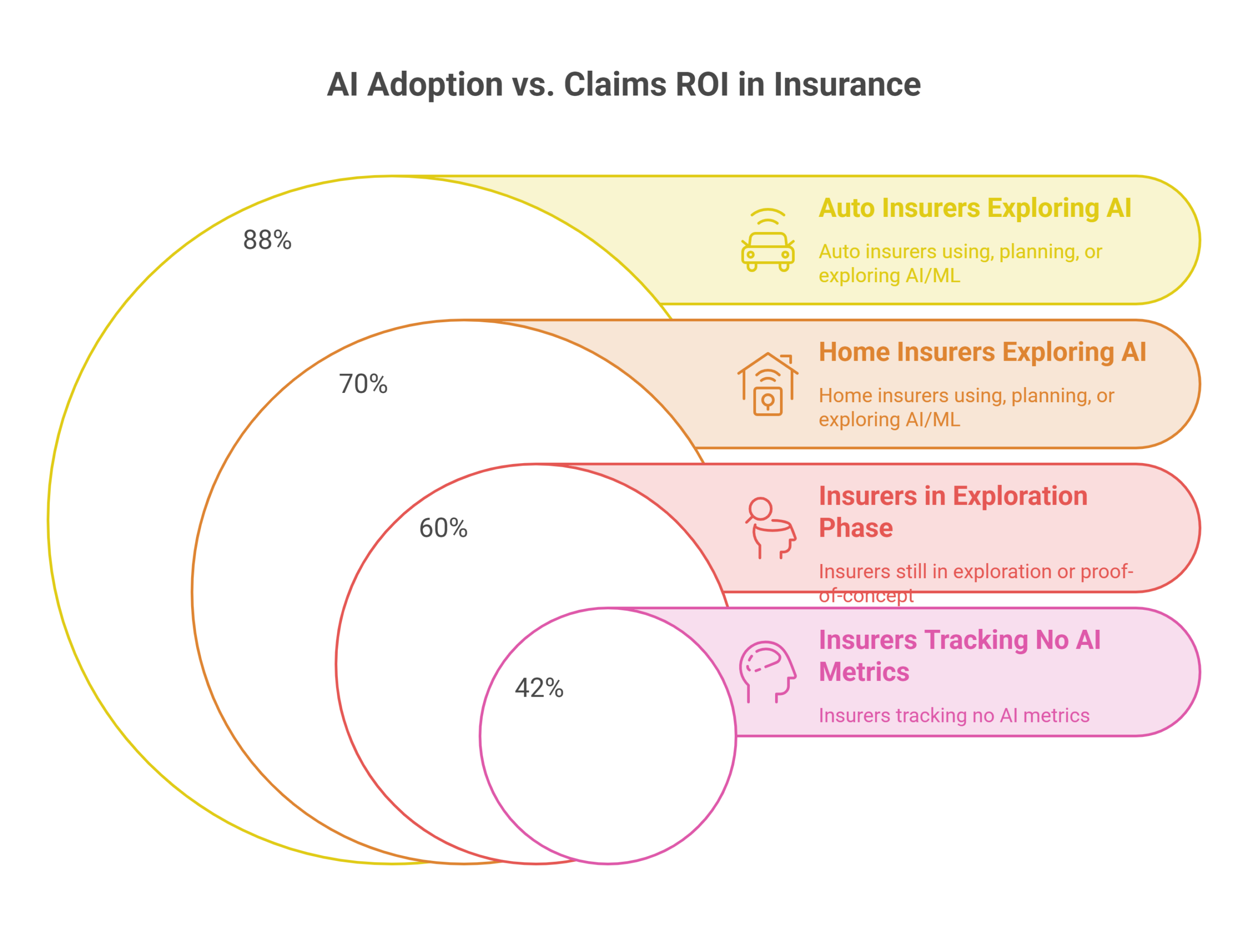
Key takeaway: AI adoption is advancing faster than the industry’s ability to consistently measure and prove claims-level financial returns.
The next challenge for insurers is therefore less about adding more AI tools and more about building the measurement, data and governance needed to prove which ones actually improve AI Claims ROI.
Conclusion
The insurance industry is moving from experimenting with AI to proving what it can deliver. In claims, that means looking beyond how quickly a system can process documents or identify patterns and focusing on whether it can reduce the cost per claim, leakage, fraud losses and handling time while improving accuracy and customer outcomes.
The growing use of AI across claims shows that the technology is becoming part of everyday insurance operations. But adoption alone does not create value. Insurers still need reliable data, clear performance measures, strong governance and workflows that combine automation with human judgement.
That makes AI Claims ROI less about the technology itself and more about the business results behind it. The insurers that can connect AI investment to measurable improvements in claims performance will be better placed to scale it across the organisation.