Liability insurance is becoming harder to price as the cost of claims rises for reasons that go beyond ordinary economic inflation. Larger jury awards, changing attitudes toward corporate responsibility, broader litigation activity and growing legal costs are all adding pressure to the final cost of liability claims. Together, these forces are often described as social inflation, and they are becoming an increasingly important issue for insurers, businesses and the wider insurance market.
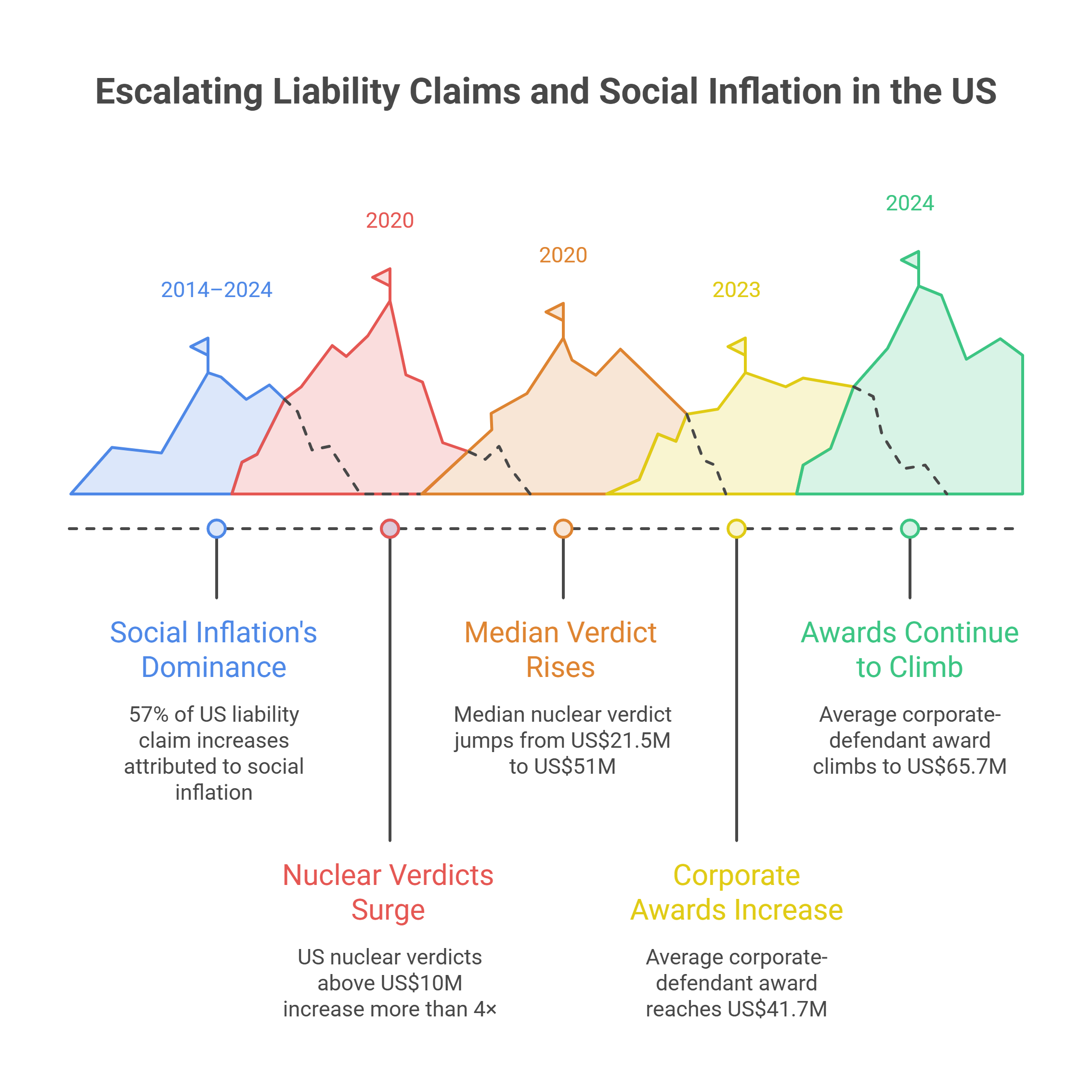
The change is most visible in the United States, where the number of so-called nuclear verdicts, generally awards above US$10 million, has more than quadrupled since 2020. Over the same period, the median value of those verdicts rose from US$21.5 million to US$51 million. In 2024, the average award in cases involving a corporate defendant reached US$65.7 million, compared with US$41.7 million a year earlier.
The financial impact is already reaching beyond individual claims. Recent industry analysis found that US insurers added US$16 billion to prior-year liability loss estimates during 2024 reviews. Across 2015 to 2024, commercial liability lines recorded US$62 billion in adverse reserve development, excluding medical professional liability.
This is why the verdict economy is becoming more than a courtroom issue. When claims become larger and harder to predict, insurers have to rethink the assumptions behind pricing, reserves, underwriting appetite and the amount of risk they are willing to take on.
Social Inflation Is Changing the Cost of Liability Claims
Economic inflation is relatively easy to understand. Medical treatment, wages, repairs and other costs rise, making claims more expensive. Social inflation is different because it describes liability claims costs rising beyond what can be explained by those economic factors alone. The drivers can include changes in attitudes toward corporate responsibility, litigation behaviour, jury decisions, legal marketing and the growing use of large monetary awards.
Recent research estimates that these social inflation factors accounted for 57% of the increase in US liability claims over the decade to 2024. In 2023 alone, social inflation contributed around seven percentage points to liability claims growth, making it a significant source of pressure alongside ordinary economic inflation.
The issue is not confined to one market. Research has identified social inflation pressures in the UK, Australia and Canada as well, although the scale differs significantly between jurisdictions. Legal systems, court structures, rules around collective actions and approaches to compensation all shape how quickly claims costs can rise. The US remains the most exposed market, while other common-law jurisdictions are also showing signs of growing pressure.
That difference matters for global insurers. A multinational business may operate across several legal systems, while an insurer may manage liability portfolios that include risks with exposure to US litigation. Rising claims severity in one jurisdiction can therefore affect the broader cost of international insurance programmes and the amount of capacity available for certain risks.
The financial consequences become clearer when these trends are viewed across an entire liability portfolio rather than through individual lawsuits. A single large verdict can affect one insurer, but sustained changes in claims severity can alter the assumptions used to price thousands of policies. That is where the verdict economy starts to influence the wider insurance business.
Rising Verdicts Are Changing Reserves and Underwriting Decisions
The financial pressure becomes clearer when liability claims are viewed across an insurer’s entire portfolio. A single large verdict can create a major loss, but a sustained rise in claim severity can affect the assumptions used to price policies, calculate reserves and determine how much risk an insurer is prepared to take.
That is already showing up in reserve development. US insurers added around US$16 billion to prior-year liability loss estimates during their 2024 reserve reviews. Across 2015 to 2024, commercial liability lines recorded about US$62 billion in adverse reserve development, excluding medical professional liability.
For insurers, this creates a difficult timing problem. Liability claims can take years to settle, so today’s premium has to account for costs that may not become clear until much later. If legal awards, settlement behaviour and defence costs move faster than expected, historical claims data can become a weaker guide to future liabilities.
The impact can then spread into pricing and underwriting. WTW’s 2026 casualty market analysis found general liability rates rising by an average of 4.4%, while auto liability rates increased 14.9%. Lead umbrella and excess liability lines saw average increases above 12%, with more than a quarter of lead umbrella programmes being restructured because of capacity constraints.
This does not mean every liability account is becoming more expensive. Market conditions differ by line, geography and risk quality. International liability markets, for example, have continued to see additional capacity and more competitive conditions in some regions, even while concerns about social inflation and reserve adequacy remain.
The more important shift is that insurers are becoming more selective about where they deploy capacity and how they assess high-severity exposures. A company with significant US liability exposure can present a different risk from a similar business operating in a jurisdiction with a different legal system and claims environment.
That makes the verdict economy a portfolio-management issue. Insurers need to understand not only the probability of a claim, but also how the legal environment could influence the size and timing of the eventual settlement.
Litigation Trends Are Creating a More Complex Global Liability Market
The forces behind rising liability costs are not limited to jury awards. Legal advertising, plaintiff strategies, collective actions, litigation funding and changing approaches to corporate liability can all influence how claims move through the system. The NAIC identifies several of these factors as contributors to social inflation, while recent academic research notes that the phenomenon is difficult to measure because it combines several legal and social forces rather than one single cause.
Third-party litigation funding is one example. The model allows outside investors to provide capital for lawsuits in return for a share of the proceeds. Industry estimates put the US litigation-funding market at around US$15.2 billion, while the broader global market has also attracted increasing institutional interest.
The important point for insurers is not that litigation funding automatically produces a larger verdict. The relationship is more complicated. More available capital can allow some cases to continue for longer, potentially increasing legal expenses and changing settlement dynamics. Research continues to examine how much of the rise in claims severity can actually be attributed to litigation funding compared with other drivers of social inflation.
The global picture is equally uneven. The strongest social-inflation effects remain concentrated in the US, where jury awards and the liability system create greater exposure to extreme verdicts. Other common-law markets can experience similar pressures, while countries with different court structures and compensation systems may see a very different claims environment. WTW’s global liability research also notes that US claims can influence international insurance programmes when multinational businesses carry significant US exposures.
This creates a more complicated market for multinational insurers and businesses. The same liability policy may sit within a global programme, but the underlying risk can behave very differently from one jurisdiction to another. Pricing, limits, retentions and excess layers therefore have to reflect more than the historical loss record of the insured.
The verdict economy is ultimately changing how insurers think about risk transfer. Larger and less predictable liabilities can increase the amount of capital needed to support coverage, make some risks harder to price and encourage businesses to explore alternatives such as higher retentions, captives and structured risk-transfer solutions. WTW notes increasing use of these alternatives as insureds respond to capacity constraints and changing liability conditions.
The result is not a uniform hardening of the global liability market. It is a market becoming more differentiated, where the quality of the risk, its legal exposure and the ability to model its long-term claims costs matter more than ever.
Conclusion
The verdict economy is changing liability insurance in ways that extend well beyond individual courtroom awards. Rising claims severity is putting pressure on reserves, pricing and underwriting decisions, while insurers are becoming more selective about the risks and limits they are willing to support. WTW’s 2026 casualty outlook shows this clearly, with increases across general liability, auto liability and umbrella and excess coverage, alongside tighter capacity for more challenging risks.
The challenge is not that every liability market is moving in the same direction. It is that insurers have less certainty about how legal, social and economic factors will influence claims over the long life of a liability policy. Social inflation is difficult to measure and forecast, and its impact can be particularly significant in long-tail lines where today’s underwriting decisions may take years to fully develop.
That is making claims intelligence increasingly important to the wider insurance business. Better understanding of litigation patterns, verdict severity, jurisdictional differences and emerging legal exposures can help insurers improve pricing, reserving and risk selection before those pressures show up fully in financial results.
For insurers and businesses alike, the verdict economy is therefore becoming a question of preparation rather than simply reacting to the next large award. The companies that can better understand how liability risks are changing will be in a stronger position to price coverage, manage capital and maintain sustainable risk transfer as the global claims environment evolves.