

















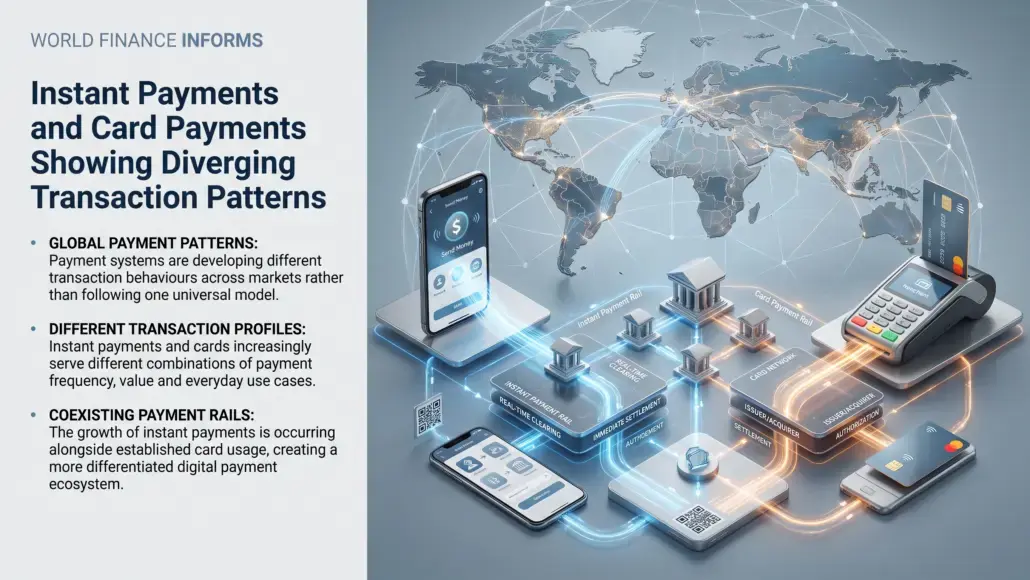

Across the global payments landscape, instant payments and card payments are increasingly developing through different transaction patterns rather than following a single path of substitution. For World Finance Informs, the distinction is becoming more relevant as digital payment use expands across both advanced and emerging economies. The BIS Committee on Payments and Market Infrastructures reported in 2026 that cashless payments continued to increase globally, but the main drivers differed by market group. Card payments were the principal source of growth in advanced economies, while credit transfers were the fastest-growing cashless payment method in emerging market and developing economies, with fast payments contributing significantly to that expansion.
Fast Payments Increasing Frequency While Cards Retain Established Roles
The divergence becomes clearer when transaction frequency is considered alongside the underlying payment method. BIS data show that fast payments are increasingly being used for small-value transactions in both advanced and emerging economies, giving these systems a growing role in frequent retail and account-to-account payments. In emerging and developing economies, fast payments accounted for a substantially larger share of cashless transaction volume than in advanced economies, reflecting differences in payment infrastructure, adoption and use cases.
At the same time, instant payments and card payments can continue expanding within the same market because they serve different transaction needs. Cards remain deeply embedded in retail payment activity across mature digital markets, while instant-payment systems can capture payments where immediate account-to-account settlement, mobile interfaces or continuous availability are more relevant. ECB data illustrate this coexistence: cards accounted for 57% of euro-area non-cash payment transactions in the second half of 2025, even as instant credit transfers continued to increase within the broader credit-transfer category.
This also highlights why transaction volume cannot be viewed independently from transaction value. A payment system may process a very large number of relatively small transactions without carrying the majority of the financial value moving through an economy. As instant payments and card payments continue developing across different use cases, the global payment ecosystem is therefore becoming more differentiated by transaction frequency, value and purpose rather than converging on a single dominant payment model.
Transaction Volume and Value Revealing Different Payment Profiles
The divergence between instant payments and card payments becomes clearer when transaction volume is examined alongside transaction value. BIS data show that fast payments are increasingly used for small-value transactions across both advanced economies and emerging market and developing economies, while cards continue to account for a large proportion of frequent retail payments in advanced economies. The underlying difference is therefore not simply how many transactions each rail processes, but the types and values of payments flowing through them. A growing number of instant payments can reflect frequent, lower-value transactions without corresponding to an equivalent share of overall payment value.
The euro area provides evidence of this separation between frequency and financial value. In the second half of 2025, card payments accounted for 57% of non-cash transactions, while credit transfers accounted for 21%. Yet credit transfers represented 92% of the total value of non-cash payments because higher-value payments are generally conducted through that channel. This demonstrates why instant payments and card payments should be assessed through both transaction frequency and value rather than through volume alone.
Global Payment Activity Showing Increasingly Different Transaction Characteristics
The contrast also reflects different payment behaviours across markets. BIS research shows that cards remain the main driver of cashless-payment growth in advanced economies, while credit transfers, supported increasingly by fast-payment systems, are growing more rapidly in emerging and developing economies. At the same time, consumer behaviour can remain relatively stable even as new payment infrastructure expands. The Federal Reserve’s latest U.S. consumer-payment research found that credit and debit cards together continued to account for two-thirds of consumer payments in 2025, illustrating the persistence of established card usage within a changing digital ecosystem.
instant payments and card payments are therefore developing alongside one another through different combinations of frequency, value and use case. For the wider shift toward continuous digital settlement, this distinction connects with the growing macro-level role of fast payment systems.
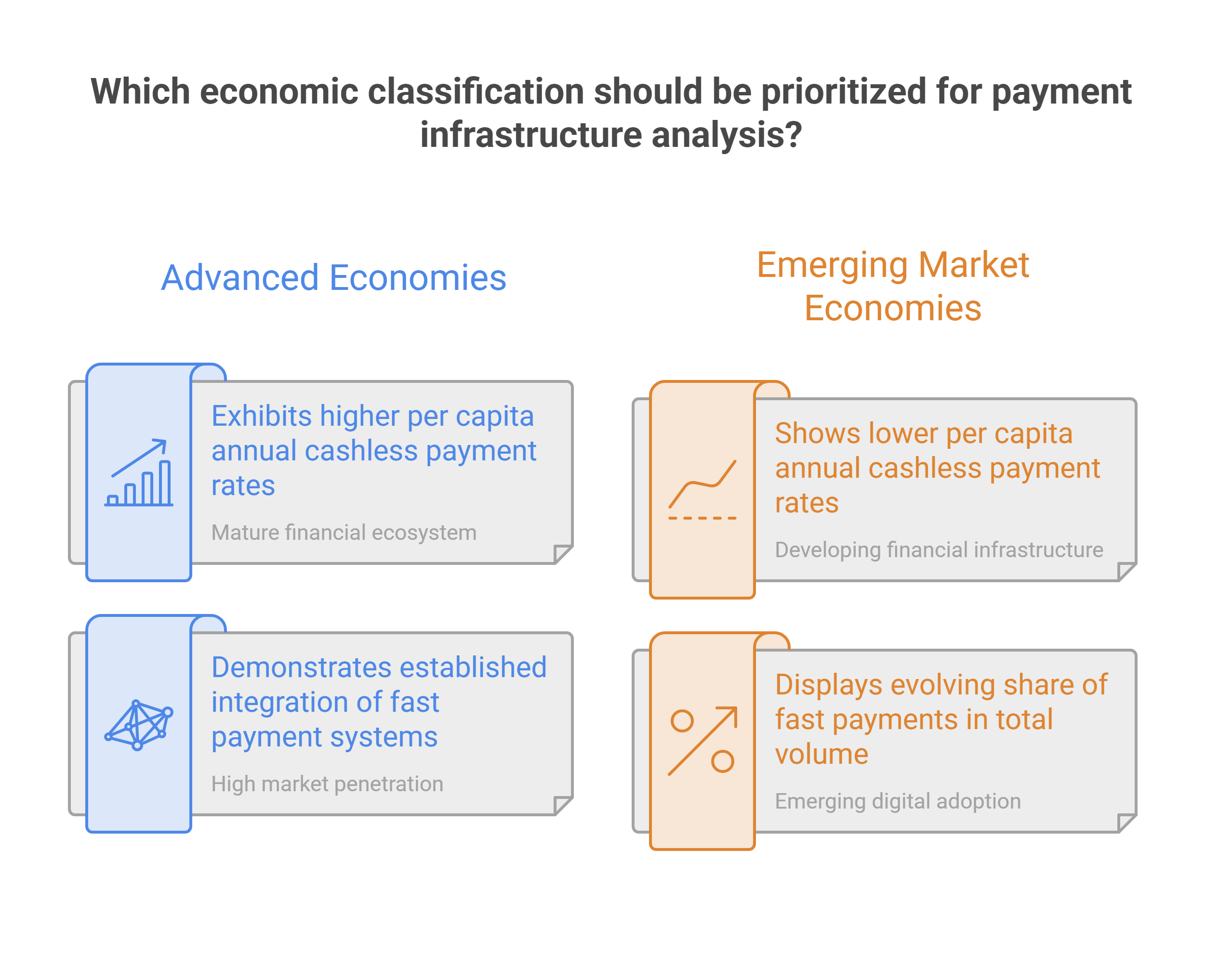
Key Takeaway: Payment systems are developing different transaction profiles globally, with card use remaining prominent in advanced economies while fast payments account for a larger share of transaction activity in emerging and developing economies.

