

















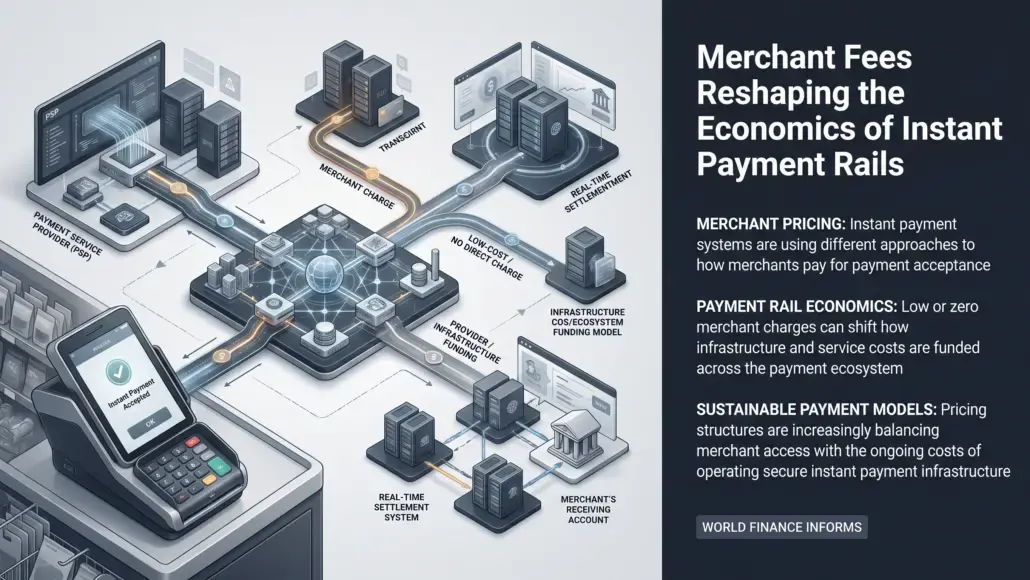

Instant payment systems have often been built around rapid settlement and low-cost access, but the economics of supporting these rails are bringing merchant pricing into sharper focus. For World Finance Informs, merchant fees provide a useful lens for examining how payment providers can balance affordable acceptance with the costs of operating secure, scalable payment infrastructure. The issue is how the cost of the service is distributed across the payment ecosystem.
Pricing can differ between the payment rail, participating financial institutions and the merchant-facing service. A rail may charge participating institutions while a payment service provider separately prices the merchant service. In other models, merchants may face no direct charge because operating costs are supported through subsidies, participant fees or other revenue streams. This makes merchant fees part of a wider economic model rather than a standalone transaction cost.
Pricing Models Balancing Merchant Access and Rail Sustainability
Global fast-payment systems use zero-fee arrangements, regulated charges and selective pricing for particular transactions. Research from the Bank for International Settlements shows that pricing decisions can influence adoption incentives and the financial sustainability of fast-payment systems. Where transaction charges are kept very low, providers may need other revenue sources or financial support to fund infrastructure, security and ongoing development.
The issue is therefore less about whether instant payments should be free and more about how pricing affects the wider ecosystem. A fee that supports merchant acceptance still needs to fit within a sustainable operating model. The relationship between these factors also provides a natural bridge to transaction patterns across instant and card payments.
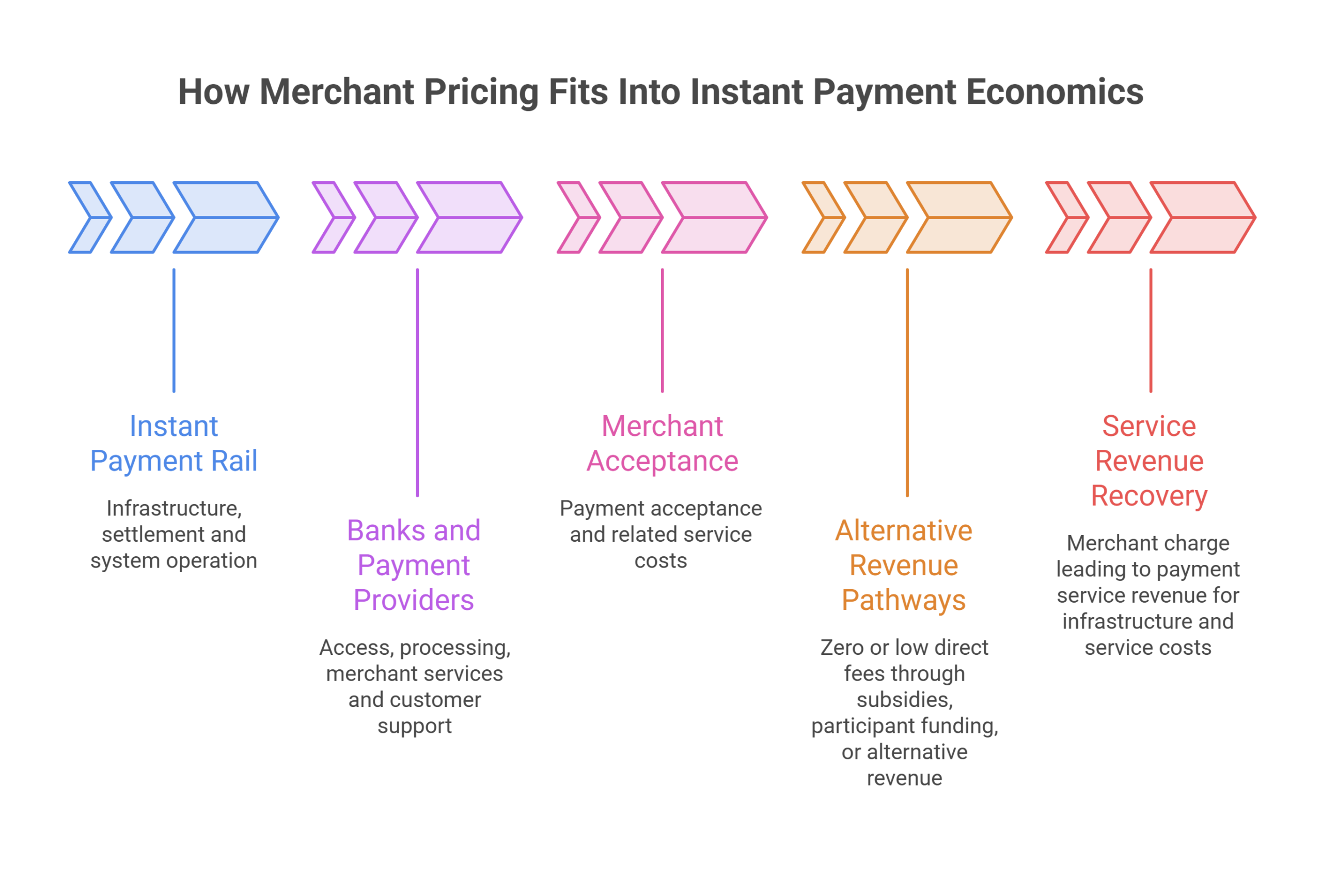
Key Takeaway: Merchant pricing is one part of a wider fast-payment economic model connecting merchant affordability, provider incentives and the costs of operating the payment rail.
Merchant Pricing Models Creating Different Economic Trade-Offs
The economics of instant-payment rails differ significantly depending on how costs are distributed among merchants, payment service providers and other participants. merchant fees can be set at zero, structured as a percentage of transaction value, capped at a defined amount, or applied only to specific transaction categories. These approaches can influence how attractive instant payments are for merchants while also affecting the revenue available to providers supporting the payment service.
Zero-fee models can encourage merchant acceptance, but they do not remove the underlying cost of operating the payment ecosystem. Infrastructure, connectivity, fraud controls, cybersecurity, compliance and system development still require funding. Research from the Bank for International Settlements notes that where fast-payment transactions are offered without direct fees, alternative revenue sources or external support may be required to maintain financial sustainability. This makes the structure of merchant fees relevant not only to merchants but also to the longer-term economics of the payment rail.
Merchant Charges Interacting with Payment Service Economics
The relationship between merchant fees and payment-system costs also depends on where the charge is applied. A fee imposed at the rail level may be paid by participating financial institutions rather than directly by merchants, while merchant-facing providers can add their own charges for processing, integration or related services. As a result, the headline price of an instant-payment transaction does not necessarily represent the total cost of acceptance for a business.
Recent pricing developments illustrate how different models are emerging. Some fast-payment systems continue to support free or very low-cost merchant transactions, while others are introducing selective charges for particular categories. The underlying economic question is whether pricing can maintain merchant access while giving payment providers sufficient incentives to invest in secure, resilient infrastructure and additional services.
For merchants, the calculation can also extend beyond the transaction fee itself. Faster settlement may affect the timing of funds availability, while digital reconciliation and payment processing can influence operating costs. The economics therefore depend on how the instant-payment service combines its direct price with the wider value and costs associated with accepting the rail.
Merchant Pricing Becoming Part of Long-Term Instant Payment Economics
The economics of instant-payment rails increasingly depend on how costs are distributed across merchants, payment providers and other participants. merchant fees can influence acceptance decisions, while the absence of direct charges can shift funding requirements toward subsidies, participant fees or alternative revenue streams.
The broader issue is finding pricing structures that support accessible payment acceptance without weakening the financial sustainability of the underlying service. As instant payments expand, providers also need to account for infrastructure, security, fraud management, system resilience and ongoing development.
For merchants, the cost calculation extends beyond the headline transaction fee and can include settlement, processing and operational considerations. This makes pricing an important part of how instant-payment systems develop commercially, while different markets continue to use different models according to their regulatory and business structures.
For World Finance Informs, the development highlights how the economics of payment acceptance are becoming an increasingly important part of the wider real-time payments landscape.

