




















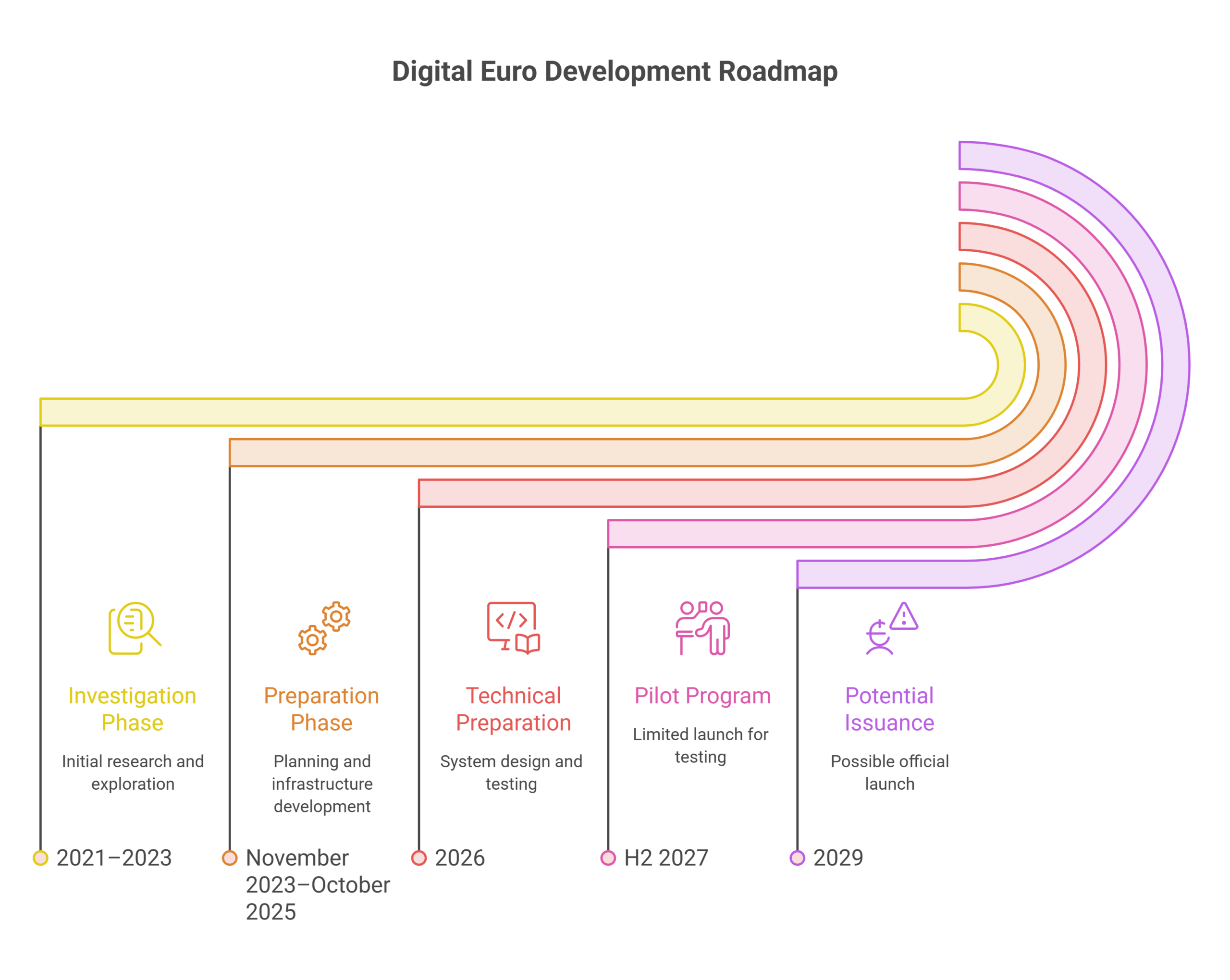
The digital euro is moving from a central-bank research project toward a more defined phase of technical preparation, market participation and regulatory development. The Eurosystem completed its initial investigation phase in 2023 and moved into a preparation phase later that year. The current stage is focused on building the infrastructure, testing the proposed functionality and preparing the payment ecosystem for a potential launch, subject to the adoption of the necessary legislation.
This is giving digital euro payment infrastructure a more concrete role in the evolution of European digital payments. The project is no longer centred only on whether a central bank digital currency could work technically. It is increasingly concerned with how a digital form of central-bank money could operate alongside commercial banks, payment service providers and existing payment systems.
The Digital Euro is Moving from Design Toward Implementation
The current roadmap provides a clearer indication of how the project could develop. The ECB plans a 12-month pilot in the second half of 2027, allowing selected payment service providers, merchants and Eurosystem staff to test the digital euro in practical payment scenarios. The ECB currently aims to be ready for a potential first issuance in 2029, provided the required legislation is adopted. These milestones remain conditional rather than representing a confirmed launch date.
The development is therefore moving beyond technical theory. A pilot can test how the proposed system performs in everyday situations, including person-to-person and in-store payments, while also providing information about the operational requirements of participating payment providers.
For digital euro payment infrastructure, this stage is important because implementation depends on more than the central bank’s own technology. Distribution, authentication, merchant integration and user access all require participation from the wider financial ecosystem.
Private-Sector Participation is Expanding
The growing involvement of payment service providers provides another indication of this transition. The ECB received more than 50 applications from PSPs seeking to participate in the pilot and selected 36 providers in July 2026. The selected institutions represent different types of payment providers and markets across the euro area.
This model places commercial financial institutions between the Eurosystem’s underlying infrastructure and many end users. It also means the practical development of the digital euro will depend on how effectively central-bank infrastructure can connect with existing banking and payment environments.
The approach is significant beyond the euro area because it offers another model for introducing central-bank money into an increasingly digital payment ecosystem. Rather than creating a completely separate consumer environment, the proposed system is being developed with existing financial intermediaries and payment services in mind.
Digital euro payment infrastructure is therefore emerging as a broader ecosystem proposition involving central-bank settlement, private-sector distribution and merchant acceptance.
Key Takeaway: The digital euro is progressing from research toward practical ecosystem testing, with payment providers increasingly involved in preparing the infrastructure required for potential deployment.
The significance of the project is therefore shifting from whether digital central-bank money is technically possible toward how it could function within an established payment ecosystem. Digital euro payment infrastructure is becoming a practical development programme involving technology, regulation and private-sector participation rather than a purely conceptual CBDC initiative.
Digital Euro Design is Adding New Payment Infrastructure
The development of the digital euro is also raising a broader question about how central-bank money can fit into an increasingly digital payment ecosystem. Unlike conventional account-based payments, which depend on commercial-bank deposits, the proposed digital euro would represent a digital form of central-bank money distributed through payment service providers. Its role would therefore be different from simply creating another instant-payment option.
This makes digital euro payment infrastructure relevant to the wider structure of digital finance. The proposed model is designed to operate alongside existing payment instruments rather than replace every current payment method. The ECB has also stated that the digital euro would use a centralised settlement platform, while incorporating design principles intended to support resilience and efficiency.
Public Digital Money is Entering a Private Payment Ecosystem
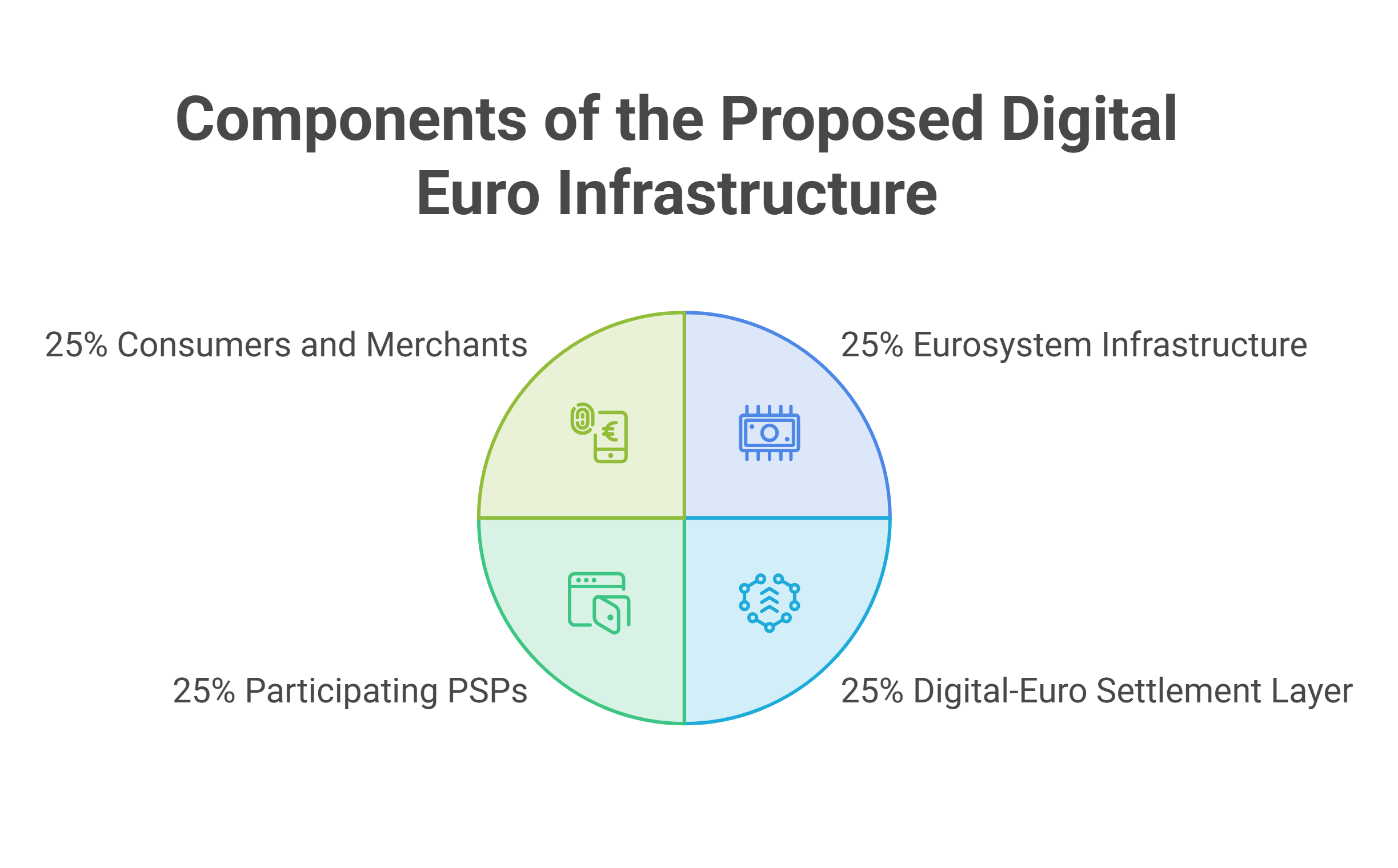
The digital euro is being designed around cooperation between the Eurosystem and private payment providers. Banks and other participating PSPs would provide digital-euro services to end users, while the underlying settlement infrastructure would remain part of the Eurosystem framework. This creates a model in which central-bank money can be used through familiar banking and payment relationships rather than through an entirely separate consumer ecosystem.
That distinction matters because digital payments are already highly developed across the euro area. Consumers can use cards, bank transfers, instant payments and other digital payment services, while merchants already operate through established acquiring and acceptance infrastructure. The potential role of the digital euro is therefore not simply to digitise payments, but to introduce another form of money into an existing digital environment.
For digital euro payment infrastructure, interoperability will consequently be important. The system needs to connect effectively with banks, payment providers and merchant environments while preserving clear distinctions between central-bank money and commercial-bank deposits.
Privacy and Offline Functionality are Shaping the Design
Privacy is another major design consideration. The ECB has said that the proposed digital euro architecture is intended to minimise the personal transaction data available to the Eurosystem, while offline functionality is designed to provide a higher degree of privacy for certain payments. These features are being developed as part of the system design rather than as characteristics of an already deployed payment network.
Offline payments also introduce a different resilience model. A digital payment that can function with limited connectivity could be useful in situations where network access is temporarily unavailable. This could expand the range of environments in which digital central-bank money can operate while reducing dependence on continuous online connectivity.
The design also includes measures intended to limit potential disruption to the banking system. Proposed holding limits and mechanisms such as a reverse waterfall are intended to reduce the risk of large-scale movement of deposits into digital euros. These safeguards reflect the fact that introducing central-bank money into retail digital payments can have implications beyond payment convenience.
Digital Euro Design is Balancing New Capability With Existing Infrastructure
The resulting architecture is therefore being shaped around several objectives at once: providing a public form of digital money, maintaining privacy, supporting online and offline payments, integrating private-sector distribution and limiting potential effects on bank funding.
This makes the digital euro different from a standalone payment application. Digital euro payment infrastructure is being designed as a layer that could sit alongside existing banking and payment systems while giving users another way to hold and transfer digital central-bank money.
Key Takeaway: The digital euro is being designed as an additional public-money layer within an existing private payment ecosystem, with privacy, resilience and banking-system safeguards built into the proposed architecture.
The broader significance is therefore architectural rather than simply transactional. Digital euro payment infrastructure could introduce central-bank money into everyday digital payments while remaining connected to the banks, PSPs and merchant systems that already support the European payment ecosystem.
Digital Euro Development is Becoming a Broader Banking Infrastructure Question
The digital euro is developing as more than a new consumer payment instrument. Its proposed architecture brings central-bank money into an ecosystem already shaped by commercial-bank deposits, instant payments, cards and other digital payment services. The challenge is therefore to create a system that adds new functionality without disrupting the infrastructure and intermediaries that already support everyday payments.
This makes digital euro payment infrastructure increasingly relevant to questions around interoperability, privacy, resilience and the role of payment service providers. Its eventual impact will depend not only on the technology itself, but also on how effectively it integrates with existing financial infrastructure and how consumers, merchants and banks use it.
As development moves toward the planned pilot, digital euro payment infrastructure is becoming a practical test of how central-bank money can participate in a highly digital payment ecosystem. The longer-term significance will depend on the final regulatory framework, market adoption and the ability of the system to coexist with existing payment networks.

