




















Tokenisation is moving beyond experimentation with digital assets toward more practical applications in financial-market infrastructure. Financial institutions and central banks are testing whether commercial bank deposits and central bank money can be represented digitally on programmable platforms, allowing payment instructions, compliance processes and settlement to operate more closely together.
This is giving tokenised payment infrastructure a more significant role in discussions about the future of payments. The objective is not simply to create digital representations of existing money, but to examine whether programmable infrastructure can reduce the delays, reconciliation requirements and multiple hand-offs that remain embedded in parts of today’s financial system.
Tokenisation is Moving from Concept Toward Financial Testing
Cross-border payments provide one of the clearest areas for this experimentation. Conventional correspondent banking can involve multiple institutions, operating windows and sequential processes before funds reach their destination. Tokenised infrastructure could potentially bring payment instructions, required checks and settlement onto a more coordinated platform.
BIS Project Agorá provides one of the most substantial institutional tests of this model. The project brings together central banks and more than 40 regulated financial institutions to examine a shared programmable platform for wholesale cross-border payments. Its prototype combines tokenised commercial bank deposits with tokenised central bank reserves and is designed to support atomic, multi-currency settlement.
The significance of this work lies in the involvement of established financial institutions rather than purely digital-asset companies. The project is examining how tokenisation could operate within a financial system that retains central-bank money and commercial bank deposits at its core.
For tokenised payment infrastructure, this represents a shift from asking whether financial assets can be represented digitally toward examining whether tokenisation can improve the way regulated payments are actually processed and settled.
Programmability is Expanding What Payments Can Do
A major distinction between tokenised infrastructure and conventional payment processing is programmability. Smart-contract functionality can allow financial institutions to embed conditions, workflow rules and compliance requirements directly into transaction processes.
That could support payment structures in which funds are released only when predefined conditions are met, or where settlement and related contractual steps occur together. BIS describes potential applications including conditional and always-on wholesale cross-border payments, while highlighting the possibility of reducing manual intervention and reconciliation.
This does not mean tokenisation will automatically replace existing payment networks. The more immediate development is experimentation with infrastructure that could make certain financial processes more integrated and automated.
Financial Institutions are Testing Tokenised Settlement in Practice
The movement toward real-world testing became more concrete in July 2026, when Project Agorá conducted controlled real-value transactions. Twenty-eight financial institutions and central banks across Asia, Europe and North America participated, completing transactions across 17 scenarios with a combined value of approximately CHF 800,000. The testing covered corporate and interbank cross-border payments, payment-versus-payment transactions and intragroup transfers.
The prototype also demonstrated that transactions could interact with existing RTGS and core-banking environments using established ISO 20022 payment and reporting standards. During the testing, the average time from payment initiation to settlement was approximately 80 seconds, although the platform was operating in a controlled environment and was not fully integrated with existing RTGS and core-banking systems.
The results provide evidence that tokenised payment infrastructure can be tested alongside established financial architecture rather than requiring a complete replacement of existing systems.
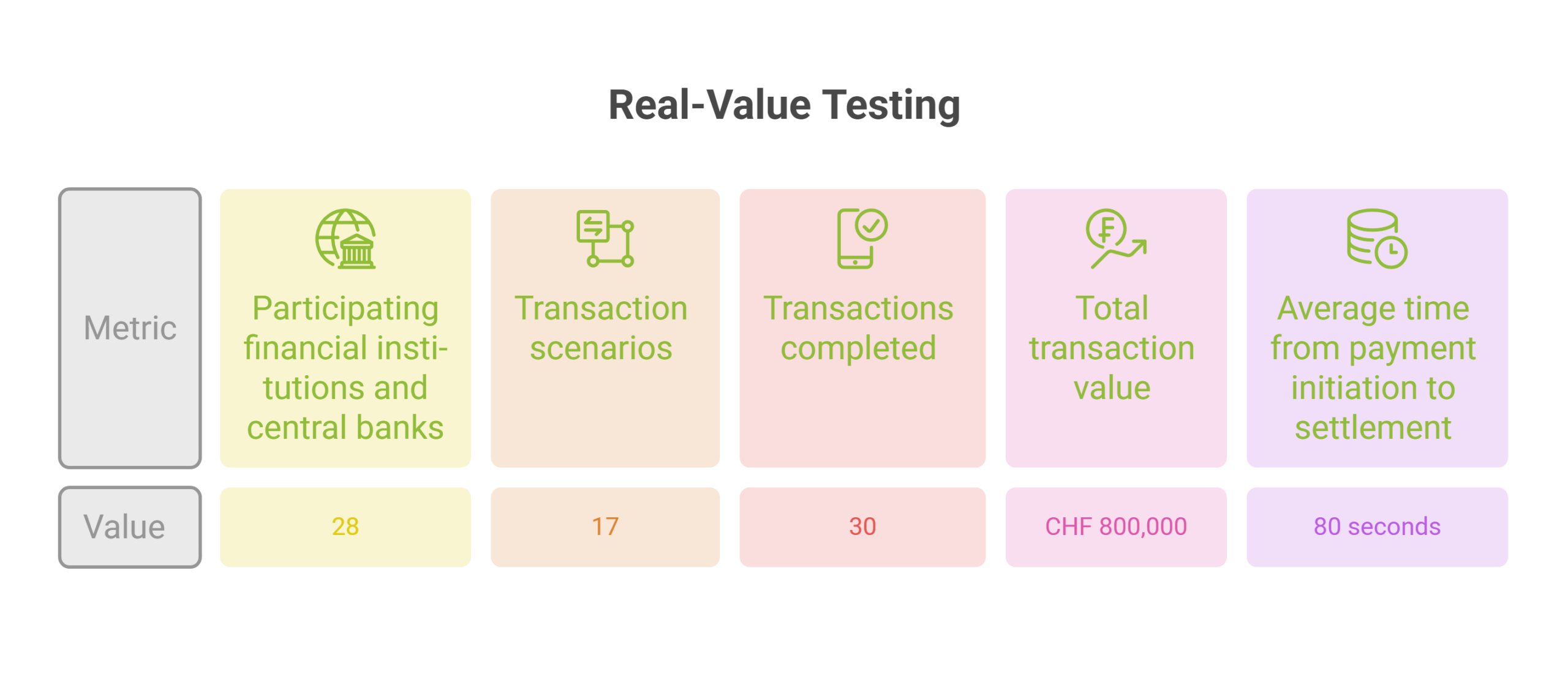
Key Takeaway: Institutional tokenisation is moving beyond conceptual experimentation into controlled real-value testing across multiple currencies, institutions and wholesale payment scenarios.
The importance of these developments is therefore increasingly about financial infrastructure rather than digital assets alone. Tokenised payment infrastructure is being tested as a way to connect money, payment instructions and settlement more closely while retaining established forms of central-bank and commercial-bank money.
Tokenised Payments are Bringing Settlement and Payment Closer Together
The development of tokenised financial infrastructure is increasingly focused on how money and assets move through the financial system rather than on creating new forms of digital ownership alone. By representing commercial bank deposits, central-bank money or financial assets on programmable platforms, institutions can potentially bring payment, settlement and related processing into a more connected environment.
This is making tokenised payment infrastructure relevant to the structure of wholesale and cross-border finance. Today, a transaction can pass through separate stages for messaging, compliance, reconciliation, clearing and settlement. Tokenised infrastructure could allow some of these processes to occur on a shared programmable platform, reducing the number of separate steps required to complete a transaction.
Tokenised Money is Creating New Settlement Possibilities
One important area of development is the combination of tokenised commercial bank deposits with central-bank money. Project Agorá is testing this model through a unified platform where tokenised deposits can be settled using tokenised central-bank reserves. The objective is to allow different forms of regulated money to interact within the same transaction environment.
This matters because commercial bank money and central-bank money perform different roles within the financial system. Tokenisation does not eliminate that distinction. Instead, it creates the possibility that both can operate on compatible programmable infrastructure.
Tokenised payment infrastructure could therefore support transactions where payment and settlement occur more closely together. In cross-border finance, this could potentially reduce the delays created by different settlement cycles and operating hours across jurisdictions.
Programmability Could Reduce Manual Financial Processes
The other major potential benefit is programmability. A programmable payment can include predefined conditions under which a transaction can proceed, reducing the need for separate manual checks or reconciliation processes in certain use cases.
For example, a trade-related payment could potentially be linked to the successful completion of a contractual condition, while a cross-border transaction could incorporate compliance requirements directly into the workflow. The BIS has identified conditional payments, atomic settlement and reduced reconciliation as areas where tokenised infrastructure could create efficiency gains.
This is different from simply making payments faster. The potential benefit lies in changing how financial processes are coordinated. Instead of payment, settlement and verification operating as separate stages, some of the underlying logic can potentially be brought onto a shared programmable environment.
The implications could extend to securities settlement, foreign exchange and other wholesale financial-market transactions. But the extent of these benefits will depend on whether the tokenised environment can connect with the broader financial system.
Interoperability Remains a Major Constraint
Tokenised infrastructure does not exist in isolation. Financial institutions still depend on core banking systems, real-time gross settlement systems, payment messaging standards and regulated market infrastructures.
Project Agorá’s testing is important partly because it demonstrated interaction with existing banking and payment environments using established ISO 20022 standards. The project therefore provides evidence that tokenisation can be explored as an additional infrastructure layer rather than requiring an immediate replacement of conventional financial systems.
The challenge is that different institutions may develop tokenised deposits or assets on different platforms. Without interoperability, liquidity can become fragmented across separate networks, undermining some of the efficiency that tokenisation is intended to create.
This makes tokenised payment infrastructure dependent on common standards, legal frameworks and connectivity with existing financial infrastructure. A technically efficient tokenised platform has limited value if it cannot exchange value reliably with other payment and settlement systems.
Tokenisation is Moving Toward an Integrated Financial Process
The broader development is therefore about bringing previously separate functions closer together. Payment instructions, settlement, compliance and contractual conditions could increasingly be coordinated on programmable infrastructure where the relevant legal and operational requirements allow.
Tokenised payment infrastructure could eventually support financial transactions that are more automated and continuously available, but the technology alone will not determine whether that occurs at scale. Interoperability, legal certainty, liquidity and integration with existing systems will remain critical to its development.
Tokenised Payments Could Reshape Financial Infrastructure
Tokenisation is increasingly being explored as a way to bring payment, settlement and financial-asset processes onto more programmable infrastructure. Institutional projects are moving the discussion beyond digital-asset experimentation toward regulated use cases involving central-bank money, commercial bank deposits and cross-border transactions.
This makes tokenised payment infrastructure relevant to the longer-term evolution of financial markets. Its potential lies in reducing fragmentation between payment and settlement processes, supporting conditional transactions and enabling more continuous financial operations.
The ability to scale these models will depend on interoperability, legal certainty, liquidity and integration with existing banking and payment systems. Tokenised payment infrastructure is therefore unlikely to develop as a complete replacement for current financial infrastructure, but could become an additional layer through which selected payment and settlement processes operate with greater automation and programmability.

