Banking is moving toward a model in which payments are expected to work continuously rather than within the operating windows of traditional clearing systems. Fast-payment infrastructure now allows funds to become available almost immediately, including outside conventional banking hours. The World Bank’s global fast-payments dataset shows that people and businesses in 137 countries had access to instant payment services on a 24/7 basis as of June 2026, illustrating how broadly the infrastructure has spread across different banking markets.
This expansion is giving instant payment banking a broader significance than simply processing transfers more quickly. The underlying infrastructure is increasingly becoming part of how banks deliver everyday payments, account services and digital financial products. The BIS has also found that fast payments are gaining ground globally and are increasingly being used for small-value payments in both advanced and emerging economies.
Instant Payments are Moving Beyond Faster Transfers
The distinction between conventional electronic transfers and instant payments is increasingly about the underlying operating model. Traditional systems can depend on clearing cycles and processing windows, whereas fast-payment systems are designed to make funds available to beneficiaries on a 24/7/365 basis. The World Bank defines these systems as infrastructure that can support banks and non-bank providers, multiple payment channels, domestic and cross-border use cases and overlay services such as request-to-pay.
That creates opportunities beyond person-to-person transfers. Businesses can use faster payments for collections, supplier payments and disbursements, while financial institutions can build digital products around immediate movement of funds. The BIS has found that fast-payment infrastructure can also contribute to wider digital-finance adoption, with its research linking the expansion of fast payments to increased use of finance applications.
For instant payment banking, the significance is therefore not simply that money moves within seconds. The capability can change when financial services can operate, how quickly funds become usable and how digital products are designed around payment infrastructure.
Payment Availability is Becoming a Core Banking Expectation
The shift is also being reinforced by regulation and market expectations. Europe’s Instant Payments Regulation provides one of the clearest examples. Euro-area payment service providers have been required to support the receipt of instant euro payments since January 2025 and the sending of instant payments since October 2025. The rules also require charges for instant transfers to be no higher than those for corresponding regular transfers and introduce verification-of-payee requirements.
Other markets are following different paths, but the direction is increasingly similar: payment infrastructure is expected to operate continuously and integrate more closely with digital banking experiences. Large-scale systems such as India’s UPI, Brazil’s Pix and US real-time payment networks demonstrate that instant payments can move from specialist infrastructure into high-volume everyday use.
The global picture is not uniform. Adoption varies according to system design, participation, pricing, use cases and cross-border connectivity. BIS research finds that fast-payment adoption tends to be stronger where systems allow broader participation, including non-bank providers, and where more use cases and connections are available.
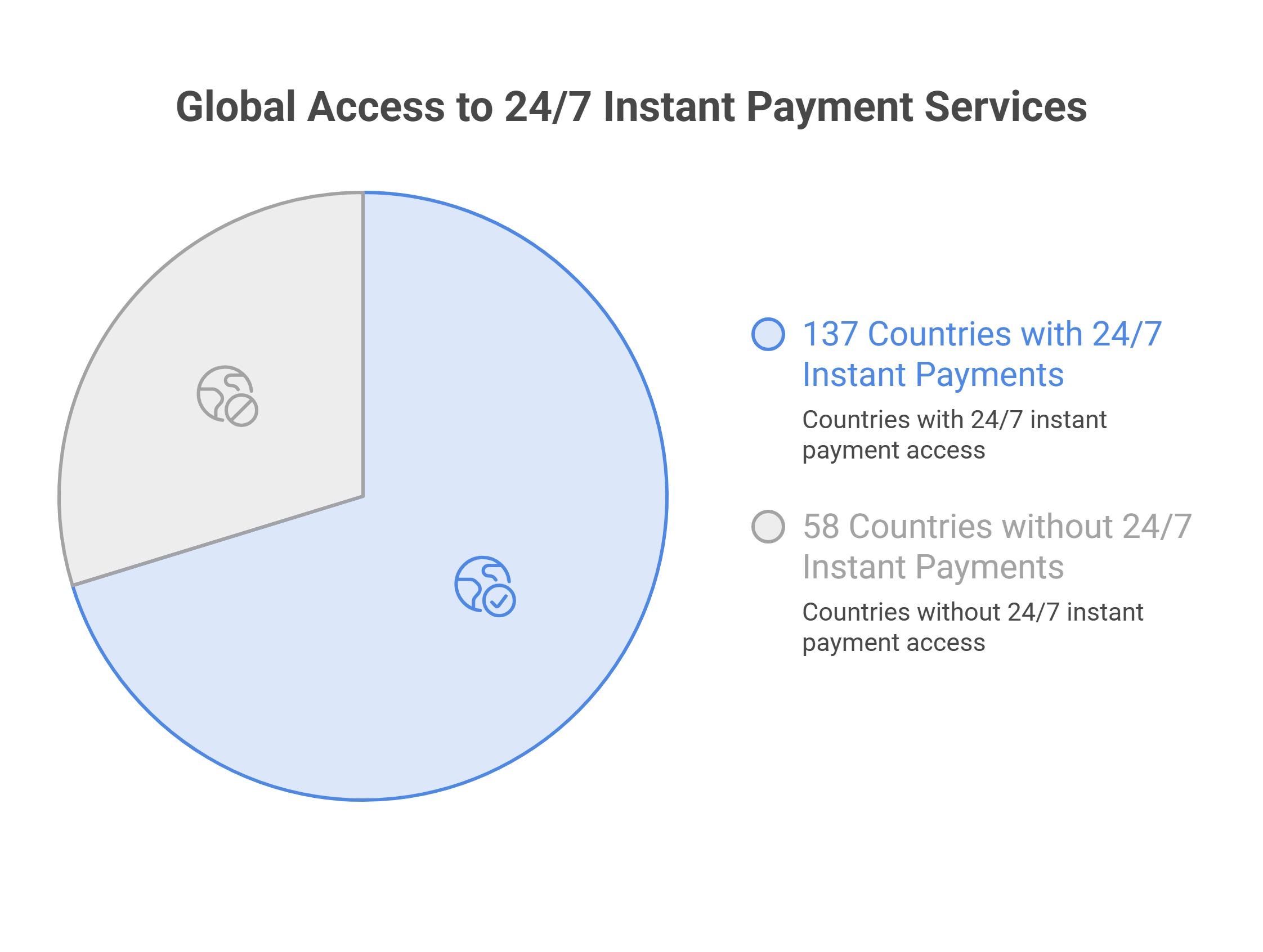
Key Takeaway: Instant-payment infrastructure has moved beyond a limited number of early-adopter markets, with 24/7 services now available across a broad global set of banking jurisdictions.
The transition is therefore becoming structural. Instant payment banking is moving toward a model in which immediate payment availability is increasingly treated as part of the core digital banking proposition rather than a separate premium capability.
Instant Payments are Expanding Across Banking Use Cases
The wider adoption of instant payment infrastructure is changing how banks can design and deliver financial services. Once payments can move continuously and funds become available almost immediately, the capability can support use cases that were previously constrained by clearing schedules or operating hours. This is extending instant payments beyond everyday transfers into merchant payments, account funding, disbursements and business transactions.
For instant payment banking, this creates a broader relationship between payment infrastructure and digital banking. Banks can build services around immediate movement of money rather than treating faster payments as a standalone transaction type. This can make payment capability more closely integrated with lending, savings, commerce and other financial services.
Instant Payments are Expanding Beyond Person-to-Person Transfers
Person-to-person payments remain an important driver of fast-payment adoption, but the infrastructure is increasingly being used across other parts of the financial system. Businesses can receive funds immediately, platforms can make rapid disbursements and merchants can offer account-to-account payment options without relying exclusively on card-based transactions.
Request-to-pay services are another development. These can allow a recipient to send a structured payment request that the payer can review and authorise through their bank. Because the request and payment can operate within the same broader instant-payment environment, banks can support more integrated digital payment journeys.
For instant payment banking, these developments matter because they turn immediate settlement into an underlying capability that can support multiple banking products. A faster payment rail can therefore influence how customers collect, send, receive and manage money across different digital channels.
Banking Services are Becoming More Real-Time
The availability of immediate payments also has implications for services that depend on the timing of funds. An insurer can potentially accelerate a claims disbursement, a lender can release approved funds more quickly and an employer can make time-sensitive payments without waiting for a conventional settlement cycle. These applications do not necessarily require entirely new banking products. Instead, they use existing financial services with a payment infrastructure capable of supporting faster execution.
This can also reduce the gap between a transaction being authorised and the funds becoming usable. In digital banking, that distinction matters because customers increasingly expect the status of their finances to reflect completed transactions with minimal delay.
The result is a shift from payments being one stage within a banking process toward payments becoming a more continuous underlying service. Instant payment banking can support digital experiences where funding, payment and confirmation happen within a much shorter operational window.
Banks are Adapting their Infrastructure Around Continuous Availability
The transition also creates operational requirements for banks. Instant payment services need systems that can support processing, monitoring and customer support continuously rather than only during defined business periods. Fraud controls, authentication, liquidity management and operational resilience therefore have to function alongside the payment rail.
This changes the economics of payment infrastructure as well. Banks need to consider whether their existing systems can support higher transaction volumes, real-time risk decisions and continuous availability without introducing excessive operating costs or service failures.
The global landscape remains uneven, with different markets using different payment models and levels of participation. Nevertheless, the direction is increasingly toward payment services that operate as always-on digital infrastructure. Instant payment banking can therefore become embedded across a wider range of financial products and customer journeys, reducing the distinction between a payment service and the broader digital banking experience.