
















Corporate treasury is traditionally built around forecasting cash requirements, scheduling transfers and managing liquidity across accounts and banking relationships. The growing availability of instant payments is beginning to change that operating model by allowing companies to move funds continuously rather than relying exclusively on clearing windows and predetermined payment schedules.
This is giving instant payment treasury a broader role in corporate cash management. The opportunity extends beyond paying suppliers faster. Treasury teams can potentially respond to changing cash positions more quickly, move funds between accounts when required and reduce the gap between receiving money and making it available for another business purpose.
Cash Management is Moving Toward Real-Time Liquidity
For companies operating across multiple entities, banks and jurisdictions, cash can be distributed across numerous accounts throughout the day. Under conventional payment arrangements, moving excess funds into a central account or providing additional liquidity to an operating account may depend on scheduled transfers or bank cut-off times.
Instant-payment infrastructure can shorten that process. Where the relevant payment systems, banks and account structures support it, treasury teams can move funds when a liquidity requirement emerges rather than waiting for a later processing cycle.
This is particularly relevant to cash concentration. An operating subsidiary receiving funds during the day could potentially transfer excess liquidity to a central treasury account more quickly, while a business account facing a short-term funding requirement could receive funds without waiting for a conventional settlement window.
The benefit is not simply speed. It is the ability to manage liquidity with more frequent adjustments. Instant payment treasury can therefore support a model in which cash positioning becomes more responsive to actual business activity rather than being determined primarily by fixed schedules.
Corporate Payments are Moving into Higher-Value Use Cases
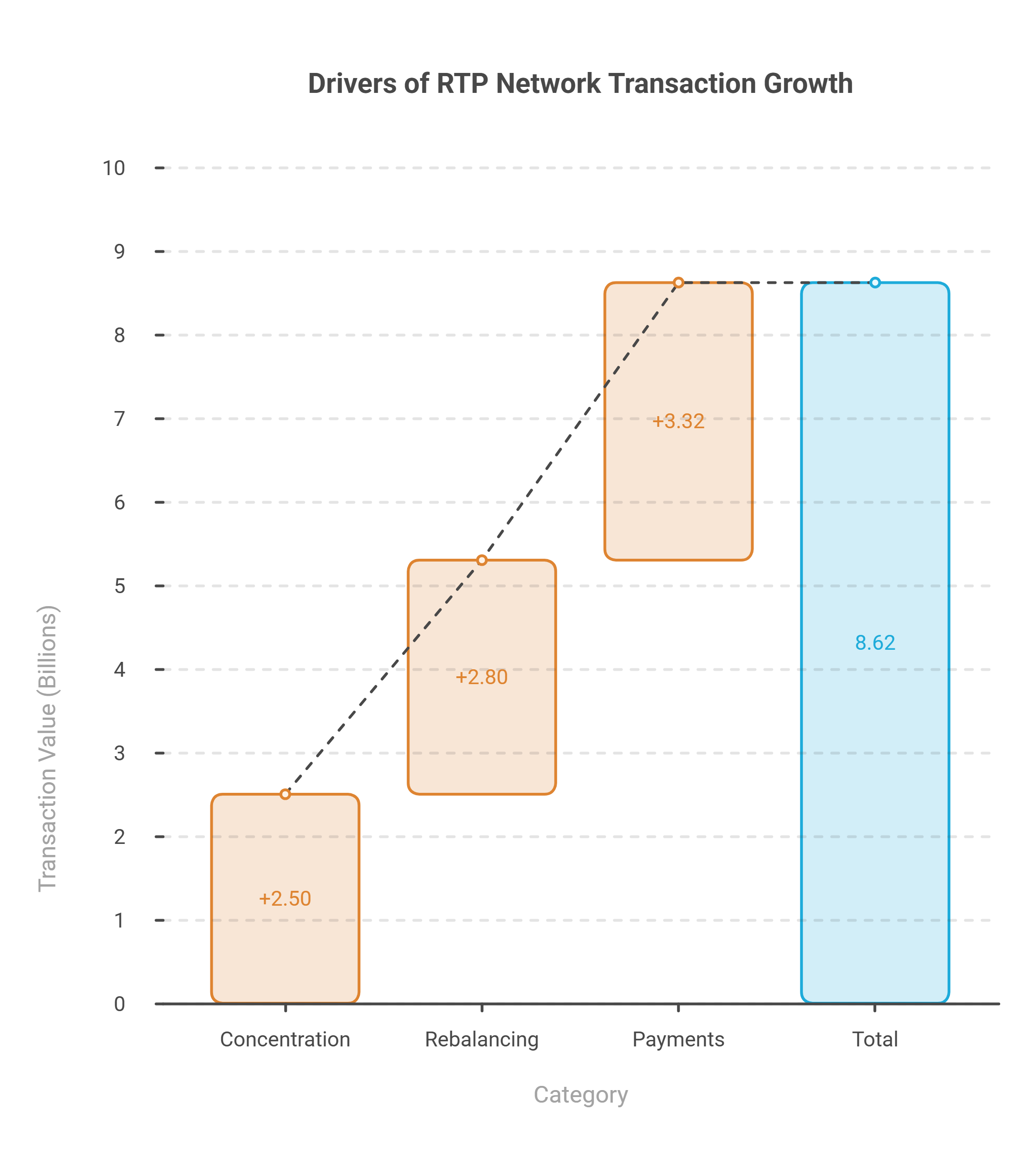
The use of instant-payment infrastructure is also expanding beyond low-value consumer transfers. In the United States, The Clearing House reported that the RTP network reached a single-day record of $8.62 billion in transaction value in May 2026. The network identified corporate applications including cash concentration, portfolio rebalancing and supplier or vendor payments among the use cases contributing to its growth.
The development demonstrates that instant-payment systems can support financial activity relevant to treasury departments, rather than remaining primarily associated with retail payments. The ability to execute time-sensitive corporate transactions can be particularly valuable where delays affect investment decisions, supplier relationships or the availability of working capital.
The same trend is visible across the wider industry. Capgemini’s World Payments Report 2025, based on research involving 600 corporate treasurers across 15 markets, identifies real-time payment solutions, richer payment data and open-finance APIs as important components of real-time treasury.
Treasury is Becoming More Closely Connected to Payment Infrastructure
The growing availability of instant payments therefore changes the relationship between treasury and the underlying payment rail. Payment execution can become more closely linked to liquidity decisions, while real-time transaction information can provide treasury teams with a more current view of their cash positions.
This does not mean every corporate payment needs to become instant. Payment limits, costs, approval processes, fraud controls, foreign-exchange requirements and the nature of the transaction will continue to influence which payments are best suited to immediate settlement.
The longer-term shift is that treasury departments can increasingly treat payment infrastructure as an active component of liquidity management rather than simply the mechanism used to execute preplanned transfers. Instant payment treasury is consequently emerging as part of a broader move toward continuous cash management, where companies can respond to liquidity needs with greater speed and precision.
Real-Time Cash Visibility is Becoming More Important
The value of instant payments for corporate treasury extends beyond the ability to transfer funds quickly. The more significant change is the potential to connect payment execution with a continuously updated view of liquidity. When transaction information becomes available faster and can be delivered directly into treasury systems, companies can make cash-management decisions with less reliance on delayed account information and manual reconciliation.
This is making instant payment treasury increasingly dependent on the combination of payment rails, bank connectivity and financial data. Capgemini’s research identifies instant payments, richer payment information and open-finance APIs as key components of real-time treasury, reflecting a broader move toward integrating payment execution with cash visibility and liquidity management.
Instant Payments are Enabling Faster Cash Concentration
Cash concentration is an important use case because large companies often manage balances across multiple subsidiaries, accounts and banking relationships. Excess liquidity in one account may need to be moved to a central treasury structure, while another entity may require additional funds to meet an immediate obligation.
Instant payment capability can make these transfers more responsive. Rather than waiting for a scheduled sweep, a treasury system could potentially identify a surplus or shortfall and initiate a transfer during the day, subject to the company’s controls and the participating banks’ capabilities.
This can create a closer relationship between cash positioning and actual business activity. Instant payment treasury can support more dynamic liquidity management by allowing treasury teams to rebalance positions when funds are available or required, rather than relying entirely on predetermined transfer schedules.
The opportunity becomes greater when multiple bank accounts can be monitored through APIs. A treasury platform can potentially receive updated balances and transaction information from several institutions, compare liquidity positions and determine whether a transfer or funding action is necessary.
APIs are Connecting Payments with Treasury Systems
The development of real-time treasury also depends on what happens after a payment is initiated. A transaction that settles instantly but still requires manual entry, reconciliation or accounting reduces some of the operational benefit.
This is why connectivity between payment infrastructure and enterprise systems is becoming increasingly important. Bank APIs can provide treasury-management and enterprise-resource-planning platforms with payment status and account information, while structured payment data can support automated reconciliation and accounting processes.
ISO 20022 is also becoming relevant because richer structured payment information can provide more useful context around transactions. When payment data can be passed directly into treasury and accounting systems, companies can reduce the amount of manual work required to identify transactions, update records and reconcile accounts.
For instant payment treasury, this combination of immediate settlement and machine-readable information is particularly important. Real-time movement of money becomes considerably more useful when treasury systems can also recognise that movement quickly and incorporate it into the company’s overall liquidity position.
Real-Time Treasury is Becoming More Automated
The longer-term model is increasingly based on a connected cycle in which cash is monitored, payment activity is processed, account positions are updated and treasury decisions can be adjusted with limited manual intervention.
Automation could allow predefined rules to trigger cash sweeps, replenish operating accounts or flag liquidity positions that require treasury attention. Human oversight remains important, particularly for larger or more complex transactions, but routine movements can potentially be handled through controlled workflows.
This does not mean that forecasting becomes less important. Instead, real-time information can complement forecasts by giving treasury teams a more current view of what is actually happening across their accounts. Instant payment treasury can therefore combine forward-looking liquidity planning with faster responses to changes in cash positions.