





















The financial services industry stands at an inflection point. As institutions grapple with intensifying regulatory pressures, evolving customer expectations, and fierce competition from fintech disruptors, a transformative technology is emerging as the cornerstone of modern banking strategy. Generative AI in financial services represents far more than a technological upgrade; it is fundamentally reshaping how financial institutions operate, make decisions, and engage with their customers.
The adoption trajectory tells a compelling story. Industry research reveals that 56% of banking and insurance organizations have already begun implementing a generative AI strategy, with another 35% reporting that they have a strategy in place but have not yet begun implementation. Yet this enthusiasm masks a deeper challenge: while institutions are investing heavily in the technology, fewer are reporting positive returns on investment, suggesting a critical gap between strategic ambition and operational execution.
Understanding the Transformative Power of Generative AI
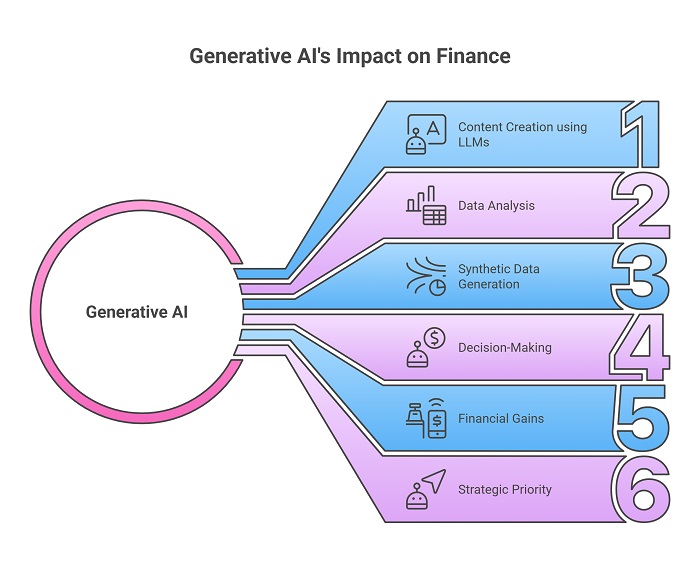 Generative AI in financial services leverages advanced large language models (LLMs) and machine learning algorithms to generate novel content, analyze complex datasets, and create synthetic data for informed decision-making. Unlike traditional artificial intelligence, which is programmed to perform specific tasks, generative AI systems learn from vast amounts of financial data, including transaction histories, regulatory documents, financial reports, and market intelligence, to perform tasks that were previously the exclusive domain of human expertise.
The technology’s capacity to process unstructured data is particularly revolutionary. Financial institutions generate enormous volumes of textual information daily, from regulatory communications to customer correspondence to market research. Generative AI excels at synthesizing this information, identifying patterns that human analysts might overlook, and translating complex financial concepts into actionable insights. This capability enables financial institutions to operate with unprecedented speed and precision, fundamentally altering competitive dynamics across the industry.
The business case is substantial. Industry analysts estimate that generative AI could add up to $340 billion in banking annually by improving credit scoring, fraud detection, Anti-Money Laundering (AML) compliance, trading strategies, and customer personalization. These figures underscore why generative AI in financial services has transitioned from an experimental curiosity to a strategic imperative for boards of directors and executive leadership teams.
Redefining Customer Experience and Operational Efficiency
One of the most visible applications of generative AI in financial services manifests in customer interaction and engagement. Advanced chatbots and virtual assistants powered by generative AI now provide 24/7 customer support, handling routine inquiries, guiding customers through complex processes like loan applications, and offering personalized financial guidance. These systems analyze individual customer profiles, including transaction history, spending patterns, risk tolerance, and financial goals, to deliver recommendations tailored to each customer’s circumstances.
The operational benefits extend well beyond customer-facing functions. Research indicates that banks can enhance productivity by up to 30% by integrating generative AI into their workflows. Financial institutions are deploying these tools to automate document processing, streamline data entry, accelerate loan underwriting, and manage compliance checks. Tasks that previously consumed countless hours of human labor, summarizing regulatory reports, extracting data from financial statements, drafting compliance documentation, now occur in minutes rather than days.
This efficiency translates directly to cost reduction and revenue expansion. Automated scheduling and queue management in branches free staff to focus on high-value customer interactions. Streamlined loan processing accelerates customer acquisition while improving decision-making accuracy. Enhanced operational efficiency creates capacity for financial institutions to serve more customers without proportional increases in operational headcount, fundamentally improving unit economics across the organization.
However, the path to realizing these benefits remains complex. Infrastructure limitations present significant bottlenecks, with 98% of financial services respondents reporting challenges when scaling generative AI workloads from development to production environments. Additionally, 52% of organizations cite IT infrastructure as an area requiring substantial investment, underscoring that technology adoption extends far beyond acquiring software licenses.
Risk Management and Fraud Prevention: A New Paradigm
The financial services sector has long recognized fraud as an existential threat to institutional stability and customer confidence. Generative AI in financial services introduces transformative capabilities for identifying, preventing, and responding to fraudulent activities with unprecedented sophistication.
Traditional fraud detection systems rely on rule-based algorithms designed to flag transactions exceeding certain thresholds or exhibiting specific patterns. While effective against known fraud types, these systems struggle against sophisticated, evolving criminal methodologies. Generative AI systems, by contrast, develop nuanced models of normal financial activity by analyzing millions of historical transactions across diverse customer segments. Any deviation from these sophisticated baselines, regardless of how subtle, triggers investigation. Machine learning algorithms continuously refine these models, adapting to emerging fraud patterns in near-real-time.
Beyond fraud detection, generative AI enhances risk assessment across multiple dimensions. Financial institutions employ these systems to model complex risk scenarios, considering market volatility, geopolitical events, regulatory changes, and macroeconomic indicators simultaneously. This analytical sophistication enables more accurate credit risk scoring, allowing institutions to extend credit to creditworthy borrowers who traditional models might reject while simultaneously protecting against higher-risk counterparties.
The implications for portfolio management prove equally significant. Asset managers leverage generative AI to analyze vast datasets, including historical performance metrics, market trends, news sentiment, and economic forecasts to optimize portfolio allocation. These systems simulate thousands of market scenarios to stress-test investment strategies before capital is deployed, fundamentally improving risk-adjusted returns.
Compliance, Regulation and Governance: Navigating the Digital Transformation
 The regulatory environment surrounding financial services has never been more complex. Institutions operate across multiple jurisdictions, each with distinct regulatory frameworks, compliance requirements, and reporting obligations. Global regulatory fines for non-compliance in financial institutions surpassed $2.6 billion in the first half of 2024 alone, reflecting the severity of regulatory scrutiny and the stakes of non-compliance.
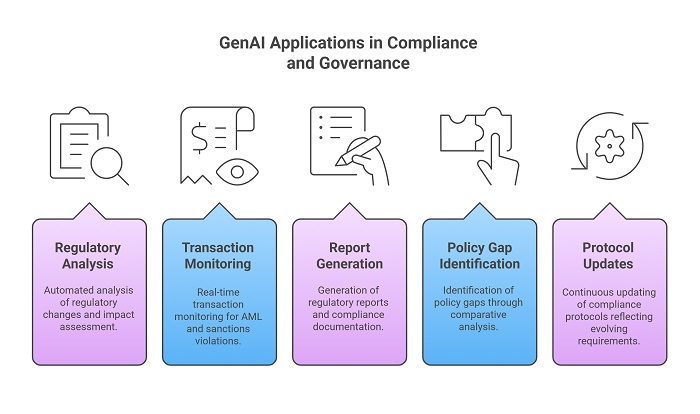
Generative AI in financial services offers institutions a powerful tool for navigating this regulatory labyrinth. Rather than relying on manual document review processes vulnerable to human error and inconsistency, financial institutions deploy AI systems to analyze regulatory requirements, compare institutional policies against regulatory mandates, and identify compliance gaps. These systems provide continuous monitoring of transactions for potential regulatory violations, generating comprehensive audit trails that satisfy regulatory requirements for transparency and accountability.
The technology enables rapid adaptation to regulatory change. As regulatory bodies issue new requirements, AI systems can quickly analyze new rules, update compliance protocols accordingly, and alert relevant teams to implementation requirements. This adaptability reduces the lag between regulatory change and institutional implementation, mitigating the risk of inadvertent non-compliance during transition periods.
Moreover, generative AI enhances regulatory transparency by creating detailed documentation of decision-making processes. As regulators increasingly demand that financial institutions explain how automated systems make consequential decisions, particularly in high-stakes areas like AML compliance and credit risk assessment, these AI systems generate the comprehensive audit trails and explanations required to satisfy regulatory expectations.
Key Applications in Compliance and Governance
- Automated analysis of regulatory changes and impact assessment
- Real-time transaction monitoring for AML and sanctions violations
- Generation of regulatory reports and compliance documentation
- Identification of policy gaps through comparative analysis
- Continuous updating of compliance protocols reflecting evolving requirements
Implementation Challenges: Bridging Strategy and Execution
Despite the compelling business case for generative AI in financial services, substantial implementation challenges threaten to derail institutional initiatives. Foremost among these challenges lies the infrastructure deficit. Modern generative AI systems demand substantial computational resources, particularly for processing large language models and managing data pipelines. Many financial institutions operate on legacy technology infrastructure designed for previous generations of applications, creating compatibility issues and performance bottlenecks when deploying cutting-edge AI systems.
Skills gaps present an equally formidable obstacle. Deploying and maintaining sophisticated generative AI systems requires expertise spanning data science, machine learning engineering, software development, and financial domain knowledge. The talent market for these skills remains extremely competitive, with demand substantially outpacing supply. Approximately 49% of financial services respondents cite IT training as a needed area of investment, while 47% identify IT talent hiring as critical for scaling generative AI initiatives.
Data governance and quality present additional complexities. Generative AI systems perform only as well as the data they analyze. Financial institutions must ensure data quality, implement robust data governance frameworks, and address biases that might be present in historical data used for training. Biased training data can result in discriminatory outcomes, for instance, lending algorithms that systematically disadvantage particular demographic groups, creating both ethical and regulatory concerns.
Change management and organizational adoption introduce further challenges. Introducing generative AI transforms workflows, redefines job functions, and disrupts established organizational hierarchies. Successful implementation requires not just technology deployment but comprehensive change management, employee training, and cultural evolution to position AI as augmenting human expertise rather than replacing human judgment.
The Path Forward: Strategic Considerations
Looking ahead, the competitive imperative for deploying generative AI in financial services will only intensify. Institutions that successfully navigate the implementation challenges will access substantial efficiency gains, improved decision-making, enhanced customer experiences, and new revenue opportunities. Those that fail to execute risk competitive obsolescence as agile competitors capture market share through superior technology capabilities.
Strategic implementation requires careful attention to risk management. Pioneering institutions are establishing robust AI governance frameworks, implementing transparency controls, conducting regular audits of AI system performance, and maintaining human oversight of consequential decisions. These institutions recognize that the greatest competitive advantage derives not from moving fastest but from moving smartly, deploying generative AI thoughtfully while maintaining rigorous controls.
The financial services industry stands at an inflection point where generative AI in financial services will determine competitive winners and losers over the next five years. Institutions must move decisively to develop internal capabilities, invest in infrastructure modernization, address skills gaps, and establish governance frameworks that enable innovation while managing risk. The transformation has begun, the question for each institution is not whether to embrace generative AI in financial services, but how quickly and effectively they can deploy these powerful technologies to drive competitive advantage in an increasingly digital financial ecosystem.
The future of financial services will be defined by institutions that master the deployment of generative AI in financial services to enhance human expertise, improve decision-making, and create superior customer experiences. The time for strategic action is now.