The European Union’s new anti money laundering framework is placing greater emphasis on the quality, consistency and accessibility of data used by supervisors. As the Authority for Anti Money Laundering and Countering the Financing of Terrorism prepares for direct supervision, data is moving beyond a reporting requirement and becoming part of the infrastructure through which risks will be identified, compared and acted upon.
This makes AML data infrastructure increasingly important to the future of European supervision. AMLA’s planned data ecosystem includes structured information from national supervisory authorities, information held in existing systems and additional intelligence that can support a broader understanding of money laundering and terrorist financing risks. Its central AML/CFT database is intended to support risk identification, monitoring, enforcement and cross-border supervisory analysis.
Data is Moving into the Centre of Risk Assessment
The transition is already visible in AMLA’s 2026 data collection exercise. The exercise is designed to test and calibrate risk assessment models that will support consistent supervisory assessments across the EU and help select up to 40 financial institutions or groups for direct supervision beginning in 2028. National supervisors and selected institutions are therefore contributing to a common data framework before the new supervisory model becomes operational.
This creates a direct connection between data and supervisory decisions. AML data infrastructure will help determine how information from different institutions and jurisdictions can be structured into comparable indicators, allowing supervisors to assess risk using a common methodology rather than relying entirely on nationally developed approaches.
Standardisation is becoming particularly important because supervisory data can vary significantly in format, scope and quality. AMLA and European authorities are developing reporting templates, data models, taxonomies and validation rules to create a more consistent reporting environment. The updated 2027 taxonomy is also being refined to distinguish unavailable information from an actual reported zero, illustrating how seemingly small data quality issues can affect the interpretation of supervisory information.
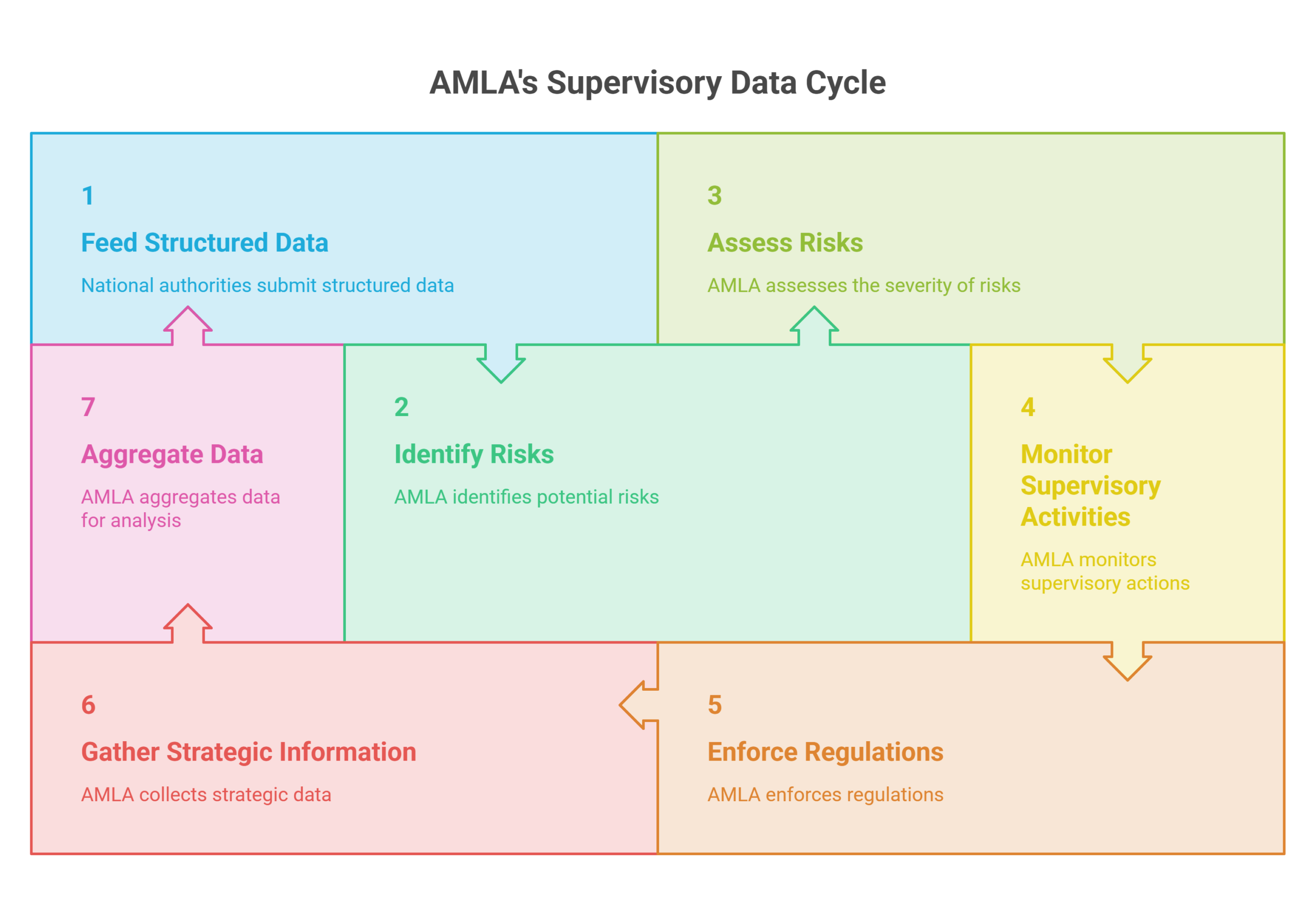
Key Takeaway: AMLA is developing data infrastructure as a core component of EU-wide AML supervision, linking standardised information with risk assessment, monitoring and enforcement.
The significance extends beyond the database itself. The first selection of entities for direct supervision is scheduled for 2027, with direct supervision beginning in 2028. That means the systems used to collect, validate and analyse information are being developed alongside the supervisory framework they are intended to support. AML data infrastructure is therefore becoming a foundational layer in the shift toward more consistent, data-driven AML supervision across Europe.
Data Standardisation is Strengthening Cross-Border AML Supervision
The growing role of data in anti money laundering supervision is also changing how financial institutions prepare information for regulators. As European supervision becomes more coordinated, authorities need information that can be compared across institutions, business models and jurisdictions without requiring extensive manual interpretation. This is placing greater emphasis on common definitions, reporting structures and validation processes.
AML data infrastructure is becoming important because supervisory effectiveness increasingly depends on whether data can be collected in a consistent and usable form. AMLA’s 2026 risk assessment exercise is being supported by structured reporting requirements developed with national authorities and financial institutions, while the European supervisory framework is moving toward common data models and taxonomies. These systems are intended to make information more comparable and improve the quality of risk assessment at the EU level.
Data Quality is Becoming a Supervisory Requirement
The implications extend into the way institutions manage their own compliance data. Risk assessments increasingly draw on information covering customers, products and services, transactions, delivery channels and geographic exposure. That means firms need data environments capable of bringing information together across different business functions rather than maintaining isolated reporting processes.
Common reporting standards can reduce inconsistencies, but they also create new operational requirements. Institutions may need to map existing datasets against regulatory definitions, identify missing information and establish controls to ensure that figures reported through different systems remain consistent. The distinction between unavailable information and a genuine zero value in AMLA’s developing reporting taxonomy illustrates why data quality can influence supervisory interpretation.
The broader objective is to create a more consistent evidence base for risk-based supervision. AML data infrastructure can help authorities compare risk indicators across institutions while giving supervisors a more structured view of where vulnerabilities may be concentrated. Standardised data can also make it easier to identify patterns that are difficult to detect when information remains fragmented between national authorities or individual reporting systems.
From Reporting Data to Supervisory Intelligence
This shift is particularly significant as AMLA develops its central AML/CFT database and prepares for the first selection of institutions for direct supervision. Data collected during 2026 is expected to contribute to risk assessment models, while subsequent reporting exercises will refine the information used in the supervisory process. The objective is not simply to gather more information, but to make the information sufficiently consistent to support decisions across the European financial system.
The development of AML data infrastructure therefore has implications for both regulators and regulated institutions. Supervisors need reliable information to assess risk and allocate resources, while firms need governance, systems and controls capable of producing that information accurately. As the European AML framework moves toward implementation, data is becoming an increasingly important connection between regulatory requirements and supervisory action.
Data Infrastructure is Becoming Part of AML Supervision
The European AML framework is moving toward a supervisory model in which data quality, standardisation and accessibility are becoming increasingly important. As AMLA develops its central AML/CFT database and risk assessment systems, financial institutions will face growing expectations around how compliance information is collected, structured and reported.
The shift is significant because supervisory decisions will increasingly depend on comparable information across institutions and jurisdictions. AML data infrastructure can provide the foundation for this process by connecting reporting systems, risk information and supervisory analysis.
For financial institutions, this means data governance is becoming closely linked to regulatory readiness. The ability to identify gaps, maintain consistent definitions and produce reliable information will matter alongside traditional AML controls. As the new framework moves toward implementation, stronger data infrastructure could therefore become an important factor in supporting more consistent, risk-based supervision.