

















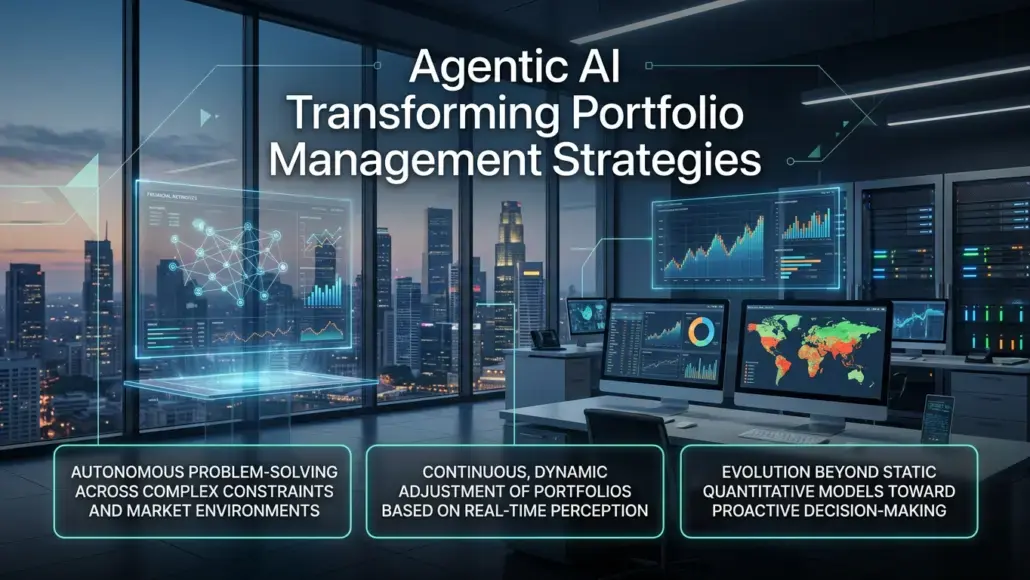

The integration of agentic artificial intelligence into institutional finance represents a significant shift in how investment professionals approach the construction and maintenance of complex portfolios. Unlike traditional quantitative models that operate on static parameters or basic machine learning algorithms that require constant human intervention, agentic systems possess the ability to perceive their environment, reason through multifaceted constraints, and execute actions autonomously to achieve specific objectives. This evolution is particularly visible in the refinement of investment frameworks, where the need for speed, precision, and adaptability has never been greater. By deploying autonomous agents capable of continuous monitoring and independent decision making, asset managers can address market volatility with a level of agility that was previously unattainable through manual or semi-automated processes.
At the core of this transition is the capability of agentic AI to handle unstructured data and shifting market regimes without the latency inherent in human oversight. For decades, the industry relied on mean-variance optimization and other mathematical frameworks that, while mathematically sound, often struggled to account for the irrationality of market participants or the sudden impact of geopolitical events. Modern portfolio management strategies now incorporate agentic layers that can interpret sentiment, track policy changes, and adjust exposure in real time. This does not imply the removal of human expertise; rather, it allows senior strategists to focus on high level objective setting while the AI agents handle the granular execution and tactical adjustments required to maintain optimal risk adjusted returns.
The Evolution of Autonomous Systems in Asset Allocation
The shift from algorithmic trading to agentic asset allocation marks a critical turning point in the financial sector. Traditional algorithms are essentially sophisticated scripts: they follow “if-then” logic to execute specific tasks when predefined conditions are met. While effective for high frequency trading or simple rebalancing, these systems lack the reasoning capacity to deal with ambiguity. Agentic AI, however, functions through a goal oriented architecture. An agent tasked with maintaining a specific ESG rating while maximizing yield does not just follow a list of rules; it actively searches for the best path to achieve those goals, even as the underlying data points change. This represents a more sophisticated approach to directing capital, as the system can anticipate the impact of its own actions on the broader portfolio composition.
One of the primary advantages of these autonomous systems is their ability to operate across multiple time horizons simultaneously. In a typical institutional setup, different teams handle short term liquidity and long term strategic allocation. Agentic AI can unify these functions by deploying specialized agents that communicate with one another. For instance, a “liquidity agent” might identify a need for cash to meet upcoming redemptions, while an “allocation agent” determines which assets can be sold with the least impact on the total return profile. By integrating AI agents for real-time market intelligence and analysis, firms can ensure that every decision is backed by the most current data available, reducing the risk of making moves based on stale information or narrow perspectives.
Additionally, the scalability of agentic AI allows for the management of thousands of individual accounts with the same level of care and detail previously reserved for the most significant institutional mandates. In the past, providing highly customized investment models to a broad client base was operationally prohibitive due to the human capital required. Agents solve this bottleneck by performing the heavy lifting of data ingestion, compliance checking, and trade preparation. They can monitor individual tax constraints, personal risk tolerances, and specific sector exclusions for every account in a firm’s book, ensuring that the final output is both optimized and deeply aligned with the client’s unique requirements.
Dynamic Rebalancing Through Agentic Reasoning
Rebalancing is a fundamental component of any investment framework, yet the traditional approach of periodic or threshold based adjustments is often suboptimal. If a portfolio is set to rebalance quarterly, it might miss opportunities to lock in gains after a mid-quarter surge or fail to protect against a sudden downturn. Agentic AI introduces the concept of “continuous reasoning” into the rebalancing process. Instead of waiting for a calendar date, these agents monitor the drift of every asset class in real time, assessing whether a rebalance is justified based on current transaction costs, tax implications, and market liquidity. This nuanced decision making is a cornerstone of advanced allocation frameworks, ensuring that the portfolio remains within its risk parameters without incurring unnecessary costs.
The reasoning capabilities of these agents also extend to the selection of execution venues and timing. An agent does not just decide “what” to buy or sell; it calculates the “how” and “when” to minimize market impact. For institutional managers dealing with large blocks of securities, this is vital. An agentic system can break down a large order into smaller pieces, spreading them across various dark pools and public exchanges over several hours or days, all while monitoring for signs of predatory high frequency trading. This level of tactical sophistication ensures that the theoretical benefits of updated allocation methods are actually realized in the final performance figures, rather than being eroded by poor execution.
The adaptive nature of agentic reasoning allows for more effective “what-if” analysis during periods of extreme market stress. During a liquidity crisis, traditional models often break down because the correlations between asset classes shift toward one. Agentic AI can recognize these shifts as they happen and adjust its internal logic. If the agent sees that historical hedges are no longer providing protection, it can independently seek out alternative assets or move to cash, provided such actions fall within its governed mandate. This ability to pivot based on real-time feedback is what distinguishes agentic systems from the rigid models of the past, providing a more resilient foundation for managing wealth in an unpredictable environment.
Alpha Generation and Multi-Agent Collaboration
The search for alpha has become increasingly difficult as markets become more efficient and data more democratized. To find an edge, managers must process vast amounts of alternative data, from satellite imagery of retail parking lots to sentiment analysis of obscure technical forums. Human analysts, no matter how talented, have physical and cognitive limits. Agentic AI overcomes these limits by deploying “swarms” of agents, each specialized in a particular niche. One agent might focus exclusively on shipping data in the South China Sea, while another analyzes the legislative progress of green energy bills in Europe. These agents then share their findings with a central “strategy agent” that synthesizes the information to refine the overall investment outlook.
This collaborative environment creates a feedback loop that constantly improves the quality of investment signals. When a specialized agent identifies a potential anomaly, it can request additional data or verification from other agents before presenting its conclusion to the human manager. This reduces the “noise” that often plagues quantitative strategies and helps identify genuine signals of value. The ability to coordinate these diverse inputs is essential for modern investment frameworks, as it allows firms to capture opportunities that are too small for a generalist to notice but significant enough to contribute to overall outperformance when aggregated across the portfolio.
The collaborative nature of these systems also enhances the transparency of the investment process. Unlike “black box” machine learning models where the path from input to output is opaque, agentic systems can be designed to provide a rationale for their actions. An agent can explain that it increased exposure to a specific sector because it observed a convergence of positive earnings revisions, improving credit spreads, and favorable regulatory news. This audit trail is invaluable for compliance departments and for building trust with institutional clients who require a clear understanding of how their capital is being deployed within the context of their chosen investment mandate.
Operational Efficiency in Modern Portfolio Design
Beyond the purely financial aspects of investment management, the operational burden of running a modern asset management firm is immense. Regulatory reporting, client communication, and internal risk controls consume a significant portion of a firm’s resources. Agentic AI can be integrated into the very fabric of the investment operations to streamline these tasks. By automating the routine aspects of the investment lifecycle, agents free up human professionals to focus on relationship management and high level strategy. This operational agility is a key component of successful portfolio management strategies, as it reduces the “drag” of administrative overhead on the firm’s ability to respond to market changes.
For example, an agentic system can automatically generate customized performance reports for every client, highlighting how the investment goals were pursued over the period and explaining any deviations from the benchmark. It can ensure that all trades are compliant with both internal mandates and external regulations before they are even sent to the desk. This proactive approach to compliance reduces the risk of costly errors and regulatory fines, providing a more stable environment for the execution of complex investment ideas. When the infrastructure of the firm is as intelligent as the investment models themselves, the entire organization becomes more effective.
The cost savings associated with these efficiencies are also significant. While the initial investment in agentic AI can be high, the long term reduction in headcount and the mitigation of operational risk lead to a lower total cost of ownership. This allows firms to be more competitive on fees, which is a major factor in the current competitive environment of the asset management industry. By utilizing autonomous agents to handle the complexity of modern financial products, firms can achieve a level of scale that was previously impossible, managing more assets with greater precision and lower cost than ever before.
Future Architectures for Institutional Asset Management
Looking ahead, the architecture of institutional investment firms will likely be defined by a “human-in-the-loop” agentic framework. In this model, the role of the portfolio manager shifts from being a direct executor of trades to being a “governor” of a vast network of autonomous agents. The manager sets the high level goals, defines the constraints, and monitors the performance of the agents, stepping in only when the system encounters a situation that falls outside its training data or ethical guidelines. This symbiotic relationship is the ultimate realization of modern portfolio management strategies, combining the intuition and ethical judgment of humans with the speed and data processing power of AI.
The development of “self-improving” agents will further accelerate this trend. As agents interact with the market and receive feedback on their decisions, they can refine their own internal models. If a particular agent consistently misjudges the impact of central bank announcements, it can analyze its past mistakes and adjust its reasoning process for future events. This continuous learning capability ensures that the investment approaches stay relevant even as market structures evolve. The firms that embrace this future architecture will be well positioned to lead the industry, while those that cling to manual processes risk being left behind in an increasingly automated world.
The transition to agentic systems also opens the door for new types of investment products that were previously too complex to manage. We could see the rise of “hyper-dynamic” funds that change their entire asset allocation on a daily basis in response to global events, or “personalized indices” that are tailored to the specific life goals and ethical preferences of individual investors. These innovations are only possible through the widespread adoption of agentic AI and its integration into the core of investment management. As the technology matures, it will continue to redefine the boundaries of what is possible in the world of finance, creating a more efficient, transparent, and responsive investment ecosystem for everyone involved.