

















The world of institutional trading has evolved far beyond the era of manual order entry and basic algorithmic scripts. As global markets become increasingly fragmented and high frequency participants dominate the order books, the challenge of executing large blocks of securities without significant market impact has reached a new level of complexity. The emergence of autonomous AI agents is addressing this challenge, providing a sophisticated framework for intelligent trade execution that adapts to market conditions in real time. Unlike traditional algorithms that follow rigid, predefined logic, agentic systems possess the ability to reason, learn, and adjust their tactics based on the immediate feedback from the market.
At the core of this transformation is the shift from “execution-as-a-service” to “autonomous execution.” Traditional smart order routers and algorithmic platforms are essentially sophisticated pipes that direct orders to various venues based on static rules. Agentic AI, however, functions as an active participant in the market. These agents can interpret the intentions of other participants, identify hidden liquidity, and choose the optimal moment to strike. This level of tactical depth is a defining characteristic of modern trade desks, ensuring that institutional firms can capture the best possible prices while minimizing the footprint of their trades in the public market.
Beyond Simple Algorithms: The Rise of Cognitive Execution
Traditional algorithmic trading is built on a foundation of mathematical models such as Volume Weighted Average Price (VWAP) or Time Weighted Average Price (TWAP). While these models are effective for spreading orders over time, they are inherently reactive. They follow a schedule regardless of whether the market is trending, ranging, or experiencing a sudden liquidity drought. Agentic AI introduces a “cognitive” layer to the process, allowing the system to deviate from a standard schedule when the data suggests a better alternative. This flexibility is a critical component of advanced trade fulfillment, as it allows for the exploitation of transient market inefficiencies.
The reasoning capacity of these agents allows them to handle complex multi-leg orders and cross-asset strategies with ease. For example, an agent tasked with executing a large equity buy while simultaneously hedging with futures can coordinate the two activities with millisecond precision. It can assess the relative liquidity and transaction costs of both instruments, adjusting the pace of execution to maintain the desired hedge ratio at the lowest total cost. This level of coordination was previously difficult to achieve without significant manual intervention, but agents make it a standard feature of modern trading.
The integration of these systems into the broader investment workflow allows for a more logical transition from research to reality. By understanding the underlying rationale for a trade, an execution agent can better align its tactics with the portfolio manager’s objectives. If a manager is looking to build a position over several days to capture a long term trend, the agent will prioritize low market impact. Conversely, if the trade is a response to a sudden news event, the agent can pivot to a more aggressive stance to ensure the position is filled before the price moves too far. This goal oriented approach is the essence of intelligent trade execution.
Managing Slippage and Market Impact with Agentic Precision
Slippage, the difference between the expected price of a trade and the price at which it is actually executed, is a significant drain on institutional performance. In a world of thin spreads and high volatility, even a few basis points of slippage can equate to millions of dollars in lost alpha. Agentic AI addresses this issue by utilizing advanced predictive modeling to anticipate price movements and market impact. By analyzing historical data and real-time order flow, these agents can determine the optimal trajectory for a trade, ensuring that the intelligent trade execution process is as efficient as possible.
The precision of these agents also extends to the management of “toxic” order flow. High frequency traders often utilize sophisticated signals to identify large institutional orders and trade ahead of them, causing prices to move unfavorably. Agentic systems can recognize the patterns of these predatory participants and adjust their behavior to remain stealthy. They might vary the size and timing of their orders, switch between different dark pools and public exchanges, or even pause execution temporarily to allow the market to stabilize. This tactical maneuvering is essential for protecting the firm’s interests and achieving superior execution quality.
The adaptive nature of agentic reasoning allows for more effective pre-trade analysis. Before a single share is traded, an agent can model the expected market impact of an order based on current liquidity and volatility. This allows the trading desk to set realistic expectations and choose the most appropriate strategy from the outset. By providing a clear and data-driven foundation for institutional trading, agents reduce the guesswork that often plagues manual trading decisions, leading to more consistent and predictable outcomes for the firm and its clients.
Liquidity Sourcing and Smart Order Routing in Fragmented Markets
The fragmentation of global liquidity across hundreds of different exchanges, dark pools, and alternative trading systems has made the task of finding the other side of a trade incredibly difficult. Traditional smart order routers often struggle to address this complexity, leading to sub-optimal fills and increased costs. Agentic AI solves this problem by acting as a liquidity scout, constantly searching for the best venues and counterparties for a specific order. This proactive approach to liquidity sourcing is a key pillar of modern intelligent trade execution, ensuring that institutional firms can access the full depth of the market.
These agents can also manage the opportunity cost of waiting for better liquidity. In some cases, it may be better to pay a slightly higher price now than to wait and risk the market moving even further away. Agentic systems can quantify this trade off in real time, making informed decisions about when to be patient and when to be aggressive. This nuanced decision making is a significant improvement over the rigid limit or market orders of the past, providing a more resilient and responsive framework for trading in volatile environments.
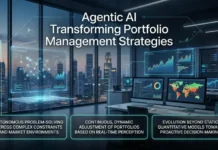
The use of these systems also allows for more effective coordination with how agentic AI is transforming portfolio management strategies by ensuring that the theoretical benefits of updated allocation methods are actually realized in the final performance figures. When an allocation agent decides to shift capital from one sector to another, the execution agents handle the heavy lifting of moving the money with the least possible friction. This tight integration between strategy and execution is vital for maintaining the integrity of the investment process and achieving the desired risk adjusted returns.
Real-Time Adaptive Feedback Loops in Trading Desks
One of the most powerful features of agentic AI is its ability to learn from its own experience. Every trade executed provides a wealth of data that can be used to refine the system’s internal models. If a particular tactic consistently leads to higher slippage in a certain market environment, the agent can identify this pattern and adjust its behavior for future trades. This continuous feedback loop is the heart of autonomous trading, ensuring that the system is always improving and adapting to the ever changing structure of global markets.
This learning capability also extends to the interpretation of market signals. As agents observe the market’s reaction to various events, they refine their understanding of how different types of news and order flow patterns correlate with price movements. If a specific pattern of activity in the options market consistently precedes a move in the underlying equity, the agent will learn to incorporate this signal into its execution strategy. This ability to discover and exploit non-obvious relationships is a key advantage of the agentic revolution in trading.
The automation of the feedback loop allows for a much faster pace of improvement than is possible with human-led analysis. A team of human traders can only review a limited number of trades in detail each day. An agentic system, however, can analyze thousands of executions in real time, identifying trends and anomalies that would be invisible to the human eye. This high speed evolution is essential for maintaining a competitive edge in a world where market structures and participant behaviors are constantly shifting.
Governance, Speed and Stability in Automated Trading Systems
As trading desks become more reliant on autonomous agents, the need for reliable governance and stability becomes paramount. The speed at which these systems operate means that a small error can rapidly escalate into a significant problem if not properly managed. This requires a multi-layered approach to risk control, where safety agents monitor the activity of the execution agents in real time. These safety agents check for consistency, identify potential runaway behavior, and ensure that all activity remains within the firm’s risk limits and regulatory mandates. This governance framework is an essential component of any institutional deployment.
Stability also involves the integration of human expertise. While agents can process data and execute trades far faster than humans, they may still struggle with unprecedented events that fall outside their training data. A human-over-the-loop model ensures that senior traders can monitor the performance of the agents and step in when necessary. This collaboration between human and machine creates a more reliable and trustworthy trading environment, combining the best of both worlds to achieve superior results.
Looking forward, the development of explainable AI will further enhance the governance of these systems. When an agent chooses a specific tactic or selects a particular venue, it will be able to provide a clear and concise explanation of its reasoning. This transparency is vital for building confidence among internal stakeholders and external regulators, ensuring that the use of autonomous agents in trading is both effective and responsible. By prioritizing governance and stability from the outset, firms can harness the full power of agentic AI while minimizing the risks associated with this powerful new technology. The future of the trading desk is one where human intuition and machine precision work in harmony to manage the complexities of global finance.