

















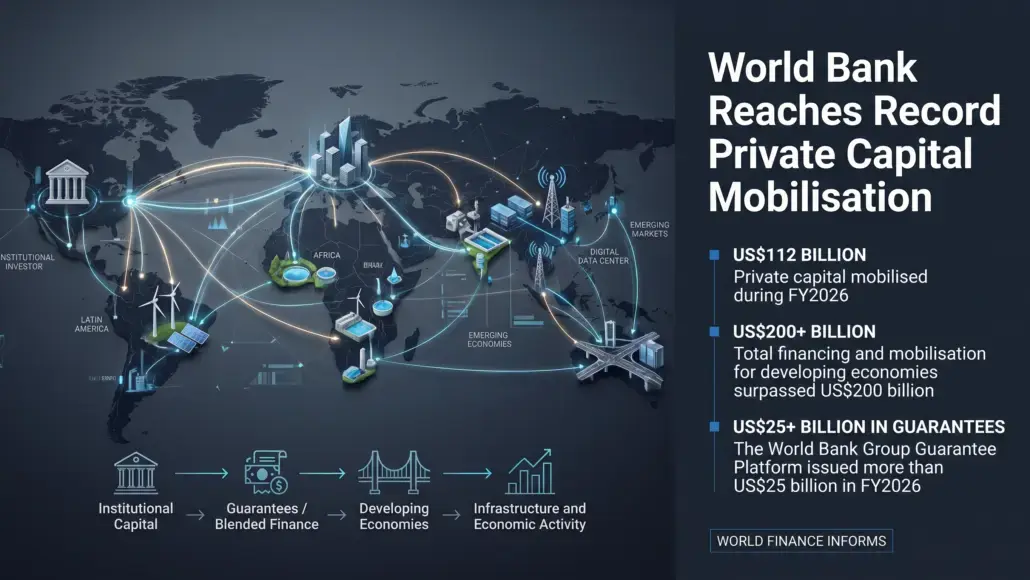

The World Bank Group has mobilised a record $112 billion in private capital during fiscal year 2026, more than tripling the $35 billion figure recorded in FY2022 and marking a substantial increase from $69 billion in FY2025. Combined with the institution’s own financing commitments, total financing and mobilisation directed toward developing economies surpassed $200 billion for the first time. The milestone reflects a deliberate shift in how the World Bank Group is attempting to channel institutional capital into markets where investment gaps remain vast.
Expanding Tools to Attract Institutional Capital
Central to the growth in private capital mobilisation is the World Bank Group Guarantee Platform, which issued more than $25 billion in guarantees during FY2026. The platform is designed to reduce risk for private investors entering markets they might otherwise avoid, using the World Bank Group’s credit standing to back sovereign and sub-sovereign obligations. By offering guarantees alongside local-currency financing options and equity instruments, the institution is working to build investment structures that appeal to pension funds, insurance companies and asset managers seeking exposure to developing economies without bearing the full spectrum of frontier-market risk.
The institution is also advancing what it describes as an originate-to-distribute approach. Under this model, the International Finance Corporation and other arms of the World Bank Group originate investments in developing economies and then package and distribute them to institutional investors at greater scale. The approach is intended to create a pipeline of bankable assets that meet the risk-return requirements of large allocators, effectively broadening the pool of capital available for development.
A concrete example of this strategy in action is the recent financing involving Banco Industrial in Guatemala. IFC backing helped the financial institution access international capital markets, demonstrating how blended structures and credit support from multilateral bodies can open doors for borrowers in smaller or less liquid markets. Transactions of this kind illustrate how private capital mobilisation works in practice, connecting local financial institutions with global investors through standardised and replicable deal structures.
Geographic Reach and Remaining Gaps
World Bank data shows that private capital mobilisation in FY2026 reached $22 billion in Africa, $37 billion in lower-middle-income countries and $50 billion in upper-middle-income countries. These figures reflect meaningful progress in directing capital toward regions that have historically struggled to attract private investment at scale. However, private capital mobilisation in low-income countries remained around $3 billion, underscoring the persistent difficulty of drawing commercial finance into the most challenging environments. Observers have noted that while the overall trajectory is positive, the concentration of flows in middle-income markets raises questions about whether the benefits of private capital mobilisation are reaching the economies that need them most.
The World Bank Group has stated its ambition to mobilise more than $200 billion in private capital within two to three years. This target reflects the institution’s broader strategy of positioning itself not primarily as a lender but as a platform for crowding in private finance. Whether that ambition is achievable will depend on sustained demand from institutional investors, continued innovation in guarantee and distribution instruments, and the ability to scale successful models like the Banco Industrial transaction across a wider range of countries and sectors. For now, the $112 billion milestone in FY2026 represents the clearest evidence yet that the strategy of private capital mobilisation is gaining traction across developing economies.

