















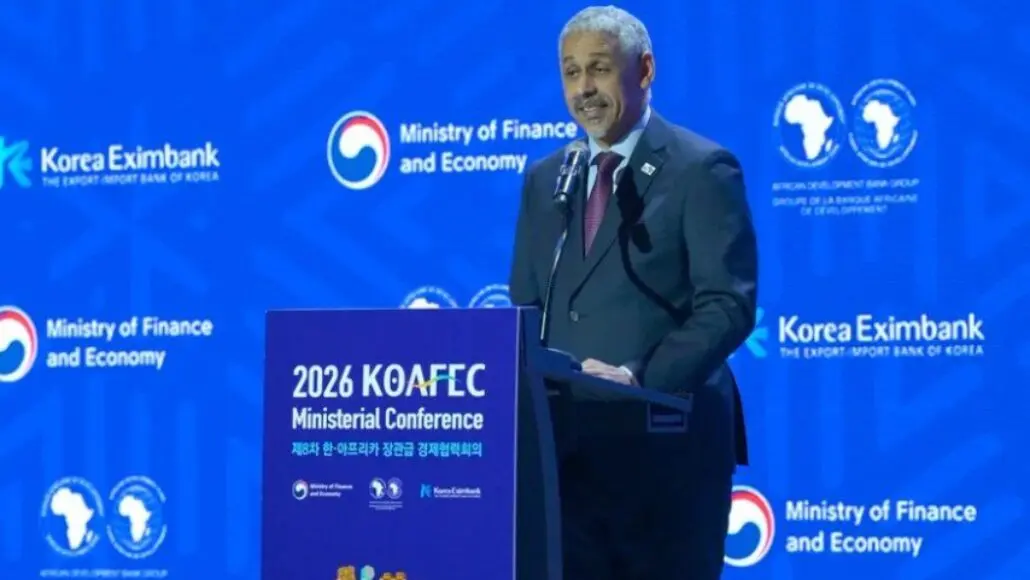

The African Development Bank and Korea’s Export-Import Bank have formalised a new co-financing partnership aimed at channelling additional capital into projects across Africa. The two institutions signed a memorandum of understanding on 9 September 2026 in Seoul, establishing a five-year framework that replaces their earlier cooperation agreement, which had been in place since 2005. The AfDB KEXIM co financing agreement sets out structured mechanisms for both institutions to jointly identify, evaluate and develop financing opportunities across the continent.
AfDB President Dr Sidi Ould Tah and KEXIM President and CEO Hwang Ki-yeon signed the memorandum on the sidelines of the 8th Korea-Africa Economic Cooperation Ministerial Conference. Dr Ould Tah stated that the priority is now to translate the framework into a concrete portfolio of high-impact projects by mobilising funding, technologies and expertise from the Korean private sector in areas essential to Africa’s economic transformation, notably artificial intelligence, digital infrastructure, critical minerals, energy and transport.
New Co-Financing Framework and Financial Instruments
The memorandum of understanding is designed to consolidate economic ties between Korea and the AfDB’s regional member countries while strengthening structured cooperation in co-financing. Under the AfDB KEXIM co financing framework, both institutions will collaborate more closely to assess and develop joint financing opportunities for Africa projects. The agreement allows both partners to draw on their respective financial instruments, including loans, guarantees and equity investments, to support eligible initiatives.
It is important to note that this agreement represents a cooperation and co-financing framework rather than a completed financing package tied to any specific project. The memorandum of understanding is intended to strengthen technical and financial cooperation between the two development finance institutions and support sustainable and inclusive growth in Africa. The AfDB KEXIM co financing structure provides a foundation for the institutions to align their resources and expertise when pursuing joint opportunities across the continent.
Priority Sectors and KOAFEC’s Broader Capital Mobilisation Role
The two institutions have identified several strategic sectors for their co-financing efforts. These include artificial intelligence and digital technologies, the infrastructure needed to deploy them, supply chain resilience, development and processing of critical minerals, energy, transport, urban development, green infrastructure, and products for financial institutions such as trade guarantee instruments. The breadth of these sectors reflects the scope of both institutions’ mandates and the range of Africa projects that could benefit from joint support.
The memorandum was launched alongside the KOAFEC Ministerial Conference, which in 2026 marks the 20th anniversary of the forum’s founding. Over the past two decades, KOAFEC has evolved from a political dialogue platform into a vehicle for project preparation, investment mobilisation and private-sector engagement. According to figures cited by the AfDB, KOAFEC has channelled about $50 million into project preparation since its inception, helping to generate an investment pipeline exceeding $6 billion and mobilise approximately $4 billion in financing. These figures represent KOAFEC’s historical track record and are not commitments under the new memorandum of understanding.
The renewed AfDB KEXIM co financing framework reflects both institutions’ shared commitment to accelerate investment in sectors that will shape Africa’s competitiveness over the coming decades. It positions the partnership to support development finance priorities at a time of growing international interest in the continent’s potential across digital technology, energy, infrastructure and value-added industrialisation. The AfDB KEXIM co financing agreement remains a cooperation framework, and specific project financing will depend on how the two institutions operationalise the mechanisms established under the memorandum of understanding.

