



















Close
Optic 2026
AFME’s European AML Conference 2026

Claims Intelligence is Becoming a Strategic Asset for Underwriting

Note* - All images used are for editorial and illustrative purposes only and may not originate from the original news provider or associated company.

Related stories

The Retirement Cliff Facing the Global Claims Workforce

Insurance claims work has always depended on experience. Complex...

Litigation Funding is Reshaping the Economics of Insurance Claims

Litigation is no longer funded only by the people...

AI Regulation is Reshaping the Future of Insurance Claims

Artificial intelligence is becoming a more common part of...

Claims have traditionally been used to understand what happened after an insured event. A loss was reported, investigated, settled and eventually recorded as part of the insurer’s claims history. That information then fed into reserving and performance analysis. But the role of claims data is starting to change. Insurers are increasingly looking at claims as a source of claims intelligence that can help them understand what may happen next.

The difference is important. Claims can reveal changes in loss severity, litigation behaviour, repair costs, fraud patterns, emerging exposures and differences between jurisdictions. When those signals are connected to underwriting, they can help insurers reassess risks before a policy reaches renewal rather than waiting for a loss trend to become obvious in historical results.

The shift is already visible across the market. Recent research found that 92% of property and casualty insurers expect big data to generate significant improvements in areas including pricing, underwriting, claims management and client experience. Separate research across European insurers found that AI is already being used across areas including pricing, underwriting, claims and fraud detection, showing how claims and underwriting are becoming increasingly connected through data and analytics.

This is creating a new role for claims intelligence. Instead of treating claims as a final record of loss, insurers can use patterns in those claims to identify changes in risk while there is still time to act.

Claims are Becoming an Early Signal for Underwriting

The value of claims data does not necessarily come from any one claim. It comes from patterns that appear across thousands of claims over time.

A rise in claims severity in one industry, for example, could signal that the underlying risk is changing. A growing number of disputes in a particular jurisdiction could point to a change in litigation exposure. Rising repair costs could indicate that existing loss-cost assumptions need to be revisited. Repeated claims involving a particular asset, process or type of incident could also reveal an exposure that was not fully understood when a policy was originally priced.

This makes claims intelligence useful well before a claim is finally closed. The Connected Claims industry agenda is increasingly focused on creating governance and data flows that move loss information into underwriting and actuarial teams ahead of renewal, including signals such as plaintiff tactics, jurisdictional trends and emerging exposures.

For insurers, that can change the underwriting cycle from a largely retrospective process into a more continuous one. Instead of waiting until a claim is closed to study what happened, insurers can monitor claims continuously, identify emerging risk patterns early, and use those insights to adjust underwriting decisions before the next policy renewal.

The commercial value lies in what happens next. An insurer may reprice a risk, change policy terms, adjust limits or retentions, increase risk controls, or reconsider its appetite for a particular exposure. The decision will vary by line of business, but the underlying idea is the same: claims data becomes an input into the next underwriting decision, rather than a report on the previous one.

That is why claims intelligence is becoming more than a claims-management tool. It is becoming part of how insurers decide where and how they deploy underwriting capacity.
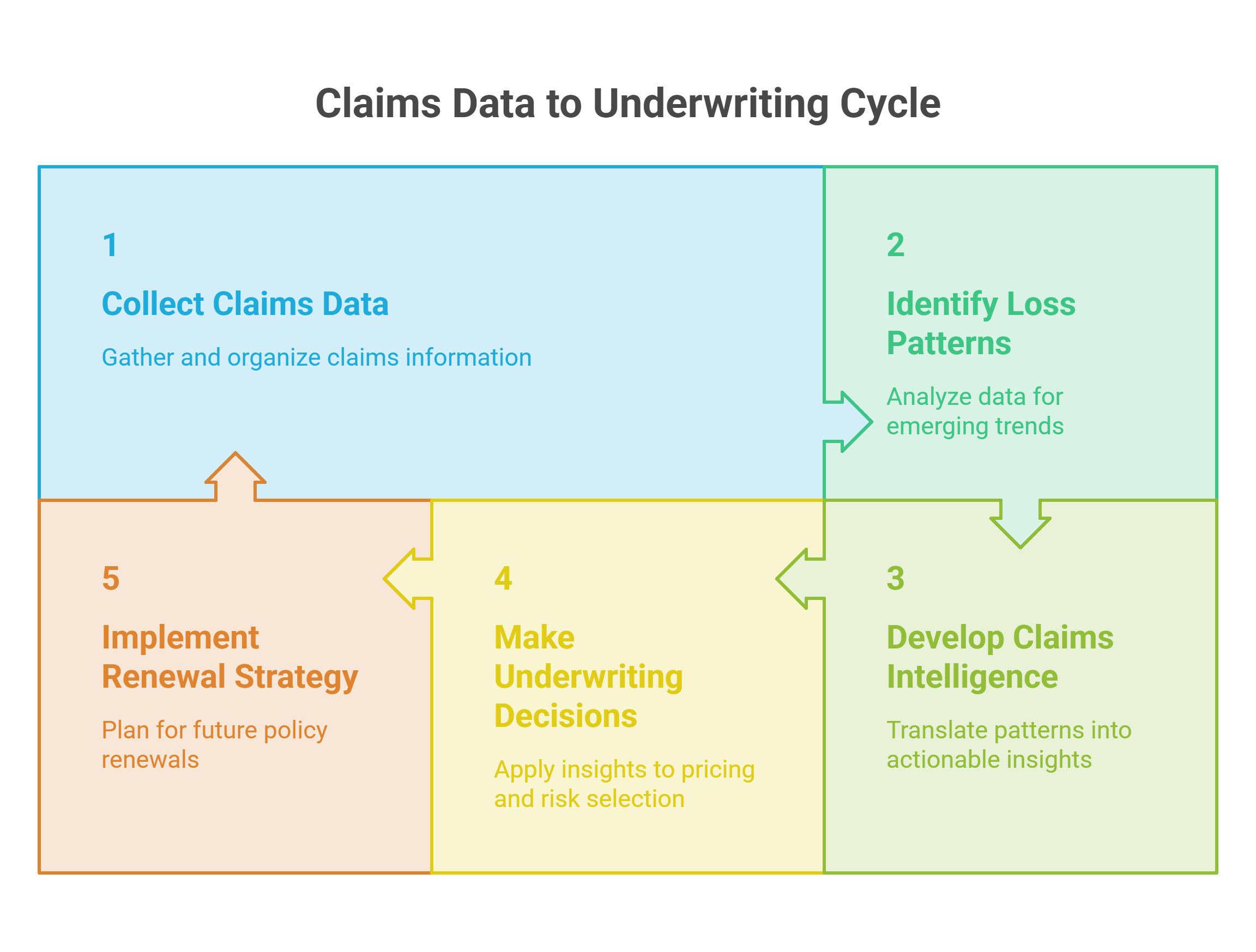
Key takeaway: Claims data becomes more valuable when it is used to identify emerging risk before the next underwriting decision.

Claims Intelligence is Turning into a Cross-Functional Insurance Asset

The value of claims intelligence becomes much greater when claims information is connected with the teams that decide how risk should be priced and managed. Instead of leaving claims data inside the claims function, insurers can use it alongside underwriting, actuarial, risk and product information to identify changes in an exposure before they become a larger portfolio problem.

That requires more than collecting more data. Claims records often sit across different systems and contain a mix of structured information, adjuster notes, documents, images and external data. Turning all of that into something an underwriter can act on requires consistent data definitions, reliable pipelines and tools that can identify meaningful patterns.

This is already becoming part of the wider digitalisation of insurance. Research from the European insurance market found that 50% of non-life insurers and 24% of life insurers were already using AI across parts of the insurance value chain, including pricing, underwriting, claims and fraud detection. The same research found that most reported AI use cases were still being used with human involvement, rather than operating fully independently.

The important point is that claims intelligence does not have to mean replacing underwriters with algorithms. It can give them better information at the point where judgement is still required.

From Claims Signals to Underwriting Decisions

Consider a commercial insurance portfolio where claims involving a particular type of equipment are becoming more frequent. On their own, those claims are historical records. Combined with repair costs, location data, incident descriptions and policy information, they can reveal that the underlying risk is changing.

The same applies to litigation. If claims teams begin seeing more disputes in a particular jurisdiction, changes in plaintiff behaviour or higher settlements for a specific type of exposure, that information can become relevant to the next underwriting decision.

The value comes from connecting those signals early enough to influence action. An insurer may decide to adjust pricing, change deductibles or limits, introduce risk-management requirements, alter its appetite or review a relationship before the next renewal.

That is why the industry is increasingly treating claims data as an underwriting intelligence asset, rather than simply a record of past losses. Current industry research points to data and analytics becoming more important in risk selection and pricing as insurers respond to changing claims severity and increasingly specific differences between products, industries and geographies.

The financial benefit is ultimately tied to the quality of those decisions. Better claims intelligence does not automatically produce better underwriting, but it can give insurers a faster view of where their assumptions are changing.

Data Quality is Becoming as Important as Data Volume

The biggest barrier may therefore be less about how much claims data insurers have and more about whether they can use it consistently.

Legacy systems, different coding standards, incomplete records and unstructured claims information can make it difficult to compare losses across portfolios. A signal that is obvious to one claims team may be difficult for an underwriting team to identify if the underlying information is stored differently across systems.

Regulation is adding another layer. As insurers increasingly use third-party data, models and AI in pricing and underwriting, regulators are paying closer attention to data governance, fairness, explainability, record-keeping and model risk. In the US, regulatory work is now specifically examining frameworks for third-party data and models used in property and casualty pricing and underwriting.

For insurers, this makes the next stage of claims intelligence less about gathering the largest possible data set and more about building a reliable connection between claims information and business decisions.

The insurers that can turn fragmented claims records into clear, timely and trustworthy risk signals will have a stronger basis for deciding which risks to price, which risks to change, and where to deploy underwriting capacity next.

Conclusion

The value of claims intelligence comes from turning past losses into better decisions about future risk. When claims data can reveal changes in severity, litigation, fraud, geography or emerging exposures early enough, underwriting teams can respond before those trends become embedded across a portfolio. Current market research shows insurers are already leaning more heavily on data and analytics to differentiate risks and maintain underwriting discipline.

The challenge is making that information reliable and usable. Fragmented systems, inconsistent data and growing regulatory expectations can limit how quickly claims insights reach underwriters. But as insurers improve the connection between claims, actuarial and underwriting teams, claims intelligence can become a more important part of pricing, risk selection and capital allocation.

The real opportunity is not simply having more claims data. It is using that data early enough to make better underwriting decisions.

World Finance Informs brings together the global financial industry — from banking and investment leaders to fintech innovators and capital markets professiona ls — through trusted editorial, market intelligence, and digital engagement.

Our 2026 Media Pack offers integrated solutions to reach your audience:

  • Magazine & Digital Editions Showcase your brand within premium financial industry coverage read by execut ives and decision - makers worldwide.
  • Industry Insights & Reports Align with data - driven analysis, trend reports, and regional roundups across the global finance and banking value chain.
  • Brand Authority & Credibility Position your company as a thought leader through expert commentary, interviews, and special features.

Subscribe

- Never miss a story with notifications

- Gain full access to our premium content

- Browse free from any location or device.

Media Packs

Expand Your Reach With Our Customized Solutions Empowering Your Campaigns To Maximize Your Reach & Drive Real Results!

– Access the Media Pack Now

– Book a Conference Call

Leave Message for Us to Get Back

Latest stories

Related stories

The Retirement Cliff Facing the Global Claims Workforce

Insurance claims work has always depended on experience. Complex...

Litigation Funding is Reshaping the Economics of Insurance Claims

Litigation is no longer funded only by the people...

AI Regulation is Reshaping the Future of Insurance Claims

Artificial intelligence is becoming a more common part of...

Catastrophe Claims are Creating Persistent Pressure on Insurers

Natural catastrophes are no longer creating occasional spikes in...

Subscribe

- Never miss a story with notifications

- Gain full access to our premium content

- Browse free from any location or device.

Media Packs

Expand Your Reach With Our Customized Solutions Empowering Your Campaigns To Maximize Your Reach & Drive Real Results!

– Access the Media Pack Now

– Book a Conference Call

Leave Message for Us to Get Back

Translate »