




















Global debit card market was valued at $95.7 billion in 2023 and is anticipated to expand to $151.1 billion through 2032 at a compound annual growth rate (CAGR) of 5.5% from 2024 to 2032. The estimated growth further solidifies the role of the debit card as one of the pillars of the financial services sector. Expansion is being fuelled by the global shift towards electronic payments, banking infrastructure consolidation, and ongoing technological innovations in payment systems, which support increased security as well as cashless transactions. Due to their widespread acceptance for in-store as well as e-commerce buying, debit cards continue to play a key role in supporting the operations of present-day payment systems.
Debit card is one form of electronic payment media that draws directly on a consumer’s checking account upon purchase. In contrast to credit cards, which provide a line of credit, debit cards only tap available funds, and consumers have direct control over how much to spend within established limits. Debit cards are applied to in-store and internet purchases, ATM withdrawals, and contactless transactions. Security features such as PINs and EMV chip technology provide protection from fraud, while widespread acceptance across retail, service, and online channels ensures continued relevance in a fast-paced cashless economy.
Regional Insights: Global Debit Card Market Size
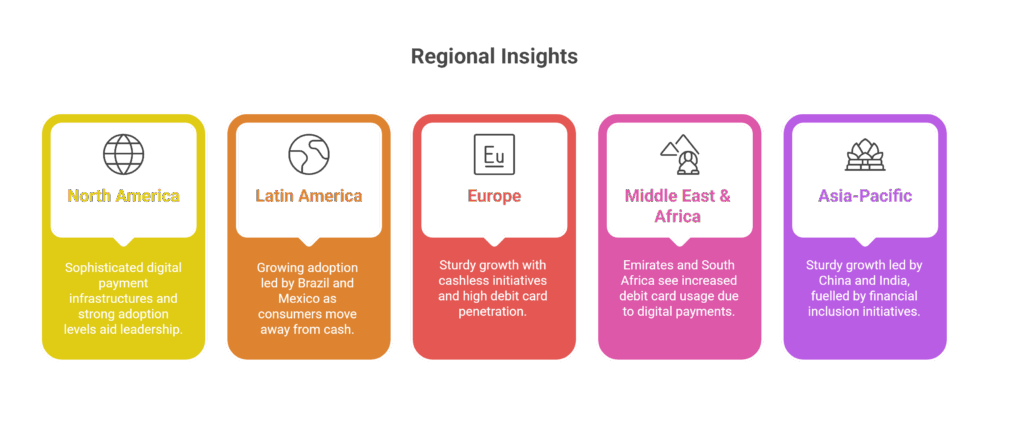
The performance of the debit card market differs geographically with the varying adoption of payments, infrastructure development, and regulatory policies:
- North America – Retains the leadership position, aided by sophisticated digital payment infrastructures and strong adoption levels.
- Latin America – Growing adoption, led by Brazil and Mexico, as consumers increasingly move away from cash to card payments.
- Europe – Records strong growth with region-level cashless initiatives and high debit card penetration in major economies.
- Middle East & Africa – The Emirates and South Africa are seeing debit card usage increase due to the adoption of digital payments.
- Asia-Pacific – Posts sturdy growth led by China and India, fuelled by government-supported financial inclusion initiatives.
Technological Solutions and Developments
Debit card technology is evolving to address changing customer and regulatory requirements. Contactless payment functionality, chip-and-PIN authentication, and mobile wallet inclusion are enhancing transaction security and convenience. New developments include handling transactions in real time, multi-currency functionality, and value-based card solutions. Dual-interface biometric cards are finding growing use in the banking sector for their enhanced payment authentication. However, cost of production, security concerns in contactless payments, and infrastructure upgrades at the point of sale remain hurdles to their widespread adoption. All these drawbacks will be mitigated with technology growth and improved manufacturing.
Regulatory Environment
Governments are embracing regulations to raise payment security, extend financial inclusion, and boost transparency in fees.
In the United States, interchange fee and routing regulations have been revised to facilitate competition and lower merchant costs. In the European Union, policies aimed at increasing authentication of electronic payments have been established. Canada has revised its payment industry code to protect merchants against hefty fees. In Australia, reforms aimed at reducing interchange fees are driving cost efficiency and elevated consumer debit card usage. These policies are affecting market development through consumer protection and industry growth support.
Market Segmentation and Regional Developments
Debit card market is divided based on type, end-user category, and geography. Based on type, the market is divided into plastic cards and metal cards. End-user categories include retail, hospitality, transportation, healthcare, and others. The market is geographically divided into North America, Europe, Asia-Pacific, Latin America, and the Middle East & Africa.
Evolution varies by region. In Indonesia, the National Payment Gateway (GPN) mandates all debit card transactions to be processed locally, making it more efficient and secure. In Germany, adoption of contactless payments has increased, particularly for public transportation. In Asia-Pacific, tap-and-go payments in such segments as grocery and pharmacy retail are increasing at a higher rate than payments that are not contactless. Regulatory efforts to lower interchange fees, as well as innovations in biometric-enabled cards, are driving adoption patterns in several regions.
Industry Trends
The debit card industry is undergoing significant transformation, shaped by shifting consumer behaviours, environmental considerations, and advancements in payment infrastructure. Increasing demand for sustainable solutions has led to the introduction of bio-sourced and recyclable debit cards, some incorporating biodegradable materials to minimise environmental impact. Contactless and tap-to-pay transactions continue to rise sharply, particularly in public transportation, quick-service retail, and healthcare facilities, driven by consumer preference for faster, touch-free payment options.
In addition, there is growing interest in biometric authentication features, such as fingerprint verification, to improve security and reduce the risk of fraud without compromising convenience. Many markets are also witnessing expanded debit card functionality, enabling cross-border usage with dynamic currency conversion and integration with mobile banking platforms. These trends point to a broader diversification of debit card applications, moving beyond traditional retail transactions toward everyday lifestyle and utility payments.
Market Outlook
The global debit card market is projected to sustain steady growth through 2032, supported by a combination of technological, regulatory, and behavioural factors. Regulatory measures aimed at reducing transaction costs and improving payment transparency are likely to encourage wider acceptance among merchants. Technological innovations, including contactless payment capabilities, biometric-enabled cards, and real-time payment integration, will further enhance the convenience and security of debit card use.
Emerging economies are expected to contribute significantly to future growth, as financial inclusion programmes expand banking access to previously underserved populations. In parallel, mature markets will likely see increased card replacement cycles, with issuers upgrading to more advanced, secure, and environmentally responsible products. Although challenges such as infrastructure investment, production costs, and evolving cybersecurity threats will persist, the combination of innovation, consumer trust, and supportive policy frameworks is set to reinforce the debit card’s role as a central pillar of global payment systems well into the next decade.

