



















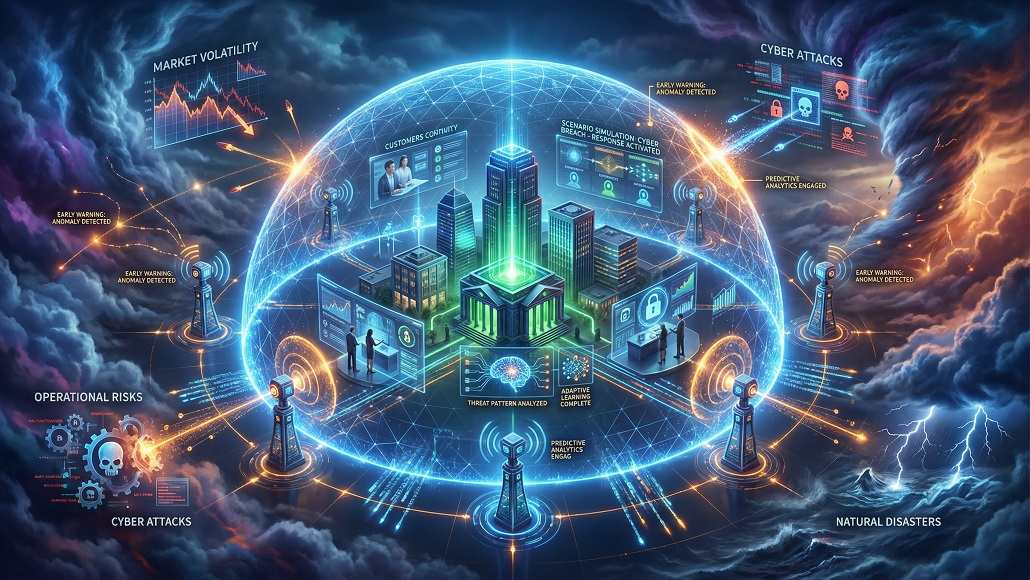

Financial institutions operate in an increasingly volatile and unpredictable environment. Market disruptions, cyber attacks, natural disasters, regulatory shocks, and operational failures threaten continuity with growing frequency and sophistication. The 2008 financial crisis, the COVID-19 pandemic, the SolarWinds cybersecurity breach, and countless other incidents demonstrate that institutions unprepared for major disruptions face existential threats.
Historically, financial institutions managed risk through reactive and defensive approaches. Risk management teams identified risks through analysis of historical data and established controls to prevent them. Business continuity teams prepared disaster recovery plans against known failure scenarios. Cybersecurity teams defended networks against known attack vectors. This defensive approach provided meaningful protection against anticipated threats but left institutions vulnerable to novel disruptions that didn’t fit historical patterns.
AI fundamentally transforms this approach by enabling financial institutions to shift from reactive to proactive resilience. Rather than defending only against known threats, AI systems anticipate emerging threats, model potential consequences, and orchestrate dynamic responses. This shift—from preparing for disruptions we’ve seen before to anticipating disruptions we haven’t—represents the frontier of institutional resilience.
From Reactive to Predictive Risk Management
Traditional risk management operates through a cycle of identification, analysis, and control. Risk managers identify risks through analysis of regulatory guidance, industry experience, and internal incidents. They analyze potential consequences and determine whether controls exist. They implement new controls for risks lacking adequate mitigation.
This approach works well for established, well-understood risks. But it struggles with emerging risks that don’t yet have obvious patterns. Before the 2008 financial crisis, few risk managers had modeled the consequences of simultaneous defaults across correlated mortgage portfolios. Before the cybersecurity crisis, institutions hadn’t anticipated supply chain compromises that could propagate across thousands of organizations. Before pandemics disrupted operations, few had stress-tested remote work capability at the enterprise scale.
AI-powered predictive risk management approaches these gaps by analyzing patterns in vast datasets to surface emerging risks before they manifest in crises. Machine learning algorithms analyzing transaction patterns, market data, and operational metrics can detect subtle signals of emerging threats. A sudden change in transaction flows across correspondent banks might signal a geopolitical crisis beginning to impact financial flows. An unusual pattern in employee access attempts might signal the early stages of an insider threat. Unexpected volatility in previously stable market relationships might signal the emergence of new systemic risk.
This early warning capability is valuable not because it allows perfect prediction—future disruptions will inevitably surprise—but because it compresses the time between problem emergence and problem recognition. Institutions aware that a threat is emerging can begin response preparation while the threat is still manageable rather than discovering the problem only after it has grown critical.
Advanced Scenario Modeling and Simulation
Traditional stress testing in financial institutions involves selecting plausible adverse scenarios—a severe recession, a market crash, a credit event affecting major counterparties—and analyzing how the institution would fare under those conditions. This approach provides meaningful insight into resilience but faces a fundamental limitation: it focuses on scenarios that have occurred historically. It cannot easily explore novel scenarios that combine known elements in new ways.
AI enables dramatically advanced scenario modeling. By training on historical data while incorporating simulations of novel combinations, AI can generate thousands of stress scenarios and rapidly evaluate institution resilience across all of them. What if a market shock occurred simultaneously with a major cyber attack? What if regulatory changes forced rapid asset reallocation at the same time customer deposits accelerated outflows? What if a natural disaster affected multiple critical data centers while a cyber attack targeted backup systems?
These novel scenarios might seem contrived, but history suggests they are precisely the types of combined disruptions that strain and break inadequately prepared institutions. The value of exploring them before they occur is immense. Institutions that discover through simulation that their recovery procedures would fail under certain combined scenarios can invest in new controls and procedures before a real crisis occurs. Those that discover such failures only during actual crises face catastrophic consequences.
AI-powered simulation also enables rapid scenario iteration as conditions change. A scenario modeling the impact of regulatory changes can be updated within hours of new regulatory guidance, allowing institutions to immediately understand how new rules affect their resilience posture.
Automated Threat Detection and Response
Perhaps the most transformative resilience capability AI enables is automated threat detection and response. Consider cybersecurity, where the traditional model involves security teams monitoring for known attack patterns and responding when attacks are detected. Given the volume of network traffic and the creativity of attackers, significant attacks often succeed before detection.
AI-powered threat detection systems analyze network traffic, system behavior, and data flows to identify anomalies—deviations from normal patterns that might indicate an attack. Anomaly detection is more powerful than signature matching because it can detect novel attacks that don’t match known patterns. When potential threats are detected, these systems can automatically execute immediate response actions: isolating affected systems, blocking unusual traffic patterns, enforcing additional authentication, and alerting human security teams.
The power of automation in response becomes evident at scale. A bank with 10,000 employees, thousands of systems, and billions of daily transactions experiences constant low-level security incidents. Some are genuine threats; many are false alarms. Manual investigation of every incident is impossible. Automated response enables the institution to respond to common, well-understood threats immediately while human security teams focus on unusual incidents that might indicate genuine attacks.
Similar automation applies to operational disruptions. If a critical system fails, automated responses might include routing transactions through backup systems, notifying customers of potential delays, triggering business continuity procedures, and escalating to operations leadership. Rather than discovering failures and manually initiating responses—a process that takes hours in many institutions—automated responses execute within seconds.
Orchestrating Institution-Wide Response
The most sophisticated resilience automation goes beyond responding to isolated incidents to coordinating institution-wide responses to major disruptions. When a major cyber attack affects multiple systems simultaneously, dozens of decisions must be made rapidly and in coordination: Which customer communications take priority? Which operations continue at reduced capacity versus full suspension? How are backup systems engaged? How are stakeholders informed? How are regulators notified?
Institutions attempting to make all these decisions manually during crises inevitably make suboptimal choices and miss coordination opportunities. AI systems trained on resilience procedures can orchestrate coordinated responses automatically. The system understands which customer communications are regulatory requirements versus discretionary. It understands which operations are critical to support and which can be suspended. It understands cascading dependencies—that stopping one operation might necessitate stopping several others.
This orchestrated response is possible because the AI system has been trained not just on what to do in disruptions, but on the business logic and regulatory requirements that drive decision-making. The system knows not just the technical procedures for switching to backup systems but the business implications of doing so.
Building Institutional Resilience Through Continuous Learning
A final critical resilience capability AI enables is continuous learning from disruptions. Each incident—whether it’s a near-miss, a minor disruption, or a major crisis—provides information about how institutions actually respond and where improvements are needed.
Traditional institutions often fail to systematically capture this learning. An incident occurs, a task force investigates, a report is produced with recommendations, and then the incident is often forgotten. New incidents occur repeatedly because the organization hasn’t embedded lessons into operational procedures.
AI systems analyzing incidents can extract and systematize learning. After a cyber attack, the AI system analyzes what vulnerabilities were exploited, how the attack spread, how detection and response proceeded, and what could have been done differently. This analysis feeds back into threat detection procedures, response protocols, and simulation scenarios. The institution’s resilience posture improves not through voluntary behavior change but through systematic updating of automated systems.
The Competitive Imperative of Resilience
As financial markets become increasingly complex and interconnected, resilience has become a competitive differentiator. Customers, investors, and regulators increasingly value stability and reliability. Institutions demonstrating superior resilience through lower incident rates, faster recovery from disruptions, and maintenance of operations during crises attract customers and capital while less-resilient competitors struggle.
The financial institutions thriving in the coming decade will be those that embrace AI-powered resilience strategies. They will detect emerging risks earlier, prepare more thoroughly through advanced simulation, respond faster through automation, and learn continuously from incidents. These compounding advantages create widening gaps between well-prepared and poorly-prepared institutions.
Implementation Challenges and Priorities
Despite clear benefits, implementing AI-driven resilience faces real challenges. Building robust threat detection systems requires access to comprehensive data about what normal operations look like—data that often spans multiple systems not designed to share information. Automated response systems raise governance challenges: How much autonomy should automated systems have? When must human judgment override automated responses? What audit trails are necessary?
Institutions succeeding with these challenges typically begin with specific, high-value use cases. A bank might start by implementing automated cyber threat detection and response in a single business unit before expanding institution-wide. An insurer might begin using AI to predict emerging policyholder risks in a specific product line before expanding to other products. These focused starts allow institutions to build capability, establish governance, and learn lessons before attempting comprehensive rollout.
Looking Forward
The financial institutions best positioned for sustained success will be those that realize resilience is not a compliance exercise or risk management function—it’s a strategic imperative that affects every business decision. Institutions embedding AI-driven resilience into operations, strategy, and culture will demonstrate superior performance through disruption and accumulate competitive advantage over time. Those treating resilience as peripheral will find themselves increasingly vulnerable to disruption in an increasingly volatile world.