



















Artificial intelligence is gaining a more specific role in post-trade operations, where the quality of underlying data can determine how effectively it is used. Rather than treating AI as a standalone automation tool, financial institutions are increasingly examining how it can work with trade records, reference data, settlement instructions, reconciliations and exception queues. The focus is shifting toward the operational foundations that allow AI to identify problems, understand their causes and support faster resolution.
The need is particularly clear in post-trade, where a single transaction can generate information across multiple systems and participants. Trade details, account information, settlement instructions and reference data all need to remain consistent as a transaction moves toward settlement. When those records do not match, an exception is created and an operations team may have to investigate the discrepancy before deciding what action is required.
This makes AI in post trade different from the broader use of AI across capital markets. The question is not simply where AI can be deployed. It is whether the information surrounding a transaction is structured and accessible enough for AI to work with reliably. The underlying data environment becomes part of the automation problem.
Post Trade AI Depends on Better Data
Post-trade processes rely on information arriving from different systems, often in different formats and with different levels of context. A reconciliation process may identify a mismatch, for example, but resolving that mismatch can require reference data, settlement information, previous transactions and communications to be examined together.
Traditional automation works most effectively when rules and inputs are clearly defined. AI can potentially handle a broader range of information, including unstructured material, but it still needs enough context to distinguish one record from another and understand which information is relevant.
This is becoming more important as settlement timelines become tighter. The shorter the time available to resolve an exception, the less practical it is to rely on long manual investigations. The European T+1 transition is adding to this pressure by requiring post-trade processes to be completed within a narrower operating window, increasing the importance of timely and accurate information.
Standing settlement instructions offer a useful example of the problem. Recent research found that up to 40% of standing settlement instructions are still processed manually, while invalid instructions contribute to nearly one-third of settlement failures. These figures relate specifically to settlement instructions, but they illustrate the wider consequences of fragmented and manually handled operational data.
AI can potentially support this type of workflow by extracting information from documents, comparing instructions with existing records and identifying inconsistencies before they lead to a failed process. The opportunity is not simply to process more information. It is to turn information that previously required manual interpretation into structured input that can be checked and acted upon more quickly.
Data quality therefore becomes a prerequisite rather than a secondary consideration. Recent research into AI and agentic systems in capital markets highlights the growing importance of metadata, lineage, provenance and timestamps, particularly as machines begin to consume operational information and make decisions from it.
That creates a more practical definition of the challenge. The value of AI in post-trade does not depend only on the model’s ability to identify patterns. It also depends on whether the surrounding operational infrastructure can provide reliable data, connect relevant records and preserve enough context for the system to determine what happened.
The result is that better data and better exception management are becoming closely linked to the next stage of post-trade automation. AI may reduce the effort required to find and investigate operational problems, but its effectiveness will depend on how well the underlying information has been structured, connected and governed.
Exception Management is Becoming an AI Use Case
The value of AI in post Trade becomes clearer when the focus shifts from identifying a problem to understanding why it happened. Post-trade teams often deal with exceptions that require information to be gathered from several systems before a decision can be made. An unmatched record, an incorrect settlement instruction or a failed transaction may look like an isolated break, but resolving it can involve trade data, reference information, account details and communications from different parties.
AI can support this investigation by recognising patterns across those records, classifying exceptions and helping operations teams determine which cases require immediate attention. Recent industry research describes post-trade AI applications including anomaly detection, settlement-failure prediction, exception handling and faster investigation of operational breaks.
Standing settlement instructions provide a concrete example of where this can matter. Up to 40% of SSIs are still processed manually, while invalid instructions account for nearly one-third of settlement failures, according to recent industry research. Manual handling can involve emails, PDFs, spreadsheets, callbacks and repeated data entry, creating additional opportunities for errors before an instruction reaches the settlement process.
AI can potentially reduce some of that friction by extracting information from unstructured documents, validating it against relevant rules and existing records, and identifying discrepancies for review. This is different from simply automating data entry. The more useful capability is connecting information from different parts of the workflow so that an exception can be investigated with greater context.
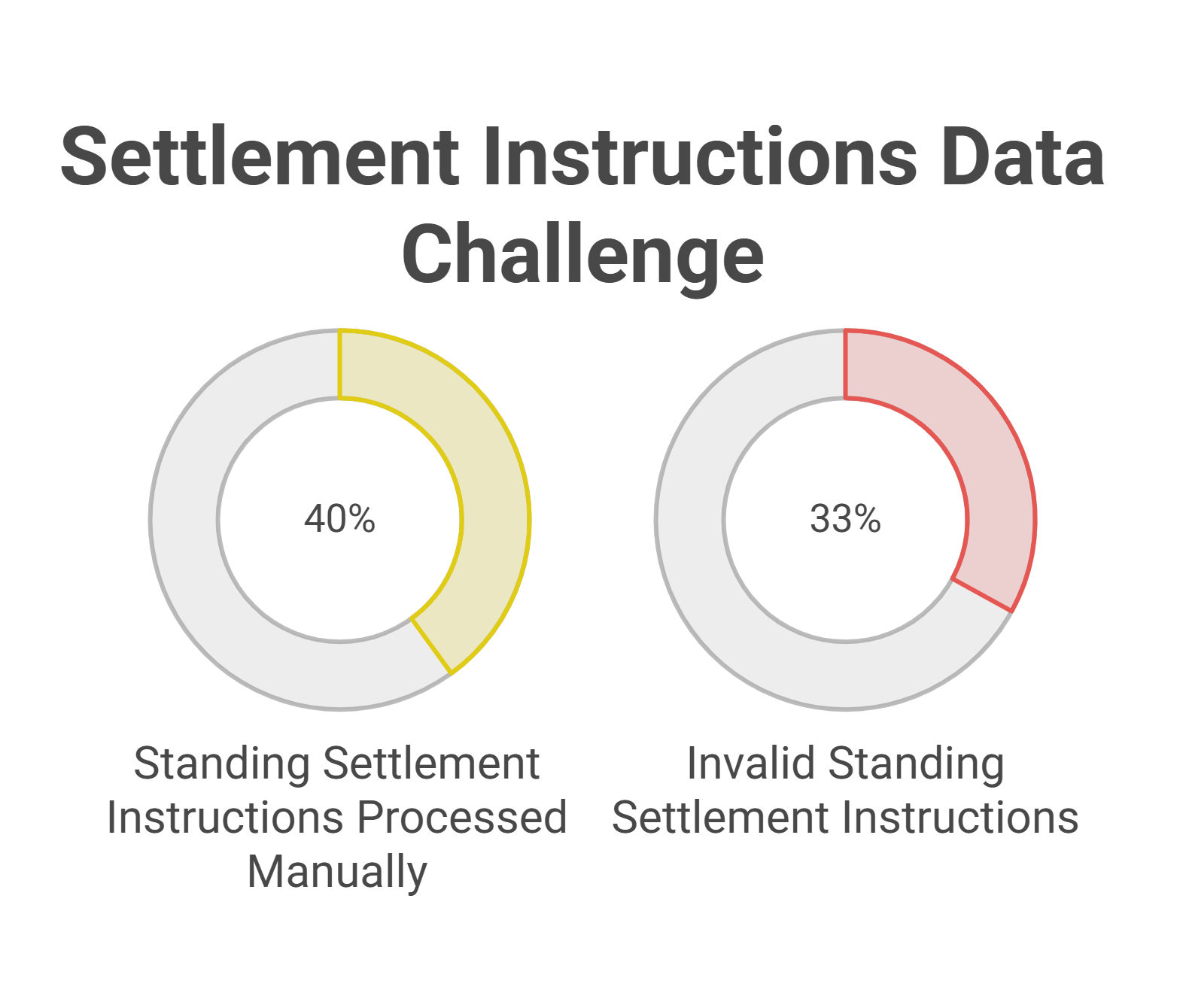
Key Takeaway: Manual and invalid settlement instructions remain a significant source of post-trade friction, showing why data validation and structured exception management are important foundations for AI-enabled automation.
Better Data Does Not Remove the Need for Human Judgement
As AI moves further into post-trade workflows, the quality of the underlying data becomes increasingly important. Recent research on agentic AI in financial institutions argues that data needs to carry context, provenance and timestamps because AI systems are less able than humans to resolve ambiguity when information is incomplete or inconsistent. The study found that 52% of 628 surveyed financial institutions were already piloting agentic AI or had reached more advanced deployment stages, while 84% of capital-markets firms surveyed viewed AI agents as a new layer of enterprise capability.
For post-trade operations, that means an AI system needs more than access to large datasets. It needs to understand which record is authoritative, when the information was produced, what it relates to and how it should be compared with other records.
This also places limits on automated resolution. AI may be able to identify a likely cause or recommend a corrective action, but a material settlement or reporting decision may still require human review. Auditability becomes important because operations and control teams need to understand what information the system used and why a particular action was recommended. Research on AI in capital markets similarly identifies traceability, auditability and model-risk controls as important safeguards for post-trade applications.
The direction is therefore not toward removing people from exception management altogether. It is toward changing where human effort is applied. AI can handle more of the searching, comparison and initial classification, while people concentrate on complex cases, judgement and oversight.
That makes better data and exception management more than prerequisites for AI. They become part of the operational infrastructure required to make AI reliable in post-trade.
Conclusion
AI in Post Trade is becoming increasingly dependent on the quality of the operational data surrounding each transaction. Better data can help AI identify discrepancies, classify exceptions and support investigation, but the technology cannot remove the underlying complexity of fragmented post-trade processes.
The immediate opportunity is therefore not full automation. It is using AI to reduce repetitive investigation and help operations teams resolve problems more efficiently, while maintaining appropriate human oversight, traceability and governance.
As post-trade activity becomes more time-sensitive, particularly with Europe’s move toward T+1 settlement, better data, stronger standardisation and more structured exception management will become increasingly important foundations for reliable AI-enabled operations.