




















Europe’s move to a one-business-day settlement cycle is changing the amount of time available for the processes that sit between trade execution and settlement. The transition to T+1 settlement is scheduled for 11 October 2027, giving market participants a fixed deadline to adapt the way post-trade activity is completed across the European market. Regulators have identified 2026 as a critical preparation year, with firms expected to test their readiness and address operational changes well before the deadline.
The change is straightforward in principle. Under the current T+2 model, eligible securities transactions generally settle two business days after the trade date. Under T+1, settlement moves forward by one business day. But the operating consequences extend beyond the settlement instruction itself. Processes such as trade allocation, confirmation, matching and settlement instruction have to be completed within a much tighter window, leaving less room for delays, manual intervention and error correction.
The European regulatory work already reflects this shift. Proposed changes to settlement-discipline rules include same-day timing for trade allocations and settlement instructions, as well as machine-readable formats for allocations and confirmations. The changes are intended to support the move to T+1 and are being introduced through a phased timetable beginning in December 2026.
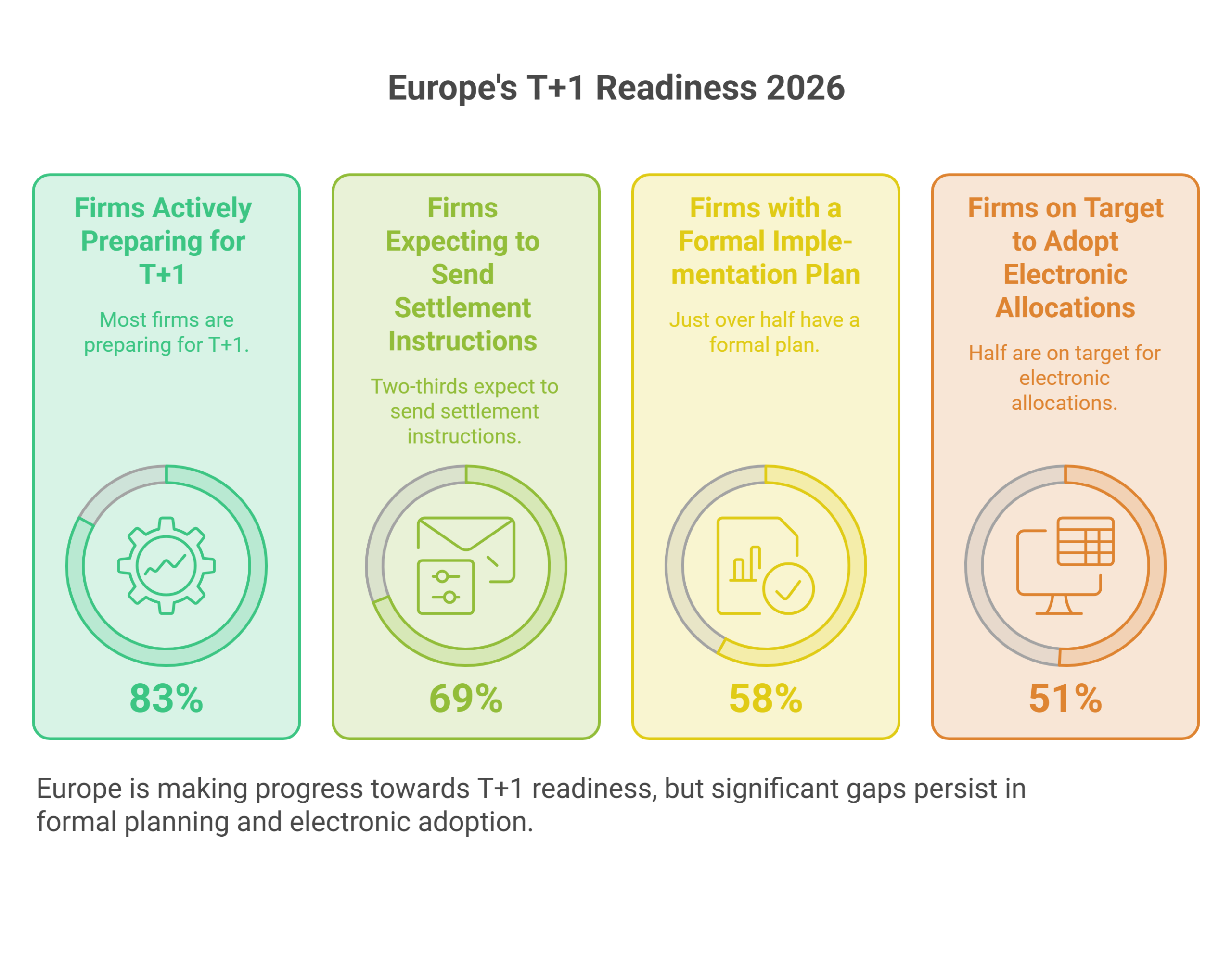 Key Takeaway: Preparation is advancing across European markets, but readiness remains uneven and depends increasingly on coordination across the wider settlement chain.
The Settlement Window is Getting Compressed
The practical effect of T+1 is therefore not simply that settlement happens a day earlier. More of the preparation needed to reach settlement has to happen earlier as well.
Trade allocation is one example. Once a transaction is executed, the relevant details have to be distributed to the appropriate parties and confirmed. Those steps can then feed into matching and settlement instructions. Under a shorter cycle, delays at any point can leave less time for downstream processes to identify and correct an exception.
The EU T+1 Industry Committee’s latest readiness survey illustrates how rapidly firms are preparing for this compressed operating environment. Conducted across more than 1,000 market participants, the second survey found that 83% of firms were actively preparing for T+1, while 58% already had a formal implementation plan. At the same time, readiness remained uneven, with larger infrastructures and major intermediaries generally further ahead than smaller firms and some buy-side participants.
That unevenness matters because settlement is an interconnected process. A firm can prepare its own systems and still face problems if another participant in the transaction chain is not ready to exchange information within the required timeframe. ESMA has therefore stressed that firms should assess not only their own readiness but also that of the wider trading and settlement ecosystem.
The operating model is consequently coming under pressure in several areas at once. Electronic communication becomes more important when manual exchanges consume valuable time. Standardised data can reduce ambiguity between systems. Straight-through processing becomes more valuable when there is less time for manual intervention. And exception management becomes more sensitive because a problem identified late in the process has less time to be resolved before settlement.
The transition is thus beginning to change the rhythm of post-trade activity. T+1 settlement is not just moving the final settlement date forward. It is pushing more of the work that supports settlement toward trade date, while making coordination, standardisation and timely processing increasingly important to the operating model.
T+1 Is Increasing the Pressure on the Entire Settlement Chain
The shift to T+1 settlement is forcing market participants to reconsider how work is organised across the full post-trade process. The settlement date moves one day earlier, but the activities that prepare a transaction for settlement still have to be completed. That leaves less time for delays between allocation, confirmation, matching, settlement instruction and final settlement.
The effect is particularly important for processes that still rely on manual intervention. A late instruction or unresolved exception can consume a much larger share of the available settlement window when the cycle is shorter. This makes the quality and timing of information exchanged between participants increasingly important.
The European transition programme therefore extends beyond the settlement process itself. Its workstreams cover areas including securities financing, funding and foreign exchange, asset management, corporate events and settlement efficiency.
Securities financing and FX funding can require additional coordination because transactions may depend on securities availability, financing arrangements and currency conversion being completed within the same compressed timeframe. Corporate actions also require careful handling of dates, instructions and entitlements, making timely and accurate information increasingly important as the settlement window narrows.
Exception management becomes another critical consideration. Under a shorter cycle, there is less time to identify a mismatch, determine its cause and correct it before settlement. That raises the value of processes that can detect problems earlier and route them to the appropriate team without unnecessary manual handoffs.
Automation Alone Will Not Deliver T+1 Readiness
Automation is an important part of the response, but the transition is also exposing the dependencies between different participants in the settlement chain. The latest European readiness work found that firms are progressing with their preparations, while also identifying dependencies across counterparties, custodians, service providers and other market participants as a significant concern.
This means that improving one firm’s internal processing is not enough. A participant may automate allocations or settlement instructions, for example, but the benefit can be reduced if information from another part of the transaction chain arrives too late or in an incompatible format.
Standardisation is therefore becoming more important alongside automation. The European regulatory programme includes requirements aimed at supporting electronic and machine-readable processing of allocations and confirmations, while same-day processing is intended to give downstream participants more time to complete settlement-related activity.
The same logic applies to settlement instructions. Market participants need to know what should be settled, where and under which account structures early enough for the instruction to reach the relevant settlement infrastructure. Better standardisation can reduce ambiguity, while automation can reduce the time needed to move information between systems.
That does not eliminate the need for people. Human intervention remains important when an exception cannot be resolved through predefined rules or when a transaction requires judgement. But the operating model can shift toward people managing exceptions and controls rather than manually handling every routine step.
The broader challenge is therefore coordination. T+1 does not necessarily require every post-trade process to be redesigned from scratch, but it reduces the amount of slack available between those processes. The European transition is consequently pushing firms toward an operating model built around earlier information exchange, greater straight-through processing, standardised data and faster exception resolution.
The significance of T+1 lies in that cumulative pressure. A one-day reduction in the settlement cycle becomes an operating-model change when every participant has less time to complete its part of the chain.
Conclusion
Europe’s move to T+1 settlement is putting pressure on the post-trade operating model by reducing the time available for processes that support settlement. Allocation, confirmation, matching, settlement instructions and exception management increasingly need to be completed earlier and with fewer manual delays.
The transition does not mean every process must be rebuilt, but it does reduce the margin for late information, operational errors and unresolved exceptions. That makes automation, standardised data and coordination across the settlement chain more important as the October 2027 deadline approaches.
The broader change is therefore operational rather than simply procedural. T+1 settlement is testing whether Europe’s existing post-trade infrastructure can coordinate the same interconnected activities within a substantially tighter timeframe.