


















Claims are often treated as the part of insurance that begins after a policy has already been sold. In reality, claims service can have a much bigger influence on the economics of the business. Claims are one of the largest cost components for property and casualty insurers, while the claims process is also one of the clearest moments when customers and brokers see whether an insurer delivers on its promise.
Recent industry analysis shows that paid losses, investigation expenses and settlement costs accounted for roughly 76% of US P&C premiums in 2022. That makes claims performance financially significant even before considering its effect on customer relationships and future business.
The commercial impact is becoming clearer as well. A 2026 survey covering more than 800 commercial claims experiences found that 78% of brokers said an unsatisfactory claims experience reduced their trust in an insurer, while 39% said they were unlikely to place business with that insurer after a poor experience. By comparison, 95% of brokers who reported a positive claims experience said they were likely to place business with the insurer again within the following year.
That puts claims service on both sides of the financial equation. Poor handling can increase rework, complaints and the risk of losing future business. Better handling can support stronger broker relationships, faster resolution and more efficient claims operations.
Claims Service is Becoming a Commercial Advantage
The financial value of claims service becomes particularly visible in commercial insurance, where brokers and businesses compare insurers not only on price and coverage, but also on what happens when a claim actually needs to be resolved.
A poor claims experience can weaken trust even when the underlying policy remains competitive. The commercial-lines research found that nearly four in five brokers who experienced an unsatisfactory claims outcome reported lower trust in the insurer. The fact that 39% would then be unlikely to place business with that insurer shows how a claims problem can extend beyond one loss and affect future premium opportunities.
The same pattern appears in retail insurance. Recent claims research found that 52% of customers who rated their digital claims experience as poor or only okay were at risk of attrition, compared with just 4% among customers who rated the experience excellent or perfect.
Claims experience is not the only factor behind retention. Price, coverage, competition and broader customer relationships still matter. But the difference in attrition risk shows that the claims journey can materially influence what happens after a customer has actually needed to use the policy.
For insurers, claims service is therefore moving beyond a customer-support function. It is becoming part of the commercial proposition, with potential consequences for retention, distribution relationships and long-term profitability.
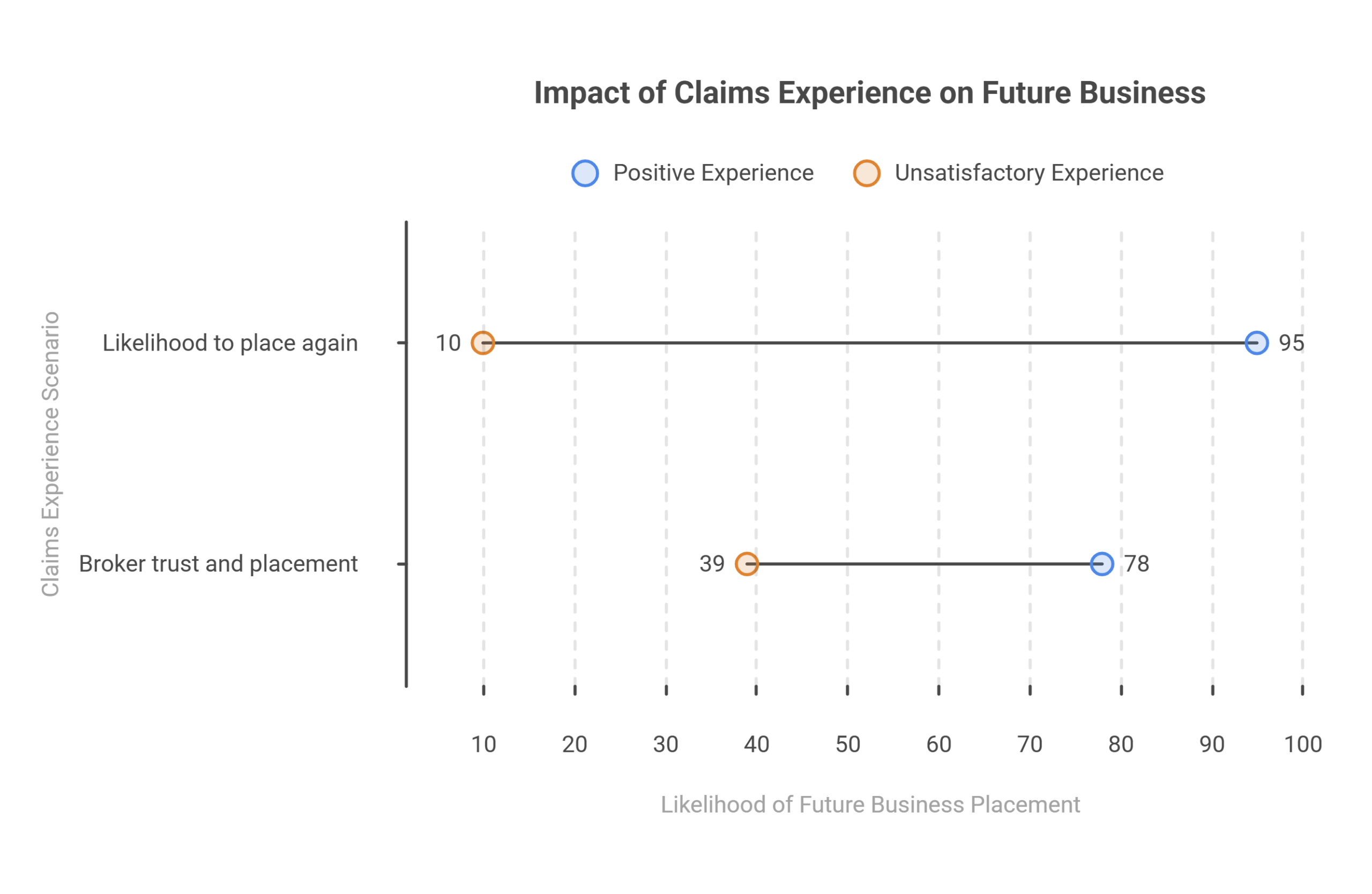
Key takeaway: Claims service can influence broker trust and future business placement, making claims performance commercially important as well as operationally important.
Faster Claims Can Improve Both Experience and Efficiency
The value of claims service is not limited to whether a customer feels satisfied. How quickly and clearly a claim is handled can also influence operating efficiency, repair costs and the amount of work required before a case is finally closed.
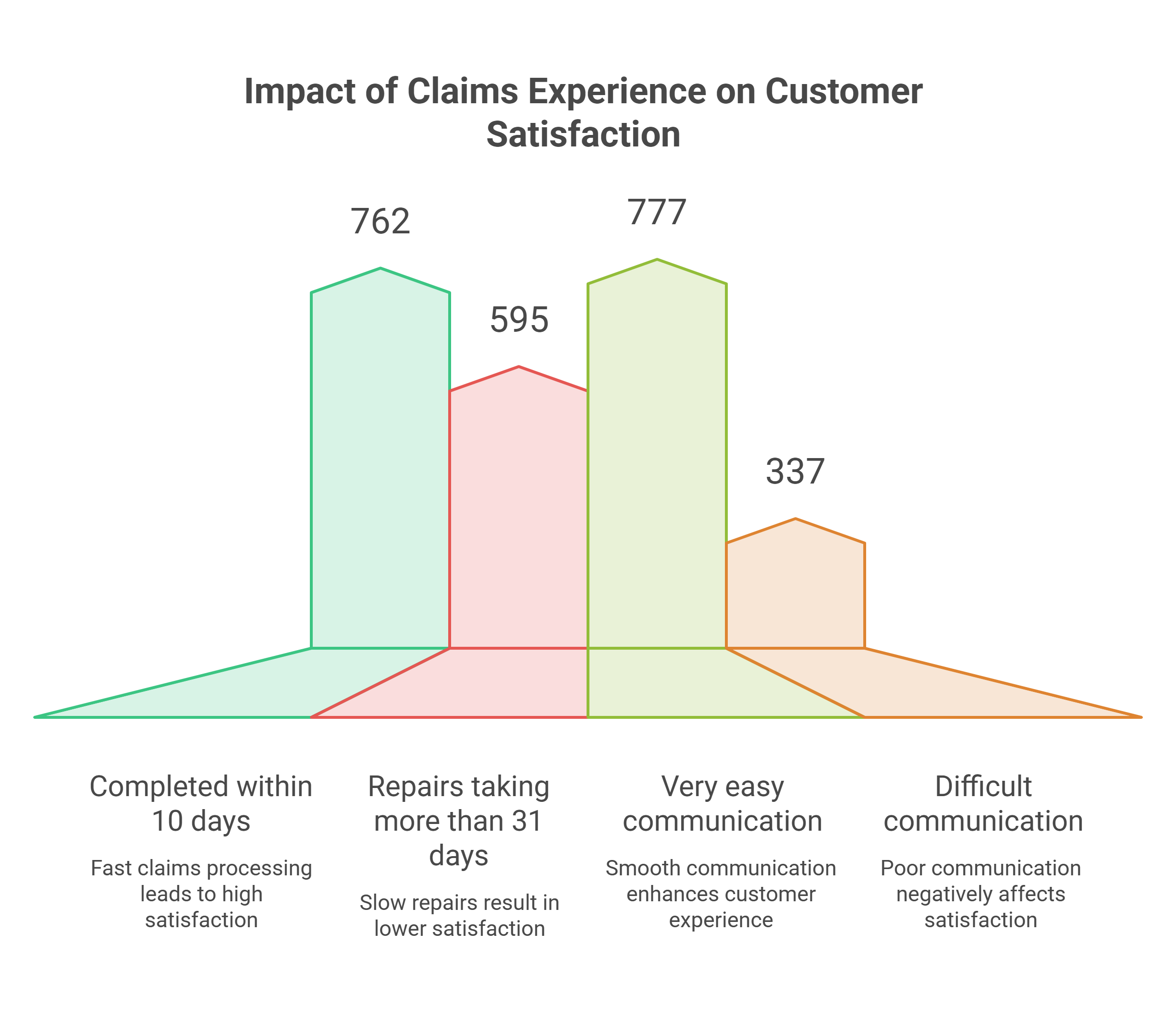
Recent property-claims research shows how strongly speed can shape the customer experience. Average time from first notice of loss to final payment has risen to more than 44 days, while the average repair cycle is around 32.4 days. Claims completed within 10 days recorded an average satisfaction score of 762 out of 1,000, compared with 595 when repairs took more than 31 days.
The difference is not simply about making payments faster. Delays can create additional communication, repeat contacts, temporary accommodation costs, contractor coordination and other administrative work. When a claim remains open for longer, insurers may also need more staff time and resources to manage it.
Communication can make an equally important difference. In the same research, customers who found it very easy to communicate with their insurer recorded satisfaction of 777, compared with just 337 among those who found communication difficult. That suggests insurers can improve the claims experience not only by reducing the time needed to resolve a loss, but also by making the process easier to understand and follow.
For claims service, this creates a useful operational target: reduce avoidable friction without compromising the accuracy or quality of the decision.