





















Insurance fraud has always been a major claims challenge, but the economics of detecting it are changing quickly. Insurers are dealing with large volumes of claims, increasingly complex evidence and fraud schemes that can be difficult to distinguish from legitimate losses. Artificial intelligence is giving insurers new ways to identify patterns across that information, while also creating a new question for the industry: can AI reduce fraud losses without adding another expensive layer to claims operations?
The financial incentive is substantial. Current industry estimates put the annual cost of insurance fraud to consumers and businesses at around US$308.6 billion across insurance lines. Property and casualty insurance represents a significant part of that burden, with recent industry analysis estimating that about 10% of P&C claims may be fraudulent, potentially representing around US$122 billion in annual losses. These figures are estimates rather than directly measured global losses, but they show the scale of the problem insurers are trying to address.
The challenge is that fraud is not always obvious. A deliberately staged accident may be easier to identify than a genuine claim where repair costs have been exaggerated or an injury has been overstated. Recent industry estimates suggest soft fraud accounts for about 60% of fraud incidents, while detection rates are estimated at only 20% to 40% for soft fraud, compared with around 40% to 80% for hard fraud.
That is where AI is becoming more relevant to insurance fraud. Instead of relying only on fixed rules, insurers can use machine learning and other AI techniques to examine patterns across claims and compare information from different sources.
AI is Expanding What Insurers Can See in a Claim
A modern insurance claim can contain much more than a written description of a loss. It can include photographs, videos, repair estimates, documents, audio, location information, telematics and other data. AI can analyse these different formats together, helping insurers identify inconsistencies or connections that may be difficult to spot through manual review alone.
This is particularly important for soft fraud, where the claim itself may be genuine but the value or circumstances have been exaggerated. Instead of asking only whether a claim meets a predefined fraud rule, AI can look for unusual combinations of information and direct investigators toward claims that deserve closer attention.
The technology is already gaining attention across the insurance industry. Recent research found that 35% of insurance executives identified fraud detection among their top five areas for developing or implementing generative AI applications. At the same time, the fraud-detection technology market is estimated to grow from US$4 billion in 2023 to US$32 billion by 2032.
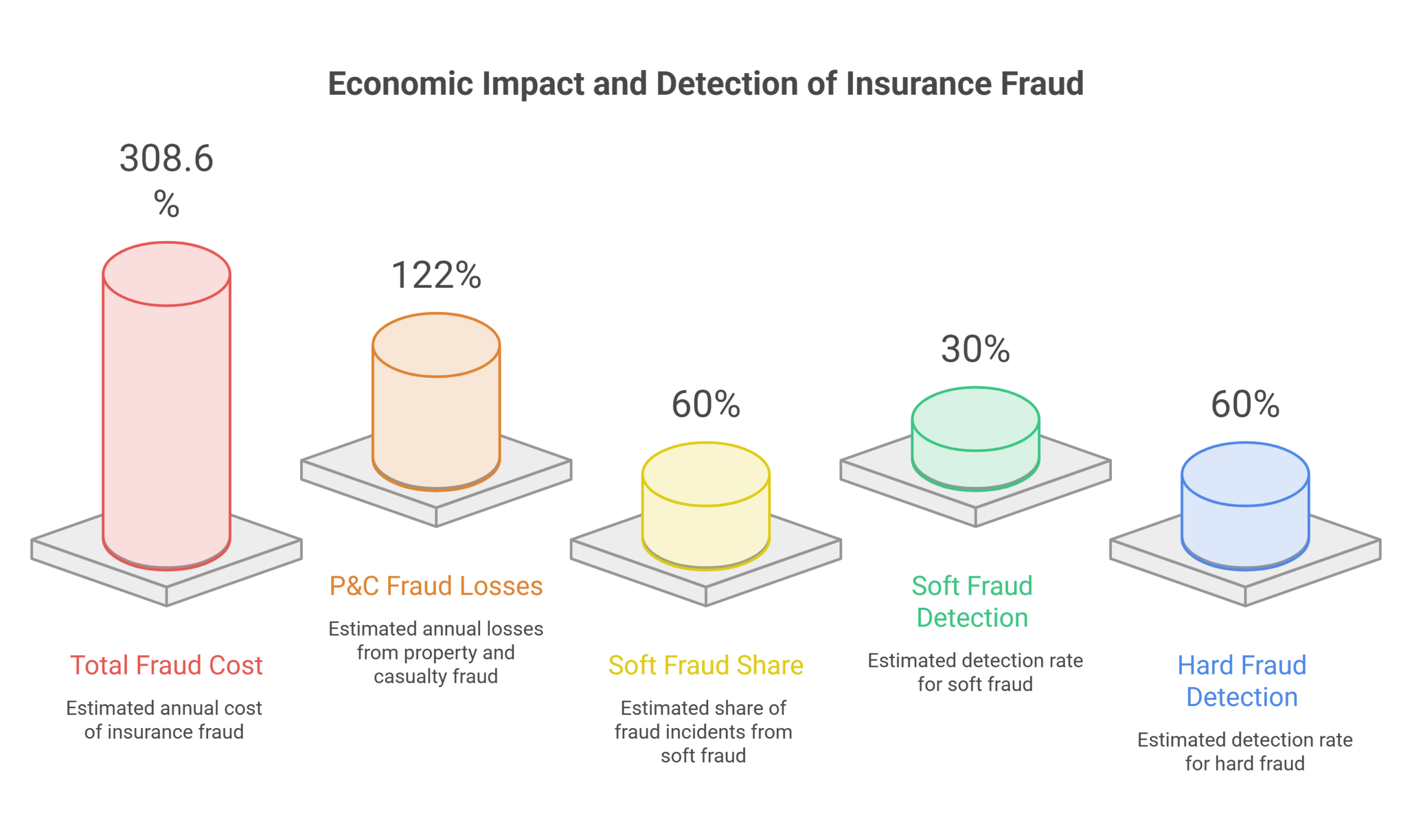
Key takeaway: Insurance fraud remains a major financial cost, while lower detection rates for soft fraud create a clear opportunity for more advanced analytics.
The opportunity for insurers is therefore not simply to find more suspicious claims. It is to identify the right claims earlier, investigate them more efficiently and reduce losses without slowing down legitimate claims.
AI is Turning Fraud Detection into a Claims-Economics Problem
The financial case for insurance fraud detection is becoming harder to ignore, but finding more suspicious claims is only part of the equation. Insurers also need to consider the cost of investigating those claims, the time taken to settle legitimate losses and the additional customer and regulatory risks created by false positives.
Traditional fraud systems often rely on fixed rules and predefined triggers. These can still be useful, but they can struggle when fraud becomes more subtle or when the available evidence spans multiple formats. Current industry research estimates that soft fraud accounts for around 60% of fraud incidents, while detection rates remain substantially lower for soft fraud than for hard fraud.
AI can change that balance by examining claims across several sources at once. Instead of looking only at the information entered into a claims system, advanced models can combine text, images, audio, video, sensor information and other data to identify relationships or anomalies. This can help investigators focus their time on claims that warrant deeper review rather than manually examining every potentially suspicious case.
That distinction is important for insurance fraud because investigation itself has a cost. A model that flags thousands of questionable claims but sends too many legitimate customers into lengthy investigations may simply move the expense somewhere else in the claims process.
The more useful objective is therefore to improve the economics of detection by finding stronger signals earlier, reducing unnecessary investigations and preserving human expertise for complicated cases.
AI is Changing How Fraud Investigations are Prioritised
The biggest opportunity may come from changing how insurers allocate investigative resources.
Fraud teams have traditionally had to work through large volumes of claims and decide which cases deserve further investigation. AI can help score or prioritise those claims by looking for patterns that are difficult to identify manually, including unusual relationships between claimants, providers, repairers, previous claims and supporting evidence.
This is particularly useful in high-volume lines such as motor and property insurance, where even a small improvement in fraud detection can have a meaningful effect when applied across millions of claims.
The potential savings are significant. Industry analysis estimates that AI-driven technologies applied across the property and casualty claims lifecycle could potentially generate US$80 billion to US$160 billion in savings by 2032, depending on implementation and the sophistication of the systems involved. This is a forecast of potential savings, not money already captured by insurers.
At the same time, insurers are investing in the technology needed to pursue that opportunity. The fraud-detection technology market is estimated to grow from US$4 billion in 2023 to US$32 billion by 2032, reflecting growing demand for advanced analytics and automated detection.
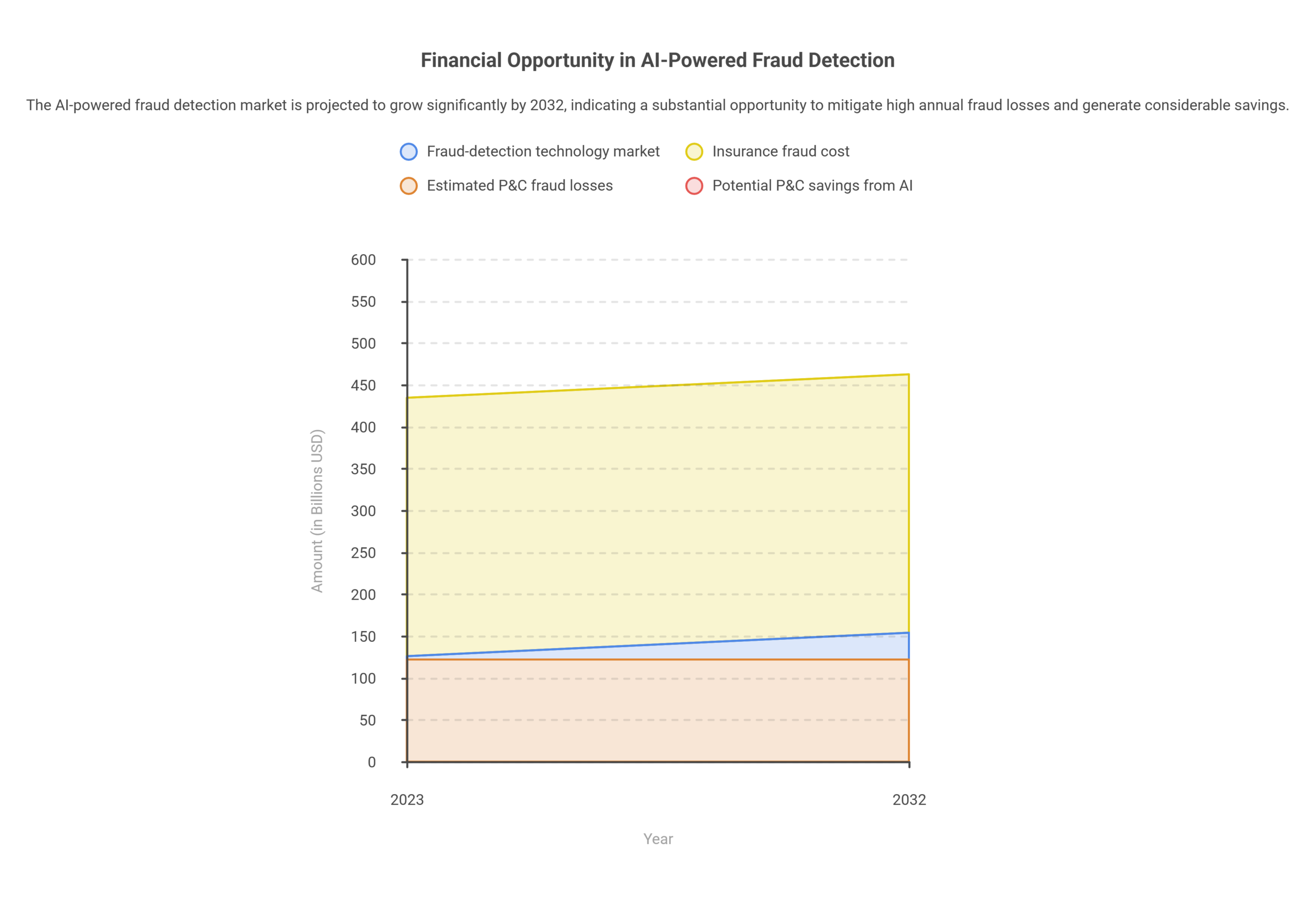
Key takeaway: The growing cost of fraud and the potential savings from better detection are creating a financial case for insurers to invest in AI, but the value depends on how effectively those systems improve the entire investigation process.
The next challenge is making sure that investment produces better detection without creating more claims friction, because the economics of fraud detection ultimately depend on what happens to both fraudulent and legitimate claims.